
An Island Rising — and the Questions That Will Determine What Comes Next
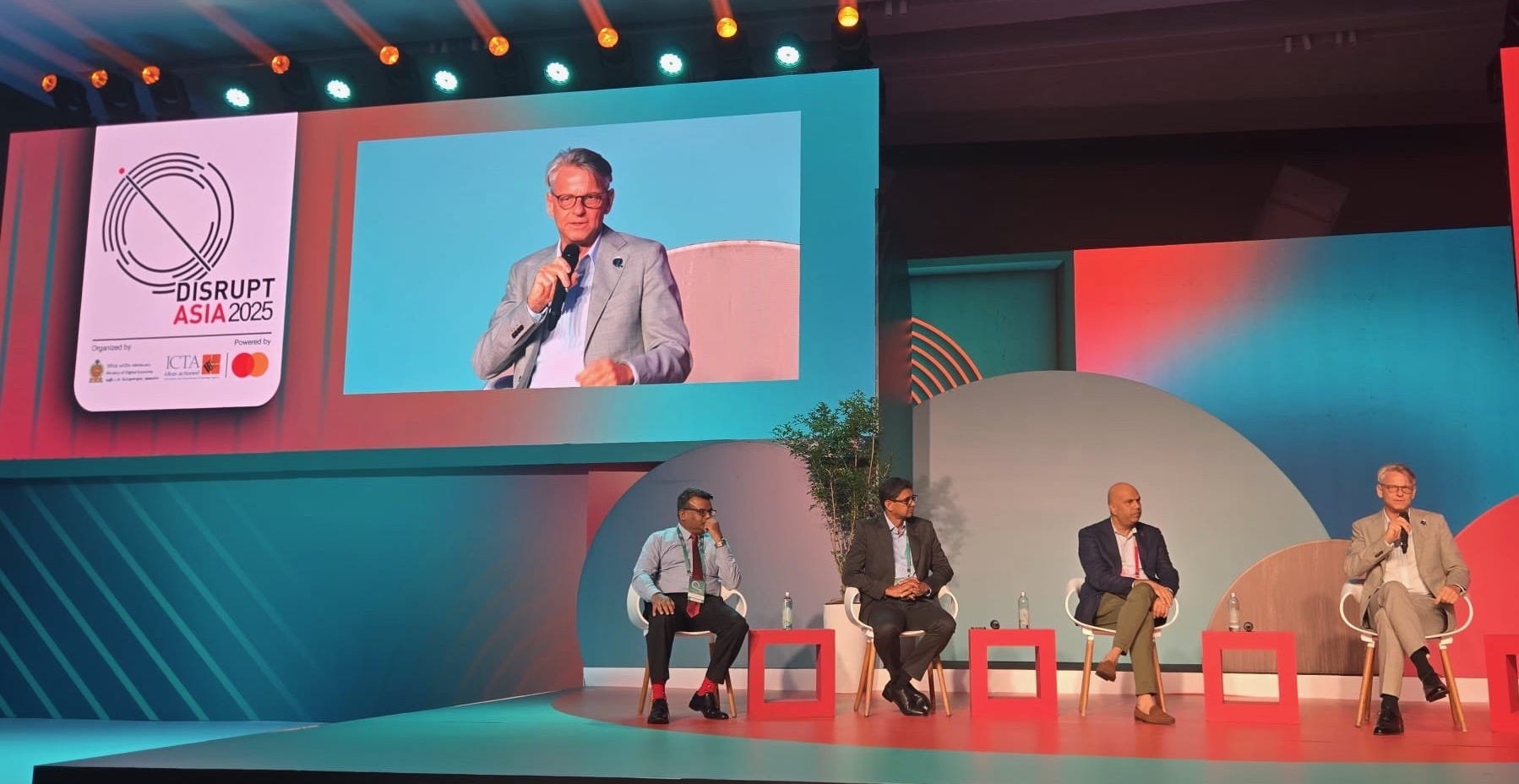
Sri Lanka’s tech ecosystem has tripled in value in two years, produced a dozen exits, and attracted EQT twice. The Disrupt Asia report maps the progress with care. What it maps less carefully are the structural transitions — from services to product, from domestic capital to international, from aspiration to architecture — that will determine whether this ecosystem graduates into something investable.
Ground Truth: Frontier Asia | Saint Clair Market Intelligence | 23 March 2026
Based on SL Tech Startup Ecosystem 2025 by Disrupt Asia and the ICT Agency of Sri Lanka, published here as an attachment. Saint Clair’s analysis follows.

Sri Lanka is not the country most European investors imagine when they hear the words “startup ecosystem.” The island is twenty-two million people, a GDP still recovering from sovereign default, and a tech sector that has historically been synonymous with outsourced engineering. That is changing — and the speed of the change is the first thing worth taking seriously.
The SL Tech Startup Ecosystem 2025 report, produced by Disrupt Asia in collaboration with the ICT Agency of Sri Lanka (ICTA), attempts the most comprehensive mapping of this transformation to date. It tracks a fifteen-year arc from the ICTA’s first incubator programmes in 2010 through to a 2025 landscape comprising nearly 950 startups, an ecosystem value that Startup Genome now estimates at $821 million, and a government that has begun — belatedly, but with notable precision — to build the institutional plumbing that venture capital requires.
The report is a useful document. It is also, inevitably, produced by the ecosystem’s own architects, and reads accordingly. Saint Clair’s reading is therefore selective: we extract what the data supports, challenge what the framing overstates, and identify what the report leaves unsaid. Our interest here is not academic. We are actively engaged with this ecosystem and have a view on where it is heading.
The Numbers — and What They Obscure
The headline figure is arresting. Ecosystem value has risen from $252 million in 2023 to $821 million by 2025 — a threefold increase in two years, according to Startup Genome data cited in the report. Startup Genome gives Sri Lanka a perfect 10/10 score for early-stage funding growth, ranks it fourth in Asia for affordable talent, and places it among the top thirty-five Asian ecosystems for value relative to cost.
These are real numbers, drawn from a credible methodology. They are also numbers that require context.
Start with the composition of those 950 startups. The report lists 947 ventures in its most recent tally: 696 are service companies, 227 are product companies, and 24 operate in both categories. Sri Lanka’s “startup ecosystem” is, in other words, overwhelmingly a services sector with a venture-backable minority embedded within it. IT outsourcing, digital marketing, and consultancy account for the bulk. The product companies that do exist — and some are formidable — are notable precisely because they have emerged despite this structural gravity. The report’s framing does not draw this distinction sharply enough. An investor should.
Then consider the registration trend. New startup registrations peaked at 130 in 2020, then fell steeply: 76 in 2021, 25 in 2022, and just 18 in 2023 before recovering to 59 in 2024. The 2022 sovereign debt crisis drove a wave of tech talent emigration that has not fully reversed. The registration decline is the shadow of that crisis, and the report presents it without the context it deserves. Yet the 2024 recovery — modest as it is — suggests the ecosystem’s absorptive capacity is rebuilding. The founders who stayed, or who returned, are a different cohort from those who left: more internationally networked, more dollar-oriented, and arguably more investable.
Geographic concentration compounds the picture. Of the mapped startups, 701 sit in the Western Province — overwhelmingly in Colombo. The Northern Province hosts 63, anchored by the Yarl IT Hub in Jaffna, which has been a genuine success story in ecosystem decentralisation. For all practical purposes, however, this remains a Colombo ecosystem. That is not unusual for a frontier market at this stage, and history suggests dispersion follows maturity rather than preceding it.
Exits: The Strongest Signal
Where the report stands on firmest ground is the exit record, and here the data is genuinely distinctive. No comparable frontier Asian ecosystem has produced this density of liquidity events at this stage of development.
The anchor transaction is WSO2’s acquisition by EQT in 2024 — widely reported as the largest private tech exit in South Asian history outside India. That EQT returned to Sri Lanka — having already taken Virtusa private in 2020 — is a signal that transcends the individual deals. When the same tier-one international investor commits twice to the same frontier market, it suggests a thesis, not an accident.
The full exit record since 2020 includes twelve transactions: Virtusa (EQT, 2020), Takas.lk (Ideal Industries, 2020), 99x (Herkules Capital, 2021), hSenid (IPO, 2021), Kapruka (IPO, 2021), Linear Squared (Algonomy, 2022), Paladin (Surge, 2022), Trabeya (Surge, 2022), WSO2 (EQT, 2024), Kaiju Labs (KAST, 2024), PickMe (IPO, 2024), and InsureMe (IPO, 2025). Total exit value since 2020: approximately $665 million according to Startup Genome data.
For an ecosystem valued at $821 million, this exit-to-value ratio is remarkable — and it reveals a productive paradox. Sri Lanka is generating exits before it has built the venture infrastructure to fund the pipeline behind them. The founders who benefit are beginning to reinvest locally: BOV Capital, nVentures, and the Lankan Angel Network are the most visible examples. This recycling of exit capital into new fund formation is precisely the pattern that catalysed ecosystem maturation in Israel, Singapore, and the Nordics. It is early, but it is happening. The report identifies three VC funds and one angel network — thin, but the direction is right.
The Institutional Architecture — Progress and Its Limits
The most consequential section of the report concerns not startups but policy. Sri Lanka’s government has launched a series of institutional interventions that, if executed as designed, would represent the most significant structural upgrade the ecosystem has seen.
The centrepiece is a government-backed Fund of Funds, modelled explicitly on Israel’s 1993 Yozma programme. Government seed capital is intended to catalyse private co-investment into domestic VC funds, which would then deploy into startups. Around this core: a Virtual Special Economic Zone (VSEZ) designed to give digital companies export-zone benefits without requiring a physical presence; a sovereign-grade AI and cloud data centre; and an investor residency programme.
Underpinning the fund architecture is the new Qualified Venture Capital Fund (QVCF) framework, which offers tax pass-through treatment — a necessary precondition that Sri Lanka has lacked until now. This is genuine progress, and the report is right to highlight it.
However, the QVCF structure merits closer scrutiny than the report provides. The framework operates within Sri Lanka’s existing Collective Investment Scheme (unit trust) regulatory architecture. For domestic fund managers, this is workable and represents a significant step forward. For international institutional investors — European pension funds, family offices, corporate venture arms — the unit trust framework diverges from the limited partnership structures they expect in several material respects: trustee oversight of investment decisions, public disclosure requirements, absence of standard carried interest mechanics, and upfront capital commitment rather than the drawdown model that is universal in international venture capital. These are not insurmountable obstacles, but they are frictions that matter in a competitive market where frontier economies must earn investor attention against more familiar jurisdictions.
The report does not address this gap. It should. The QVCF is a credible foundation, but the path from domestic utility to international investability requires a further regulatory iteration — ideally towards a Variable Capital Company or limited partnership model that conforms to international standards. Sri Lanka’s policymakers appear to understand this: exploratory work on such frameworks is under way. A credible roadmap towards international-standard fund vehicles, even if measured in years, would send a powerful signal to the cross-border investment community. The trajectory matters as much as the destination.
In the interim, the structural gap creates a specific role for investment platforms that can provide international investors with access to Sri Lanka’s innovation ecosystem through vehicles they already understand — channelling foreign capital into a market whose founders are ready for it, even as the domestic regulatory architecture continues to mature. This is precisely the space Saint Clair Asia occupies.
The government’s $5 billion digital revenue target by 2030, cited throughout the report, and the three-phase roadmap — Foundation (2025–26), Scale (2027–28), Dominance (2029–30) — are ambitious. The targets include 50,000 new tech jobs, five IPOs or international exits, and $200 million in annual VC investment by 2028. Whether these figures are achievable depends almost entirely on whether the institutional architecture is built to the standard that international capital requires. The building blocks are in place. The specification needs to be raised.
What the Report Underweights
Three things deserve more attention than they receive.
First, talent retention. The report celebrates Sri Lanka’s talent affordability — ranked fourth in Asia, with engineering costs that are a fraction of regional competitors — without adequately addressing the flight risk this creates. Post-crisis emigration accelerated a trend that remote work had already begun: Sri Lankan engineers can earn multiples of their local salary by working for international companies from Colombo, or by leaving entirely. The ecosystem’s single greatest asset is also its most portable. The report lists “Talent Retention” as an enabler but offers no mechanism. A serious ecosystem strategy would address this directly — through equity participation frameworks, returnee incentive programmes, or the kind of founder-friendly regulation that makes building locally more attractive than billing remotely.
Second, the service-to-product transition. The report’s strategic framework identifies four target groups — offshore captives, IT service companies, IT product companies, and freelancers — but treats them as parallel tracks rather than a progression. The fundamental question for Sri Lanka is whether a large, competent services base can generate a venture-backable product pipeline. The 227 product companies suggest the potential is real; the 696 service companies suggest the gravity pulling against it is strong. What would accelerate the transition — whether through government procurement preferences, corporate spin-out frameworks, or targeted product-stage funding — is a question the report could productively address.
Third, corporate innovation outcomes. The report maps impressive corporate activations — John Keells X, Dialog’s Digital Innovation Fund, Hemas Slingshot, SLT-Mobitel’s Embryo centre, Brandix’s Spiralation, Uber Springboard — but does not assess their results. Corporate innovation programmes in frontier markets have a well-documented tendency to generate activity without generating startups. Whether Sri Lanka’s corporate engagements are producing venture-scale companies would be a question worth answering in a future edition.
The Corridor View
Saint Clair covers five frontier Asian markets. In that context, Sri Lanka occupies a distinctive position — and one that is, in our assessment, under-recognised by the European investment community.
Against Bangladesh — 170 million people but a startup funding landscape where, according to LightCastle Partners’ 2025 data, local investor participation fell 95 per cent year-on-year in 2024 — Sri Lanka has a more mature exit record and stronger institutional foundations, despite being a fraction of the population. Against Indonesia and Mongolia, both pending in this series, Sri Lanka’s distinguishing feature is the speed of its post-crisis recovery and the clarity of its policy response.
The 99x acquisition by Norway’s Herkules Capital is the template that interests us most. European capital, Colombo operations, Nordic governance standards — this is the Europe–Sri Lanka corridor made tangible. EQT has been there twice. Goldman Sachs, Allianz, and Hitachi appear among the investors with Sri Lankan exposure. But the European institutional investor class has, by and large, never looked. That asymmetry is precisely where opportunity concentrates in frontier markets.
Saint Clair’s own engagement with the Sri Lankan ecosystem — through our network, our ongoing dialogue with ICTA and the Ministry of Digital Economy, and our market intelligence work on the ground — reinforces the view that this is a market approaching an inflection in international visibility. The ecosystem is producing founders, exits, and institutional ambition at a pace that outstrips its current international profile. For investors who specialise in frontier Asian innovation — and who are prepared to engage with the structural complexity that comes with it — Sri Lanka merits serious and sustained attention.
The ground truth, sourced in Colombo, is that the foundation is being laid from both ends: from the inside by Sri Lanka’s policymakers and founders, and from the outside by the small number of international actors who have already committed. What happens next depends on whether the infrastructure exists to connect them — whether international capital can find a path into this ecosystem while the domestic architecture catches up. That is the question this series will continue to answer.
Sources:
Disrupt Asia & ICT Agency of Sri Lanka, SL Tech Startup Ecosystem 2025 (attached)
Startup Genome, Global Startup Ecosystem Report (data cited within source report)
LightCastle Partners, Bangladesh Startup Investments Report 2025 (Bangladesh comparison data)
Disclaimer: This article is for informational purposes only and does not constitute investment advice. Saint Clair has an active engagement with the Sri Lankan startup ecosystem and may have commercial interests in markets discussed. All decisions should be made based on independent research and consultation with qualified advisors.
About Saint Clair: Saint Clair practises Capital Diplomacy — fostering cross-border investment relationships between Europe and Asia through trust, insight, and strategic facilitation. Saint Clair Asia (https://saintclair.asia) is a frontier investment platform providing international investors with access to innovation ecosystems across Asia.
Learn more: saintclair.sg | Contact: contact@saintclair.sg