
Fourteen Million Dollars
What Bangladesh’s 2025 Startup Funding Looks Like Without Its Largest Transaction
Bangladesh’s startup funding is reported at USD 124 million across twelve deals in 2025, roughly triple the year before. One transaction, a USD 110 million merger, accounts for eighty-nine per cent of it. Strip it out and the remaining eleven deals total approximately USD 14 million, against USD 42 million across forty-one deals in 2024: a market that lost two-thirds of its capital and three-quarters of its deal count while its headline tripled.
Ground Truth: Bangladesh | Saint Clair Market Intelligence | 10 August 2026
Based on published data and reporting from LightCastle Partners, Bangladesh Bank, The Business Standard, The Daily Star, Wamda and ExitStack. Saint Clair’s analysis follows.
Bangladeshi startups raised USD 124 million across twelve deals in 2025, roughly three times the USD 42 million raised across forty-one deals in 2024. Read quickly, the headline says recovery.
One Deal in Twelve
One of those twelve deals is worth USD 110 million: the April merger of ShopUp, a Bangladeshi commerce and financial-services company, with Sary, a Saudi business-to-business trading platform, to form SILQ Group. LightCastle Partners, the analytics house whose annual report is the market’s closest count of record, states on page five of its own document that excluding SILQ, 2025 funding was approximately USD 14 million. The report states it plainly. It is the headline that travels without it.
Financial services accounted for USD 110 million of the year’s total, eighty-nine per cent, from two deals rather than one. The top three deals made up approximately ninety-five per cent of capital deployed. Average ticket size across the year was USD 10 million; excluding SILQ, closer to USD 1 million. Late-stage financing and mergers and acquisitions (M&A) together made up ninety-two per cent of funding value, in a year with zero Series A rounds and zero debt rounds (Series A alone raised USD 21 million across six deals in 2024).
Removing the largest deal from a dataset invites suspicion, and rightly so; it can be made to prove almost anything. The defence has to be structural rather than statistical, and it is the argument the rest of this article makes.
What the Eleven Show
Below SILQ, the stage-by-stage figures are the strongest evidence in the report.
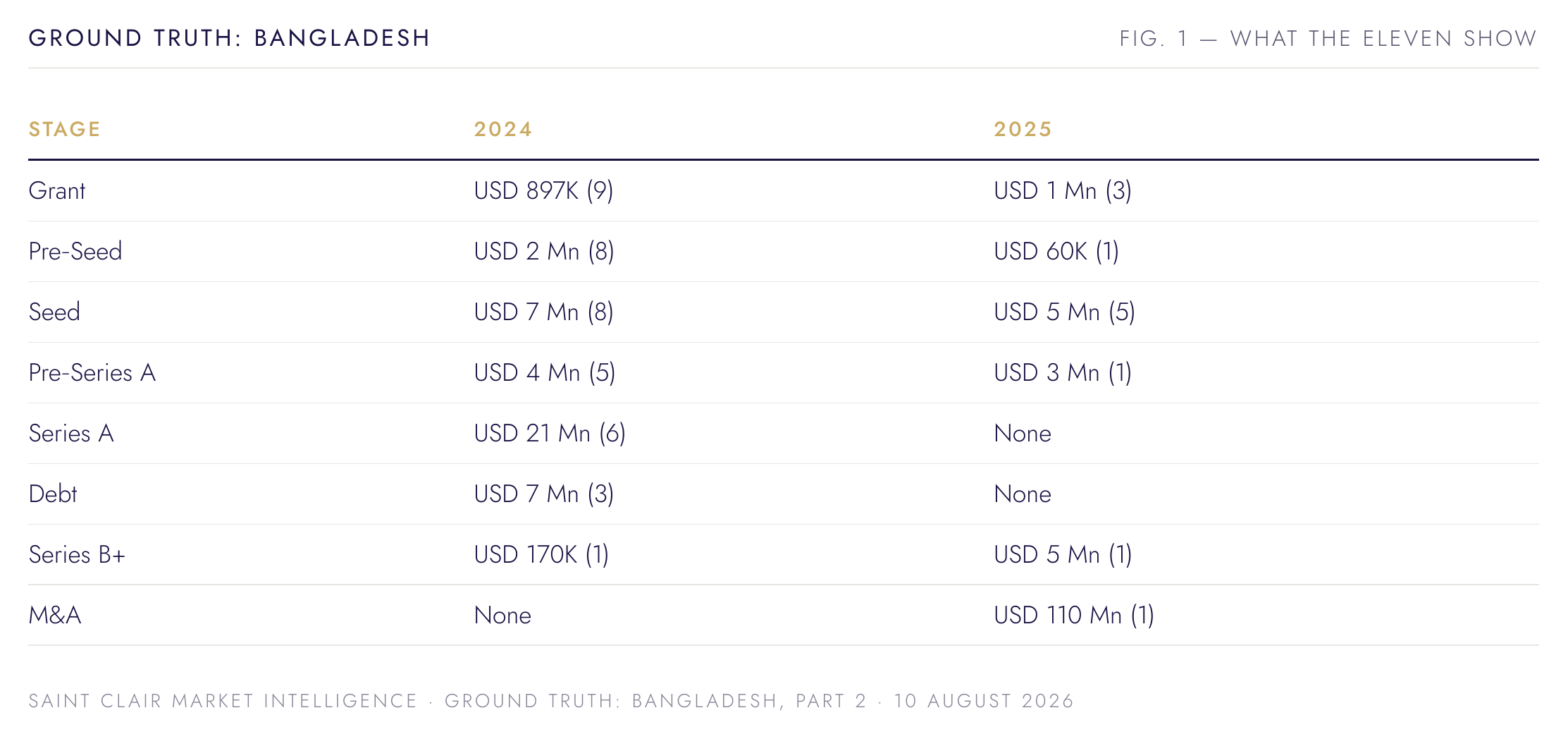
Pre-seed collapsed from USD 2 million across eight deals to USD 60,000 across one. Series A produced nothing, against USD 21 million across six rounds in 2024, and debt financing produced nothing, against USD 7 million the year before. Angel investors made no investments in 2025, down from roughly USD 1 million across five deals in 2024. Early-stage funding’s share of the total fell from thirty-three per cent to eight per cent, even as the average early-stage ticket rose from USD 451,000 to USD 948,000: fewer companies raising larger amounts at the stage where a market’s future gets planted. Late-stage average ticket size rose from USD 3 million to USD 57 million, a figure with essentially one input.
The market did not have a strong year carried by one great deal. It had a poor year that happened to contain one very large transaction.
Context matters here. 2021 remains the decade’s peak in Bangladesh, at USD 435 million across ninety-four deals, itself carried by the USD 250 million bKash–SoftBank round. LightCastle ranks SILQ as the second-largest transaction in the market’s history. A single deal defining Bangladesh’s annual funding number has happened before, which keeps this year’s reading structural rather than a complaint about 2025 specifically.
Rebuilding the Table
One boundary inside 2025’s foreign ninety-nine per cent cannot be fully audited from public sources: whether a Bangladeshi founder’s foreign holding company, raising from a fund run by the diaspora, counts as domestic capital or global. Bangladesh Bank’s Share Swap Circular of July 2025 grants general permission to establish a foreign holding entity for USD 10,000, expressly so founders can consolidate a split capitalisation table into one an international investor can underwrite. The regulator has made the flip cheap and legal, and it shifts what the domestic-versus-foreign line measures, from where a company started to where it is registered now.
LightCastle’s dataset is one house’s count of an admittedly opaque market, and its published report does not break the ex-SILQ total into a deal-by-deal table. The check available to a European investor is the named-transaction trackers and regional outlets that feed them — ExitStack, Future Startup, Wamda and similar. Eleven candidate 2025 transactions were tested against original source reporting, one by one; the table below carries the source each verdict was confirmed or excluded against.
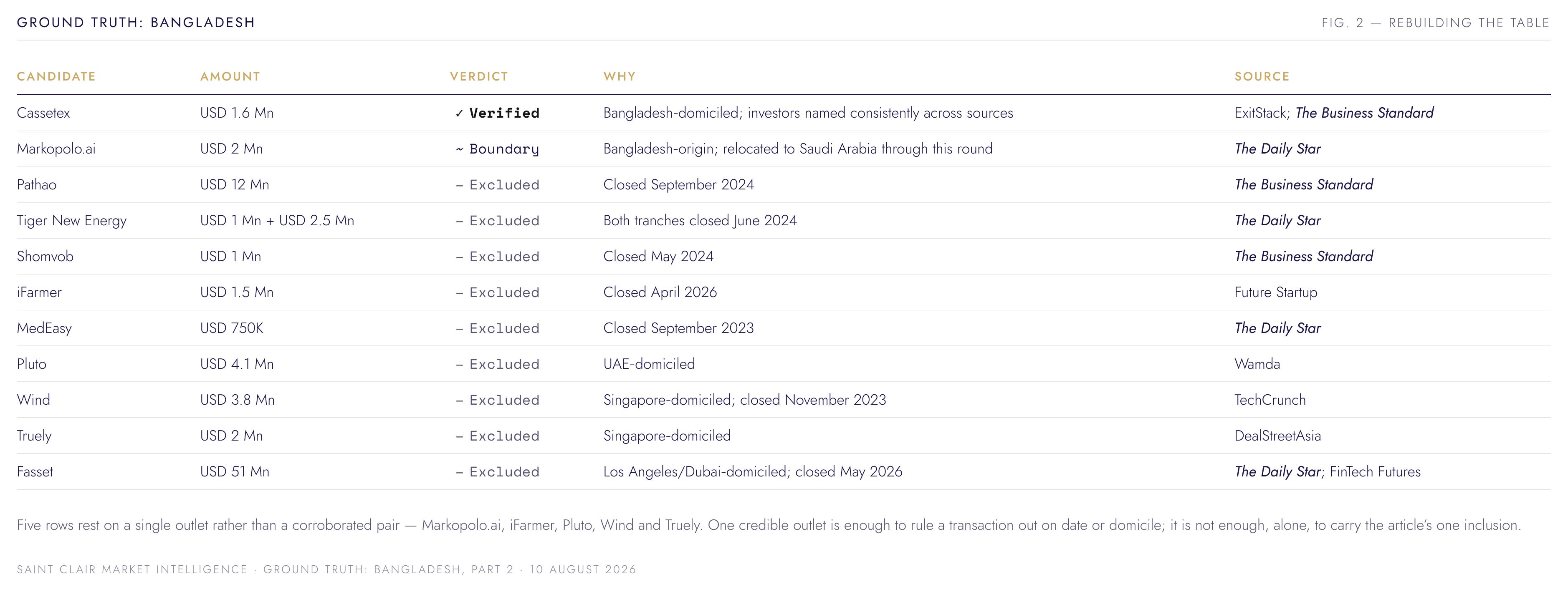
Five rows rest on a single outlet rather than a corroborated pair: Markopolo.ai, iFarmer, Pluto, Wind and Truely are each confirmed against exactly one named source. One credible outlet is enough to rule a transaction out on date or domicile; it is not enough, alone, to carry the article’s one inclusion.
One candidate survives cleanly, and on two independent legs. Cassetex, Bangladesh’s first battery-swapping company for electric three-wheelers, raised USD 1.6 million from Infusion Partners Ltd. and Waverider International Consulting Co. Ltd.; ExitStack reported the round directly, and The Business Standard named the same investors and the same figure in separate coverage weeks later. The two sources place the announcement in January and February 2025 respectively; both sit inside the calendar year. The other nine fail on one of two separate grounds: five closed outside the 2025 calendar year, by margins ranging from a few months to nearly three years, and three are registered in the United Arab Emirates or Singapore regardless of when they closed. Fasset fails on both counts simultaneously.
At USD 51 million, Fasset would have overwhelmed LightCastle’s USD 14 million ex-SILQ figure had it belonged in the count, and either finding would have mattered: a material omission in the primary dataset, or confirmation that a widely circulated “Bangladesh deal” measures a founder’s birthplace rather than a company’s domicile. It resolves toward the second, by a wide margin. Fasset’s Series B closed in May 2026, headquartered in Los Angeles and Dubai. Its only connection to Bangladesh is its founder, Mohammad Raafi Hossain, and the local press has kept a distinction the trackers dropped: the Daily Star‘s own headline describes a “Bangladeshi-born founder’s startup,” a founder’s origin rather than a company’s domicile.
Markopolo.ai resists a clean verdict either way. It raised USD 2 million on 11 May 2025, a seed round supported by Saudi Arabia’s National Technology Development Programme that arrived bundled with the relocation of its headquarters to the Kingdom. Startup Bangladesh Limited, the state fund, had backed the company previously. Markopolo.ai is a Bangladeshi company in the act of becoming something else, in the same year and through the same route the Share Swap Circular was written to make easy. Part 1’s domicile question now has a face: one named transaction, mid-flip.
Against LightCastle’s approximately USD 14 million across eleven deals, independent verification confirms USD 1.6 million and flags one transaction whose domicile is genuinely in motion. LightCastle’s figure survives the test undisturbed: nothing here contradicts it, and a thin market generates small transactions that never reach an English-language tracker at all. What the test shows instead is that the data built to check the aggregate needs the same scrutiny the aggregate received. A European investor reaching for a named-deal list to sense-check a headline is reaching for a list with the same reliability problem, one level down.
Why Financial Services, Why That Size
A USD 110 million financial-services transaction in a market this size calls for an explanation, and it sits in the country’s payments infrastructure rather than in venture appetite. Mobile financial services (MFS) accounts in Bangladesh reached approximately 239.3 million in January 2025, up 9.21 per cent on the year before. Accounts are not unique users, and multiple-account holding is common; Bangladesh Bank states that caveat itself. Monthly transaction volume reached approximately BDT 1.72 trillion, up 32.56 per cent year on year, close to USD 439 million moving through the system daily at the rate prevailing in January 2025. bKash, the market leader, processed more than eleven million transactions a day in 2024 across over sixty-eight million users; Nagad, second-placed, processed roughly seven million.
Capital of SILQ’s size arrived where the rails already existed. That connection is the year’s most useful reframing: the concentration in financial services is legible once the payments infrastructure beneath it is visible.
SILQ is structurally distinct from the venture activity a funding aggregate is built to capture. It is a merger between a Bangladeshi company and a Saudi one, co-led by Sanabil Investments — wholly owned by Saudi Arabia’s Public Investment Fund (PIF), roughly USD 925 billion in assets, in what was reported as Sanabil’s first major South Asia commitment — alongside Valar Ventures, with Qatar Development Bank, Flourish Ventures and Kuwait’s Wafra further down the syndicate. The structure combines equity with a financing facility for SILQ Financial, the group’s financial-services arm. Afeef Zaman, ShopUp’s founder, became SILQ Group’s chief executive; Mohammed Aldossary, Sary’s founder, leads SILQ Financial. Both brands are retained in their home markets, and an initial public offering (IPO) is mooted for around 2027. The strategic frame, as reported, is a Gulf–South Asia trade corridor projected above USD 682 billion over the coming decade.
The clearest evidence of what kind of business SILQ actually is arrived after the merger closed. On 22 July 2026, SILQ secured a USD 75 million Shariah-compliant debt facility from Fasanara Capital, the London-based investment firm, to fund working-capital loans for small businesses in Saudi Arabia through Fina, its embedded-finance product. The facility is projected to provide close to SAR 3 billion, nearly USD 800 million, in liquidity to around two thousand local businesses over the funding year. A company that carried eighty-nine per cent of a venture headline has since raised debt against receivables, the ordinary financing behaviour of a trade-finance operator scaling its balance sheet. Venture-backed startups rarely follow that path in their first year.
The Corridor View
A European investor reading a frontier funding headline should ask for three things before trusting it: the deal-level table behind the aggregate, the distribution across stages rather than the total alone, and the median ticket size rather than the mean, which one large transaction can distort past recognition.
Bangladesh in 2025 fails that first test twice over. LightCastle’s own report does not publish a deal-by-deal table beyond its largest few transactions, and the trackers built to fill the gap carry the wrong year or the wrong domicile for nine of the eleven candidates this article tested. An aggregate figure with no deal-level table behind it is asking the reader to trust a number it has not shown its working for. Verification, in that setting, is the entire exercise.
Taka figures are converted at USD/BDT 123.45, the rate on 29 July 2026, except where a contemporaneous rate is stated.
Sources:
LightCastle Partners, with Startup Bangladesh Limited, Anchorless Bangladesh and ExitStack, Bangladesh Startup Investments Report 2025: Year in Review (January 2026). lightcastlepartners.com
LightCastle Partners, Bangladesh Startup Investments Report 2025-H1 (July 2025). lightcastlepartners.com
The Business Standard, ShopUp, Sary merge to form SILQ with $110m Saudi, US investment. tbsnews.net
The Daily Star, ShopUp, Sary to merge, raise $110m. thedailystar.net
Latham & Watkins, Latham Advises SILQ on US$75 Million Financing Facility (July 2026). lw.com
FinTech Futures, SILQ lands $75m Fasanara debt line for Saudi SME lender Fina (July 2026). fintechfutures.com
The Financial Express, Bangladesh MFS accounts surge by 20 million in a year, transactions up 32pc. thefinancialexpress.com.bd
ExitStack, Cassetex Secures US$1.6Mn to Expand Battery-as-a-Service in Bangladesh and Beyond. exitstack.co
The Business Standard, Bangladeshi entrepreneur joins Earth Action Report programme (March 2025). tbsnews.net
The Daily Star, Markopolo.ai raises USD 2 million to scale in Saudi Arabia. thedailystar.net
The Daily Star, Bangladeshi-born founder’s startup raises $51 million in series B. thedailystar.net
FinTech Futures, Stablecoin neobank Fasset raises $51m Series B (May 2026). fintechfutures.com
The Business Standard, Pathao secures $12m from foreign investors to boost fintech initiatives (September 2024). tbsnews.net
Wamda, Pluto closes $4.1 million pre-Series A to drive KSA expansion (January 2025). wamda.com
TechCrunch, Wind.app makes DeFi accessible to the average consumer (November 2023). techcrunch.com
The Daily Star, Bangladesh-based startup Tiger New Energy secures USD 3.5mln funding (June 2024). thedailystar.net
DealStreetAsia, Singapore traveltech startup Truely secures additional $2m (June 2025). dealstreetasia.com
Future Startup, iFarmer Secures $1.5 Million from Symbiotics as International Capital Continues to Back Bangladesh’s Agritech Infrastructure (April 2026). futurestartup.com
The Business Standard, Jobtech firm Shomvob raises $1 million in pre-seed funding (May 2024). tbsnews.net
The Daily Star, Bangladeshi startup MedEasy raises $750K in seed funding (September 2023). thedailystar.net
Disclaimer: This article is for informational purposes only and does not constitute investment advice. All decisions should be made based on independent research and consultation with qualified advisors.
About Saint Clair: Saint Clair is a cross-border investment firm between Europe and Asia: an institutional investor that also builds the infrastructure through which capital crosses borders. Saint Clair Asia (saintclair.asia) builds international investors’ access to frontier innovation ecosystems that institutional channels do not reach.
Learn more: saintclair.sg | saintclair.asia | Contact: contact@saintclair.sg