
K-Beauty Now Leads Europe’s Import Market. The Compliance Bill Lands in August.
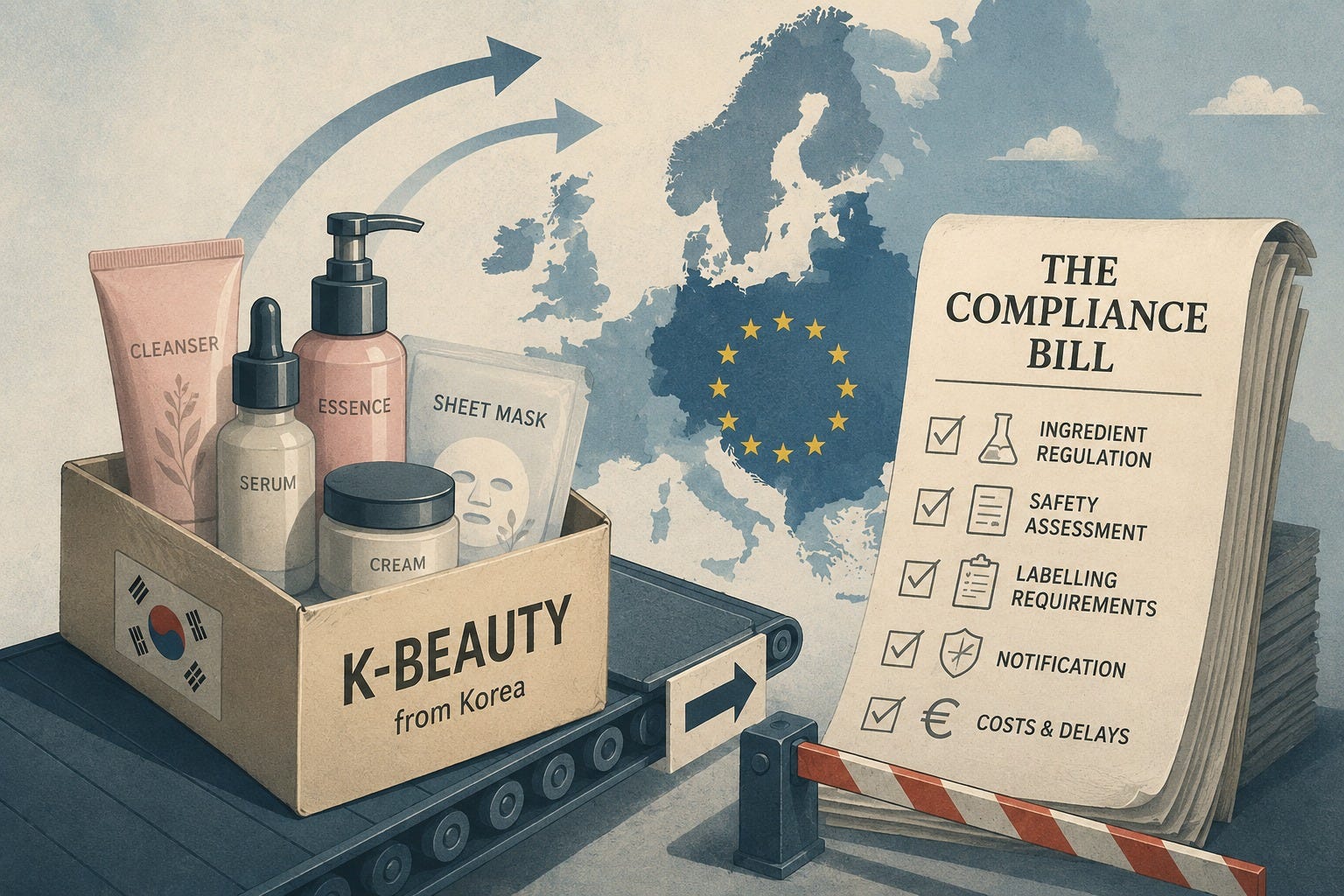
Korea has displaced the United States as the EU’s largest cosmetics supplier. Three regulatory regimes tighten this summer, and the exposure sits with the brands that hold no European entity of their
Saint Clair Global · Market Intelligence | July 2026
Executive Summary
Korean cosmetics exports reached $7.0 billion in the first half of 2026, up 27.3% and the largest half-year on record. Korea is now the single largest source of cosmetics imported into the European Union, holding 21.7% of that import market. Between July and 12 August, three EU regulatory regimes tighten at once: an updated ingredient glossary, a packaging and waste regulation, and an accelerated phase-out of CMR substances. The binding constraint on Korean brands in Europe has moved from demand to documentation, and the brands most exposed are those whose European regulatory filings sit with somebody else.
Where the Growth Actually Sits
The half-year figures the Ministry of Food and Drug Safety published on 2 July describe a market that has changed shape. Exports reached $7.0 billion, 27.3% above the same period last year, and the momentum built rather than faded: $3.1 billion in the first quarter, $3.9 billion in the second. June alone brought $1.34 billion, an eighth consecutive monthly rise.
The composition tells more than the total. Basic skincare accounted for $5.48 billion of the half-year figure, growing 25.0%. Colour cosmetics fell 4.2% to $720 million. Body cleansing products fell 20.6% to $340 million.
That settles a question which has hung over the sector for two years. The received reading of K-Beauty’s export boom places it on cheap, high-turnover novelty formats with little claim on the customer. The half-year data places the growth in the daily skincare routine, the category with the longest customer life and the firmest pricing. The disposable formats are shrinking.
Europe is where the acceleration is sharpest. Exports to the United Kingdom rose 150.6% over the half, the Netherlands 220.4%, Poland 72.8%. Three European markets now sit inside Korea’s top ten destinations, against one a year ago. EU shipments grew 78.9% in June.
First Place, and What Comes With It
KOTRA’s Brussels office reports that Korea took 21.7% of EU cosmetics imports under HS 3304 in 2025, displacing the United States at 19.7% on a rise of roughly $400 million. Imports from Asia are climbing across the board; those from the United States, the United Kingdom and Switzerland are in decline.
Market leadership changes a company’s relationship with its regulator. Korean brands operating in Europe now report a volume of monitoring correspondence and evidentiary requests that simply did not exist when they were a niche import. Complaints from European competitors and consumers have risen alongside the share. Customs authorities in individual member states have begun demanding notarised powers of attorney for Responsible Persons and notarised CVs for safety assessors. One retailer describes being fined for printing an expiry date in Korean convention rather than European.
Growth has pulled grey-market volume along behind it. Product moving through Amazon and comparable platforms without certification, and without a designated Responsible Person, is now a live enforcement concern in Brussels. The reputational exposure there is collective. An uncertified consignment held at a European border damages the category, and the category is now Korean.
Three Regimes, One Summer
From July, the updated INCI ingredient glossary (Regulation 2025/1175) applies as an obligation, and fragrance allergen labelling extends to 82 substances. For a brand with a portfolio already in market, that means either full packaging redesign or ingredient substitution. Print timelines are not short.
From 12 August, the Packaging and Packaging Waste Regulation takes effect. It sets PFAS and heavy-metal limits, imposes traceability requirements, and obliges brands to obtain Declarations of Conformity from their component suppliers. It also requires Extended Producer Responsibility registration country by country, an administrative load that scales with every market a brand sells into.
Behind both, Parliament and Council have provisionally agreed to shorten the phase-out grace period for CMR substances by six to twelve months, compressing reformulation timetables that were set against the old assumption.
Each of these is a documentation cost. They land on a legal structure and a cost base, not on a sales line, which is precisely why the export figures will not show them for another two quarters.
The Entity Question
The distribution model that carried K-Beauty into Europe was built for speed. An emerging Korean brand can reach European consumers through cross-border aggregators and brokers who run the storefront, clear customs and, in many cases, hold the CPNP registration itself. The brand ships. Somebody else files.
That arrangement works beautifully until the filing becomes the liability.
Under the regimes arriving this summer, the Responsible Person is the entity a regulator addresses and the entity a member-state customs office will ask to produce notarised documentation at short notice. A brand that has rented its Responsible Person from a logistics intermediary has rented its regulatory position along with it. It does not control the reformulation timetable, the packaging specification, or the EPR registrations. It will discover the cost of that at the point of enforcement rather than the point of planning.
This is where the corridor is thin. Between the aggregator layer and a full European subsidiary sits a category of operator that barely exists: mid-scale brand management with genuine fluency in both Korean corporate governance and European retail compliance. Korean leadership teams manage European growth from Seoul, through dashboards, routing containers to third-party fulfilment centres and reacting to demand spikes as they appear. The obligations arriving in August do not route.
What Diligence Should Now Ask
The macro case is intact and, if anything, firmer than it looked in the spring. A $7 billion half-year. First place in EU import share. Growth concentrated in the highest-retention product category, and a full-year figure that reaches $13.7 to $14.0 billion if the current run-rate holds. Demand is settled.
What has changed is the shape of the risk. Twelve months ago, assessing a Korean beauty brand’s European position meant asking about marketing efficiency and channel mix. The questions that matter now are narrower and duller: who holds the CPNP registration, whether the Responsible Person is the brand’s own entity or a rented one, whether the packaging suppliers can produce Declarations of Conformity before 12 August, and how many member-state EPR registrations actually exist.
We expect the second half of 2026 to separate the sector visibly. Brands that treated Europe as a shipping destination will absorb the compliance cost as a shock; brands that built the entity will absorb it as a cost of doing business. That distinction is legible in the diligence today. It was never legible in the export data.
Sources:
Ministry of Food and Drug Safety, H1 2026 cosmetics export figures, via Seoul Economic Daily, “K-Beauty Exports Hit Record $7 Billion in First Half, US Share Tops 20%” (2 July 2026): https://en.sedaily.com/markets/2026/07/02/k-beauty-exports-hit-record-7-billion-in-first-half-us
Ministry of Trade, Industry and Resources, June 2026 trade figures, via CNC News (씨앤씨뉴스), “6월 화장품 수출 13.4억달러(+43%), 상반기 70억달러... 미국·EU·중국 등 큰 폭 성장” (1 July 2026): https://www.cncnews.co.kr/news/article.html?no=11059
KOTRA Brussels, EU cosmetics import share and H2 2026 regulatory assessment, via CNC News (씨앤씨뉴스), “유럽 화장품시장, 현지 견제(소비자·기업)+규제(각국 식약처·세관) ‘이중 암초’” (11 July 2026): https://www.cncnews.co.kr/news/article.html?no=11077
The Korea Times, “Korea becomes world’s No. 2 cosmetics exporter as trade surplus tops $10 bil.” (22 May 2026): https://www.koreatimes.co.kr/business/20260522/korea-becomes-worlds-no-2-cosmetics-exporter-as-trade-surplus-tops-10-bil
Disclaimer: This article is for informational purposes only and does not constitute investment or business advice. All decisions should be made based on independent research and consultation with qualified advisors.
About Saint Clair: Saint Clair is a cross-border investment firm between Europe and Asia: an institutional investor that also builds the infrastructure through which capital crosses borders. Saint Clair Global builds companies to international institutional standards: the company side of the practice, where a business is made to read as a successful, attractive investment opportunity to the capital it seeks. Since 2016.
Saint Clair Pte. Ltd. · Singapore · saintclair.global