
Saint Clair · Market Intelligence | July 2026
Executive Summary
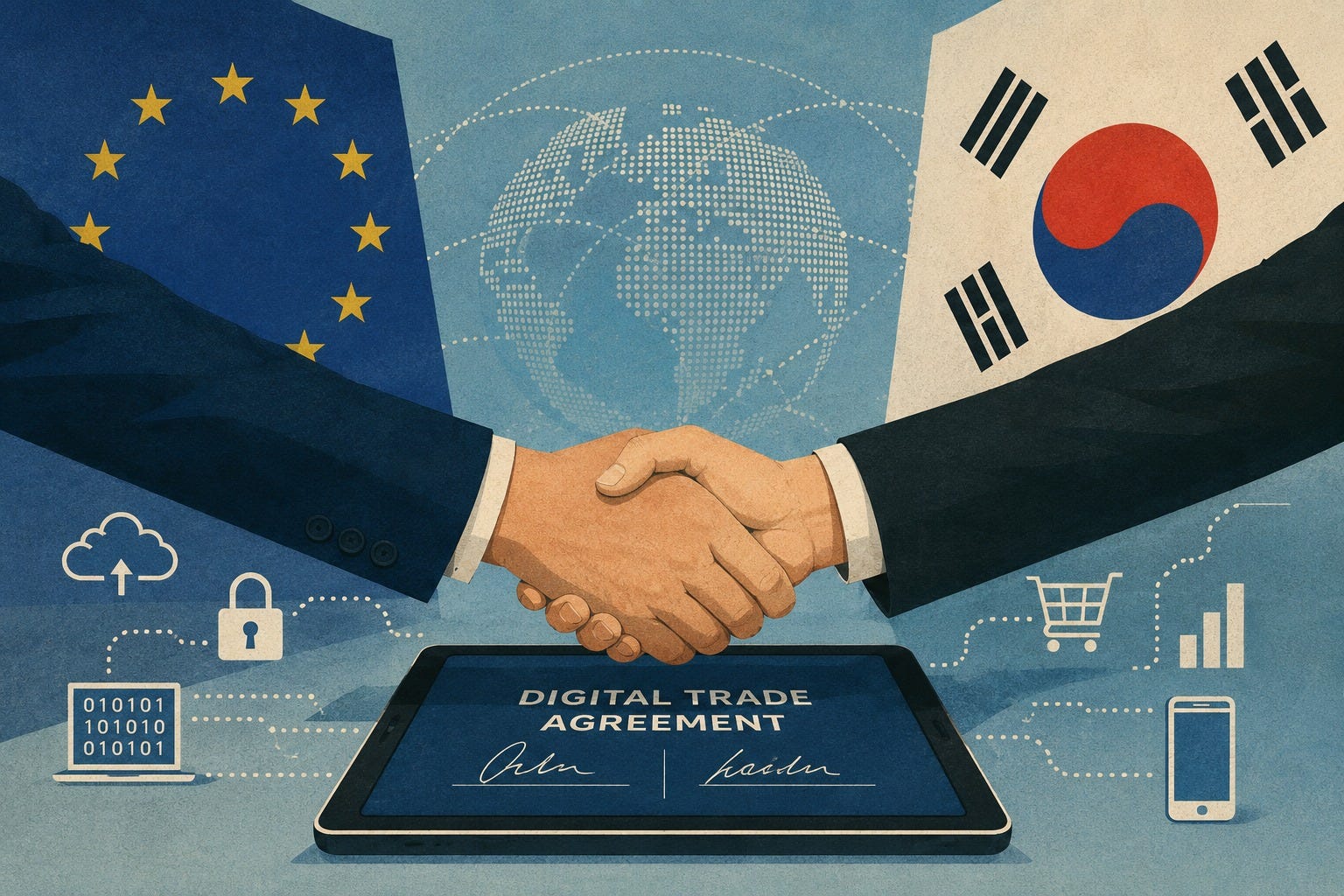
On 10 June 2026, the European Union (EU) and the Republic of Korea signed a Digital Trade Agreement (DTA) at their eleventh bilateral summit in Brussels, complementing a Free Trade Agreement (FTA) that has governed the relationship since 2011. The new agreement guarantees cross-border data flows, prohibits forced source code disclosure, and gives full legal recognition to electronic contracts and signatures, though ratification by the European Parliament is still required. For Korean technology firms, the legal route into the European market is now considerably shorter than it was a year ago. The governance route, which European enterprise buyers use in practice to decide who they trust, has not moved at all.
What the Agreement Removes
The DTA was signed by European Commissioner for Trade and Economic Security Maroš Šefčovič and Korean Trade Minister Yeo Han-koo, at a summit that also brought together European Commission President Ursula von der Leyen, European Council President António Costa, and Korean President Lee Jae-myung. Negotiations concluded in March 2025, building on the Digital Partnership the two sides launched in 2022. The text now awaits ratification by the European Parliament, after which the Council will formally conclude it.
The agreement addresses three obstacles in particular. It facilitates cross-border data flows, so that firms operating in the EU no longer depend on holding their data on servers located inside the bloc. Neither government can demand source code as a condition of market access. Electronic contracts and digital signatures carry full legal weight in both jurisdictions. That last point matters for a trade relationship in which, according to the European Commission, more than a third of EU-Korea services trade was already delivered digitally by 2023, worth roughly €11 billion. The Commission puts more than 60 per cent of global Gross Domestic Product (GDP) as now linked in some form to digital transactions.
This is the EU’s second standalone digital trade agreement, after the one it signed with Singapore. Digital-trade rules are also being written into the broader economic partnerships the EU has recently concluded with Indonesia and India, and into those it aims to close with Thailand, Malaysia and the Philippines during 2026. None of this is small. Bilateral goods trade reached roughly €124.25 billion in 2025, an average annual growth of 5.3 per cent since the FTA took effect in 2011, and Korea is now the EU’s eighth-largest goods-trading partner. The DTA gives that relationship a digital chapter it has never had.
What a European Buyer Checks Before Signing
European enterprise procurement teams built their vendor assessment processes around distributed accountability. Before a contract is signed, a buyer typically wants to know who owns a data incident inside the vendor’s organisation, how quickly an internal privacy concern reaches someone with authority to act, and whether the vendor’s structure could withstand scrutiny from a regulator or an aggrieved customer. These are governance questions. They sit outside anything a trade agreement can specify.
The DTA explicitly preserves the EU’s right to maintain its own consumer protection and data privacy standards alongside the new market access provisions. Korean firms entering the European market will continue to meet the bar set by the General Data Protection Regulation (GDPR), which already applies to every vendor operating there, Korean or otherwise. The market-access hurdle has come down. The underlying compliance requirement has not moved, because it was never a function of Korean firms’ access to the market in the first place.
A Management Model Built for One Kind of Export
Korean technology firms built decades of export competence around semiconductors, vehicles and shipbuilding, industries in which a centralised, fast-moving management structure delivers a genuine advantage. Decisions travel quickly from the top of these organisations. That speed shows up directly in global market share for physical goods.
The pattern we observe in software procurement conversations runs differently. A European buyer assessing a Korean software vendor looks for governance distributed across the organisation: a team empowered to flag a privacy issue without escalating to the chief executive first, a data protection officer with genuine authority, documentation that survives an external audit rather than a single internal sign-off. A firm organised around one point of executive decision-making can produce a compliance checklist within days. Producing an ongoing record of distributed accountability takes years, and the two are different exercises entirely.
This distinction has a European precedent worth naming. Firms based in Frankfurt or Amsterdam earned enterprise trust in this market gradually, through repeated demonstration of exactly this kind of internal accountability, long before any trade agreement existed to formalise their access. Korean firms now have the legal access. The demonstrated track record is a separate asset, and it takes years to build under any circumstances.
The Distance Left to Travel
The DTA gives Korean firms a legal route into the European market that has never existed before. It says nothing about how a Korean board reorganises internal authority to produce the kind of governance evidence a European buyer now treats as standard practice. That work sits entirely with the firms themselves.
Over the next several years, this will determine how much of the growing €11 billion in EU-Korea digital services trade actually moves in Korea’s direction, rather than toward vendors with a longer governance track record already in place. The treaty removed the obstacle governments control. The remaining one sits on Korean balance sheets, and it responds to organisational change, not further negotiation in Brussels.
Sources
European Commission, EU and Korea sign landmark digital trade agreement at Summit, press release IP/26/1317, 10 June 2026: https://ec.europa.eu/commission/presscorner/detail/en/ip_26_1317
European External Action Service (EEAS), EU and the Republic of Korea sign landmark Digital Trade Agreement at Summit, 11 June 2026 — €11 billion / one-third of services trade delivered digitally by 2023; over 60% of global GDP linked to digital transactions; second standalone EU DTA after Singapore; 2022 Digital Partnership: https://www.eeas.europa.eu/delegations/south-korea/eu-and-republic-korea-sign-landmark-digital-trade-agreement-summit_en
European Commission, Directorate-General for Trade, EU trade relations with South Korea— €124.25 billion bilateral goods trade in 2025; 5.3% average annual growth 2011–2025; Korea the EU’s eighth-largest goods partner; DTA negotiations concluded 10 March 2025: https://policy.trade.ec.europa.eu/eu-trade-relationships-country-and-region/countries-and-regions/south-korea_en
Council of the EU / EEAS, Joint Statement following the 11th European Union – Republic of Korea Summit, 10 June 2026: https://ec.europa.eu/commission/presscorner/detail/en/statement_26_1326
EU Expects to Finalize Trade Pacts With Philippines, Thailand, Malaysia in 2026, The Diplomat, September 2025: https://thediplomat.com/2025/09/eu-expects-to-finalize-trade-pacts-with-philippines-thailand-malaysia-in-2026/
MLex, EU and South Korea sign digital trade agreement, 10 June 2026: https://www.mlex.com/mlex/articles/2487928/eu-and-south-korea-sign-digital-trade-agreement
Disclaimer: This article is for informational purposes only and does not constitute investment, legal or trade advice. Saint Clair maintains active engagements in cross-border capital between Europe and Asia and may hold commercial interests in the markets discussed here. Readers should form their own view in consultation with qualified advisors.
About Saint Clair: Saint Clair is a cross-border investment firm between Europe and Asia: an institutional investor that also builds the infrastructure through which capital crosses borders.
Learn more: saintclair.sg | saintclair.asia | Contact: contact@saintclair.sg