
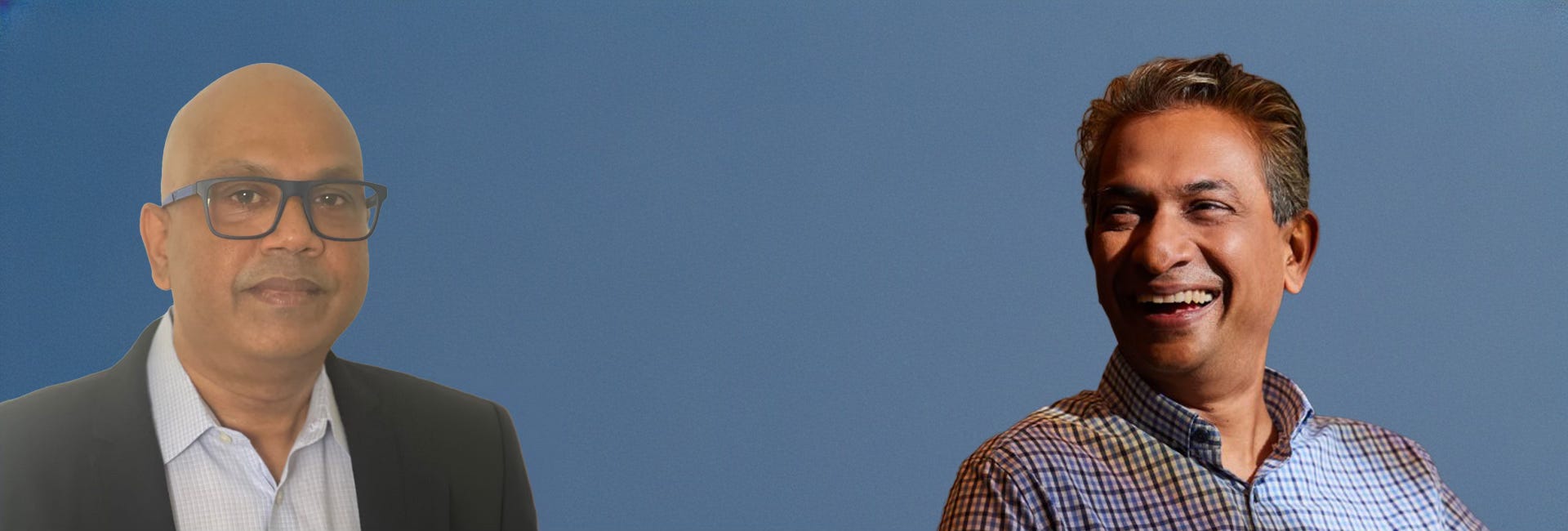
Prajeeth Balasubramaniam and Rajan Anandan left Sri Lanka during the civil conflict. Decades later, one returned to Colombo, the other rose to run Google India. Together, they built Sri Lanka’s first angel network, first startup competition, and first venture capital fund.
Saint Clair Market Intelligence | April 2026
Technology ecosystems do not emerge from talent alone. They require plumbing — the angel networks, venture funds, startup competitions, and mentorship structures that convert raw capability into funded companies. Sri Lanka had the talent for decades before it had the plumbing. The story of how that infrastructure came to exist is, in large part, the story of two men who left and came back.
Two Departures
Prajeeth Balasubramaniam spent twenty years abroad — the UK, Japan, Australia — leading established businesses and absorbing the corporate discipline of markets where precision was assumed, not aspirational. His years in Japan, in particular, shaped a management philosophy built around rigorous process and restructuring. In 2002, he returned to Sri Lanka to run his family business, Klevenberg, serving as Deputy Chairman for a decade while restructuring the company.
Rajan Anandan’s departure was more abrupt. Born in 1966 to a Sinhalese-Tamil family, he grew up in Colombo during the civil conflict. As a teenager, he and his brother narrowly escaped death during the violence that claimed thousands of Sri Lankan lives. He left the country soon after. He left the country at seventeen. MIT, then Stanford, then McKinsey, where he spent a decade as a partner. Then Dell, Microsoft India, and eventually Vice President of Google India and Southeast Asia — an eight-year tenure that made him one of the most prominent technology executives in South Asia.
Two Sri Lankans, two very different paths abroad, one shared conviction: that the country they had left could build something if someone built the infrastructure first.
Building the Plumbing
When Balasubramaniam began exploring Sri Lanka’s startup landscape after returning in 2002, the ecosystem barely existed. He has described the experience of approaching startups to ask if they wanted investment and receiving odd looks in return. The concept of venture capital was essentially foreign.
In 2010, he and Anandan began building what would become Blue Ocean Ventures — BOV Capital — with offices in Singapore and Colombo. The ambition was modest by global standards but radical for the local market: provide seed-stage capital to Sri Lankan startups with the potential to build globally viable products.
What followed was a deliberate, sequential construction of ecosystem infrastructure. In 2012, Balasubramaniam founded the Lankan Angel Network — the country’s first and largest angel network, now with over 75 members and more than Rs. 2 billion invested in local startups. That same year, he launched Venture Engine, an annual startup competition that has since vetted and mentored over 1,000 Sri Lankan startups across more than a dozen editions. The competition created a pipeline: hackathon winners entered an acceleration programme with direct access to overseas investors and mentors.
In 2017, BOV Capital established the Digital Innovation Fund in partnership with Dialog Axiata — Rs. 2.3 billion in committed capital, debuted by the Malaysian Prime Minister, targeting early-stage digital startups across fintech, health-tech, edtech, and agritech. It was Sri Lanka's first dedicated digital venture capital fund.
The sequence was intentional: angel network first, to create deal flow and investor education. Startup competition second, to surface and develop companies. Venture fund third, to provide institutional-grade capital once the pipeline justified it. Each layer enabled the next.
The Portfolio
BOV Capital has invested in over 25 startups to date, with Digital Innovation Fund investments ranging from Rs. 50 million to Rs. 200 million per company. The portfolio tells its own story about what Sri Lankan startups are capable of when capital is available.
The signal exit was nCinga Innovations — a manufacturing software platform for the apparel industry — acquired by Zilingo in 2019 in what was described as one of Sri Lanka's largest tech exits at the time. The nCinga team subsequently built IFINITY, a fintech company that the Digital Innovation Fund later backed and successfully exited. Other portfolio companies include Roar Media, a South Asian content platform operating in five languages; InsureMe, an insurance technology company; and Cultiv 8, an agritech venture with operations in Bangladesh.
These are not unicorns. They are not meant to be. They are evidence that a functioning venture ecosystem — capital, mentorship, deal flow, exits — can operate in a market of 22 million people, provided someone builds it.
The Two Halves
Balasubramaniam and Anandan represent complementary halves of the same project. Balasubramaniam is the operator — present in Colombo, chairing the Lankan Angel Network, sitting on government advisory committees, running Venture Engine, meeting founders. Anandan is the connector — deploying networks and credibility earned at Google and Peak XV (formerly Sequoia Capital), where he now serves as Managing Director overseeing the Surge accelerator programme, into a market most institutional investors cannot find on a map.
Together, they also co-founded the Lankan Angel Network with Jeevan Gnanam, who built Orion City — Sri Lanka’s largest IT park — and Hatch, the country’s largest coworking and incubation space. The overlap is not coincidental. Sri Lanka’s ecosystem builders are a small group of people who keep appearing in each other’s stories, building interlocking pieces of the same infrastructure.
Balasubramaniam has been candid about the frustrations. The ecosystem, he has noted, still has a long way to go. Annual venture capital investment in Sri Lanka remains in the low single-digit millions — a fraction of what comparable markets attract. The civil conflict, the 2019 Easter bombings, the 2022 economic crisis: the operating environment has been, to put it diplomatically, testing.
Yet the infrastructure persists. Venture Engine continues to run annually. The Lankan Angel Network continues to deploy. BOV Capital’s exits — nCinga, IFINITY — demonstrate that the model works, even if the scale remains modest.
What the Plumbing Enables
The founders profiled elsewhere in this series — the product builders, the acquirers, the Silicon Valley returnees — operate in an ecosystem that did not exist twenty years ago. Angel networks, venture funds, startup competitions, mentorship pipelines, government advisory structures: none of this was present when Balasubramaniam returned to Colombo in 2002.
The contribution of infrastructure builders is, by nature, less visible than that of company builders. No one writes headlines about angel networks. But the absence of venture infrastructure is precisely what keeps promising ecosystems from graduating — from producing talented engineers who work for others to producing funded companies that own their own IP and deploy their own capital.
Balasubramaniam and Anandan did not build a company. They built the conditions under which companies could be built. For a market still waiting for its breakout moment, that may prove to be the more consequential achievement.
Sources:
Tamil Culture, “Tamil Innovators: Prajeeth Balasubramaniam Discusses Startups & Investing in Sri Lanka”: https://tamilculture.com/tamil-innovators-spotlight-prajeeth-balasubramaniam-discusses-startups-investing-in-sri-lanka
Tamil Culture, “Prajeeth Balasubramaniam: Empowering Sri Lankan Youth by Fostering a Startup Culture”: https://tamilculture.com/prajeeth-balasubramaniam-empowering-sri-lankan-youth-by-fostering-a-startup-culture/
Daily FT, “Prajeeth Balasubramaniam takes helm at Lankan Angel Network”: https://www.ft.lk/business/Prajeeth-Balasubramaniam-takes-helm-at-Lankan-Angel-Network/34-749390
Dialog Axiata, “Digital Innovation Fund (DIF), Managed By BOV Capital”: https://www.dialog.lk/news/digital-innovation-fund-dif-managed-by-bov-capital-and-powered-by-dialog-axiata-plc
Daily FT, “Digital Innovation Fund successfully exits IFINITY”: https://www.ft.lk/it-telecom-tech/Digital-Innovation-Fund-managed-by-BOV-Capital-powered-by-Dialog-Axiata-successfully-exits-IFINITY/50-781244
Echelon, “BOV Capital Buoyant About Sri Lankan AI Startups”: https://echelon.lk/home/bov-capital-buoyant-about-sri-lankan-ai-startups/
Peak XV, “Rajan Anandan”: https://www.peakxv.com/people/rajan-anandan/
WeRiseByLiftingOthers, “Biography of Rajan Anandan”: https://www.werisebyliftingothers.in/2024/05/biography-of-rajan-anandan-journey-of.html
Echelon, “Tech startups: in to the valley of death“: https://echelon.lk/tech-startups-in-to-the-valley-of-death/
Disclaimer: This article is for informational purposes only and does not constitute investment advice. All decisions should be made based on independent research and consultation with qualified advisors.
About Saint Clair – Advisory & Capital: Saint Clair practises Capital Diplomacy — fostering cross-border investment relationships between Europe and Asia through trust, insight, and strategic facilitation. Saint Clair Asia partners with overlooked Asian innovation ecosystems where emerging opportunities and quality talent intersect. We bridge portfolio companies to European markets, partners, and acquirers. Since 2016, we have specialised in the Europe-Asia investment corridor.
Learn more: saintclair.sg | saintclair.asia | Contact: contact@saintclair.sg