
Principals: The Returner
How Mangala Karunaratne Built Two Careers and One Ecosystem
A Silicon Valley veteran lost everything in the dot-com crash, came home to Sri Lanka, and spent two decades building a company — and a country’s tech infrastructure — from scratch.
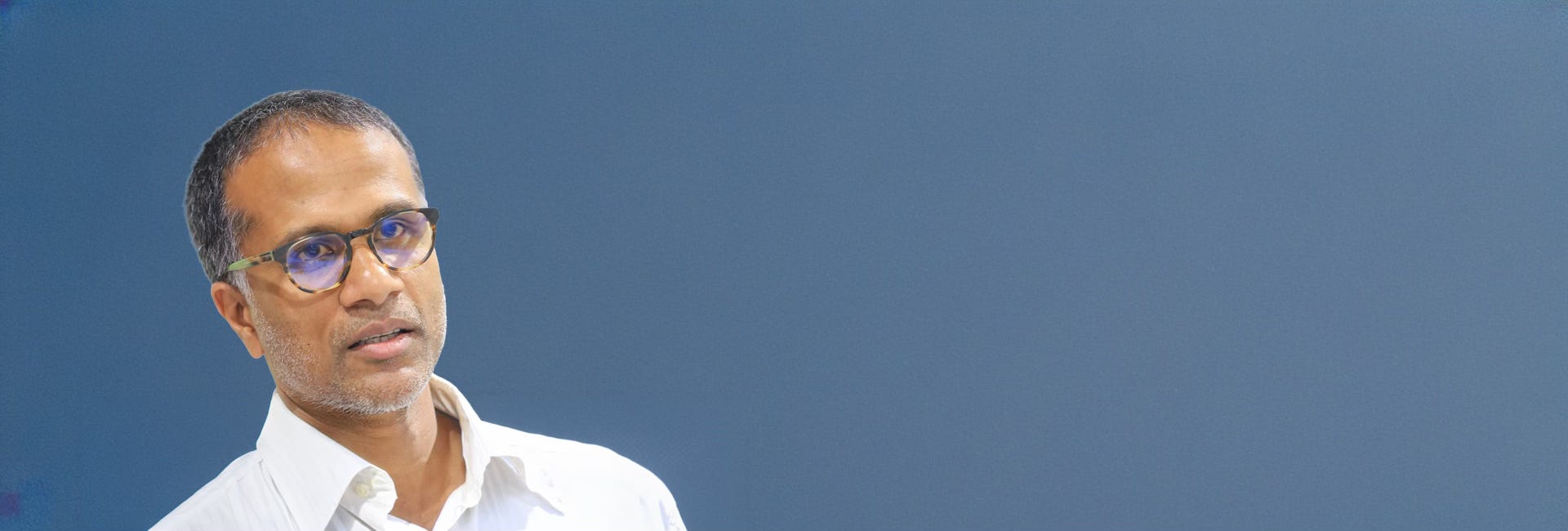
Saint Clair Market Intelligence | March 2026
Most founder stories move in one direction: small country to big market, obscurity to success, home to away. Mangala Karunaratne’s runs in loops. Silicon Valley to Colombo. Colombo back to Silicon Valley. Silicon Valley back to Colombo. Each return reshaped what he was building — and, gradually, what Sri Lanka’s technology sector could become.
The First Life
Karunaratne arrived in California in the mid-1990s, graduated from California State University, and stepped straight into the dot-com boom. His first role, at golfweb.com, ended with an acquisition by SportsLine USA eleven months later. He moved to Bay Networks, then Nortel, climbing to product manager for web intelligence. By the standards of the era, he was on track.
Then Nortel collapsed — one of the most spectacular corporate failures of the early 2000s. Tens of thousands of people lost their jobs. Karunaratne lost his position and, by his own account, ninety per cent of his savings.
What he did next is what separates his story from thousands of similar ones. Rather than find another Valley job, he went home.
Sixty Thousand Dollars and a Borrowed Office
In mid-2002, Karunaratne returned to Sri Lanka and founded Calcey Technologies with $60,000 and an idea: combine Silicon Valley engineering discipline with Sri Lankan talent. His father, himself a self-made entrepreneur, lent him a small office space. That was the first development centre.
The early years were brutal. For three years, the company went effectively nowhere. He had to let go of his only two employees. He questioned whether the entire venture was a mistake.
It was during this low point, in late 2003 or early 2004, that Google called. Karunaratne passed the initial phone interview for a product role. When they asked what he thought the next big thing on the internet would be, he said video. They wanted him in Mountain View immediately for the next round. But he did not have the risk capital to fly from Colombo to California — and was not yet ready to give up on Calcey. He let the opportunity pass. YouTube launched shortly afterwards.
In 2004, the tsunami struck Sri Lanka, and Karunaratne paused the business entirely for six months to help run fundraising for Karuna Trust, his father’s charity.
It was, paradoxically, the pause that changed the trajectory. When he returned to Calcey, he shifted approach. As he later recalled, he stopped selling and focused on relationships. The first real client, CompareNetworks, started with a modest data entry project staffed by three school graduates. The client’s verdict — that the work was better than anything they had received from the United States — opened the door to larger engagements. Small profits arrived in the fourth year. The model began to work.
The Second Valley
By 2007, Calcey had grown to a team of thirty — enough to justify what Karunaratne felt the business needed: a presence in Silicon Valley itself. He moved back to California with his young family, working directly with clients while the Colombo team scaled to seventy engineers.
In 2011, he returned to Sri Lanka for good.
The company that emerged from these oscillations was distinctive. Calcey operated as a deliberate boutique — small teams of four to eight people, inspired by Jeff Bezos’s two-pizza rule, working on complex product engineering for clients who valued precision over volume. PayPal. Stanford University. Wikimedia. The Westfield Group. Billing rates that reflected the quality: this was not a cost arbitrage play.
Karunaratne’s refusal to scale indiscriminately — his insistence on saying no to projects that did not fit — kept Calcey small by industry standards. At around 150 people, it was a fraction of the size of peers like Virtusa or WSO2. But it had built something those larger firms had not: a reputation in Silicon Valley as an engineering partner, not an outsourcing vendor.
Building the Infrastructure
What happened alongside Calcey is, in some ways, more significant than Calcey itself.
In the early 2010s, Karunaratne joined a small group of Sri Lanka’s technology founders — Mano Sekaram of 99x, Harsha Subasinghe of CodeGen, and others — to do something that had never been done in the country: build a purpose-made technology park. They converted the derelict Tripoli Market Square, an 18th-century complex of British warehouse buildings in Maradana, into TRACE Expert City — Sri Lanka’s first innovation hub. The $7 million nonprofit initiative, launched in 2013, now houses leading technology firms including CodeGen and the London Stock Exchange Group’s Sri Lankan operations.
Calcey was the second company to move in. Karunaratne’s office there — climbing wall, pool table, vinyl record player, and a poster reading “FUCK MEDIOCRITY” — became something of a landmark in Colombo’s tech scene.
The pattern is worth noting: a founder who could have remained focused solely on his own company instead invested time and political capital into the physical and institutional infrastructure of the ecosystem around him. TRACE Expert City. FARO, a foundation assisting rural Sri Lankan youth into technology careers. Monthly donations of medical equipment for children undergoing cancer treatment. These are not corporate social responsibility footnotes. They are the connective tissue of an emerging ecosystem.
The Exit and the Next Thing
In July 2025, Calcey merged with Surge Global in a $40 million transaction to form Short Circuit Pte Ltd — a regional technology group spanning Sri Lanka, India, Qatar, and Singapore, with over 500 employees. Surge’s previous investors reportedly exited at a 15.5x return, marking one of Sri Lanka’s most successful private technology outcomes.
Karunaratne remains on the Short Circuit board but has stepped back from daily operations. His attention has turned, characteristically, to something new: Asaya Sands in Mirissa, a coastal retreat designed for location-independent executives and companies seeking an alternative to conventional corporate offsites. The venture reflects a conviction that Sri Lanka’s appeal extends beyond its engineering talent — and that the founder who spent two decades bridging Silicon Valley and Colombo might now bridge the country’s technology and tourism economies.
Whether Asaya succeeds is, at this point, an open question. But the pattern is familiar: go where others haven’t, build something precise, and refuse to do it the way everyone else does.
The Loops
Karunaratne’s career is not a straight line from adversity to triumph. It is a series of departures and returns, each one recalibrating what was possible. He left Sri Lanka to learn. He came back to build. He left again to sell. He came back again to scale — not just his own company, but the ecosystem that would make the next generation of Sri Lankan technology companies viable.
The founders who built TRACE Expert City — Karunaratne, Sekaram, Subasinghe, and their collaborators — created physical infrastructure. But the deeper contribution was demonstrating a model: that a Sri Lankan technology company could operate at Silicon Valley standards, charge accordingly, and choose to remain in Colombo.
For cross-border investors, the Calcey story is a useful corrective to the assumption that emerging-market technology firms must scale aggressively or perish. Some of the most durable companies are built by founders who know precisely what they are not willing to do — and have the discipline to hold that line for twenty years.
Sources:
Roar Media, “The Calcey Secret: Strong Coffee and The Ability To Say No”: https://archive.roar.media/english/tech/startups/the-calcey-secret-strong-coffee-and-the-ability-to-say-no
IdeaMensch, “Mangala Karunaratne — Founder of Calcey Technologies”: https://ideamensch.com/mangala-karunaratne/
Readme.lk, “Calcey-fied: Silicon Valley Engineering Meets Sri Lankan Style”: https://readme.lk/calcey-fied-silicon-valley-engineering-meets-sri-lankan-style/
Readme.lk, “Surge Global and Calcey merge to form Short Circuit in $40 million deal”: https://readme.lk/surge-global-and-calcey-merge-to-form-short-circuit-in-40-million-deal/
Readme.lk, “Tracing The History of Trace Expert City”: https://readme.lk/tracing-history-trace-expert-city/
Calcey Technologies, “Wired for the Future: Surge x Calcey”: https://calcey.com/blog/wired-for-the-future-surge-x-calcey/
Disclaimer: This article is for informational purposes only and does not constitute investment advice. All decisions should be made based on independent research and consultation with qualified advisors.
About Saint Clair – Advisory & Capital: Saint Clair practises Capital Diplomacy — fostering cross-border investment relationships between Europe and Asia through trust, insight, and strategic facilitation. Since 2016, we have specialised in the Europe-Asia investment corridor.
Learn more: saintclair.sg | Contact: contact@saintclair.sg