
Reaching for the Card
A business-networking room is a social space. Koreans work it as a sales floor, and that is where the trouble begins.
Saint Clair · Market Intelligence | June 2026
A house party in Itaewon, the district of Seoul known for its international community: fifteen people, a third of them Korean, the rest expatriates living in the city. One guest, who runs a nail salon nearby, moved through the room handing her card to everyone present. She works with foreigners every day. Still, she misread the room. The host’s warmth cooled, and she never learned why. She had walked into a living room and seen a sales floor.
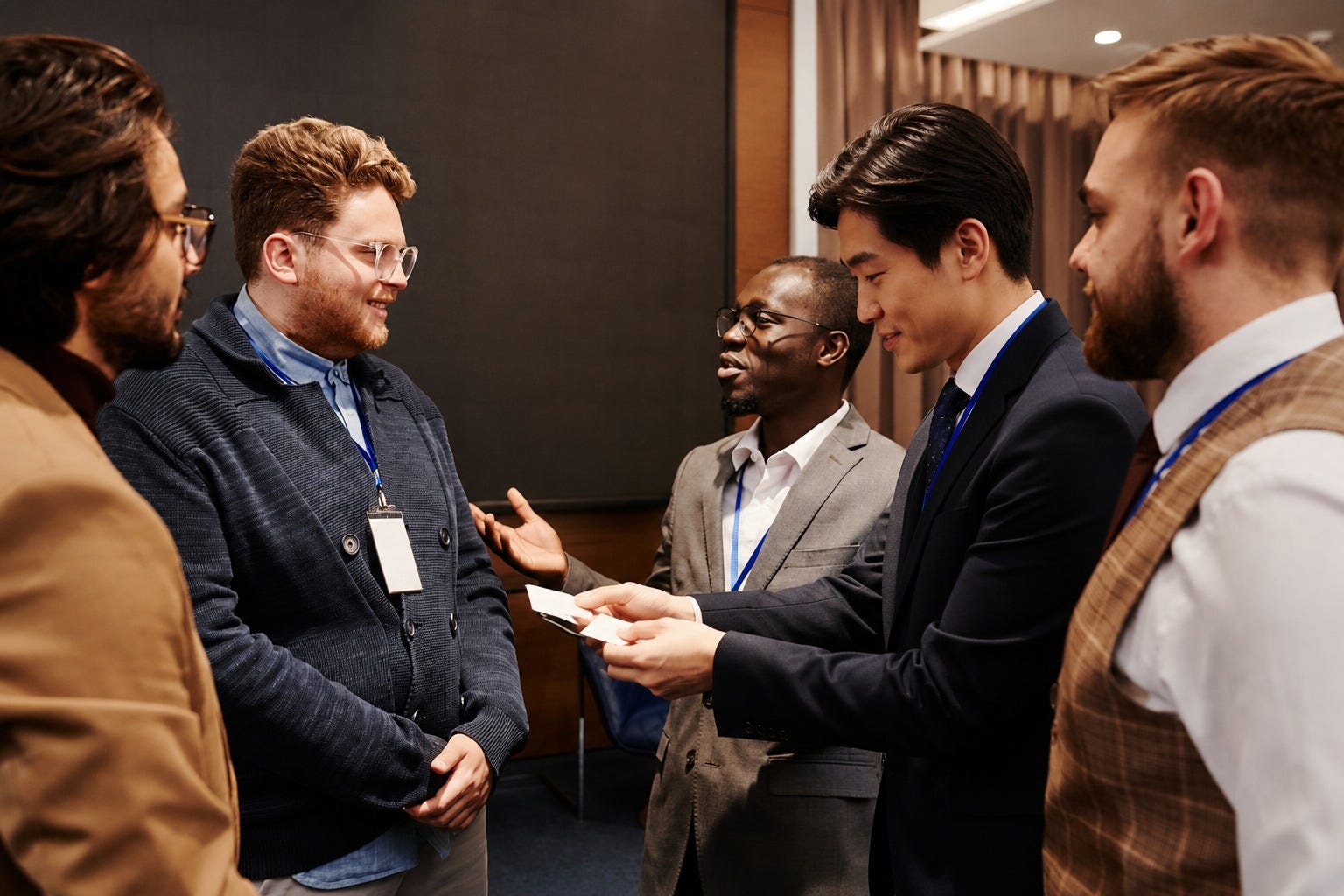
The figures vary. One hands out cards as though they were greetings; another launches into who he is, what he does and why he came, before exchanging a name; a third steps into a conversation already under way, blind to its temperature. The seasoned operator waits at a distance for an opening; the others cut into the talk at its height. The behaviour differs. The mistake holds. Each turns a social occasion into a transaction.
These rooms run on Western habits, or more precisely on the habits of the international stage, which Koreans have never learned, whether professor, founder or executive. Carry the home version into a global gathering, and it cannot help but read as strange.
The clerk a step behind
Consider the shop floor. In a Korean store the assistant trails the customer at the shoulder, a step behind, watching every movement in silence, ready the instant something is needed. The attentiveness is earnest, and it follows a script; to anyone unused to it, the closeness can feel like being followed. A North American or European store works by a different habit. The assistant opens with a warm greeting, a “Good afternoon, how are you?”, and the customer answers in kind; the manner belongs to both sides. He keeps his distance, and he meets the customer as a person first. It is small talk, and it does real work.
The networking room, in our experience, runs on the same rule. The Korean professional behaves like the attentive assistant: cards out, business first. The people in the room came as peers, and a peer resents being worked. The moment the purpose shows too plainly, the relationship closes before it opens.
The social comes first
The misreading is simple. Korean professionals treat the room as marketing. The room is, first, a social one, and the business arrives much later.
Watch two heads of state meet. They eat together, exchange gifts, tour the city. The deals and the negotiations come last. Even the largest agreement in the world reaches its substance only after a long social prelude.
Western counterparts read a room as closely as anyone. A purpose shown too openly is, to them, the breach. Korea has nunchi (눈치), the instinct for reading a room; the West has it too, pointed elsewhere. The Korean version tracks rank and hierarchy, while the Western one tracks restraint, the keeping of one’s aim out of view. At home, and the more so when Korea hosts, such lapses pass. Across a border it does worse than fail; it is misread.
Give before you take
Give before you expect to receive. The return rarely comes straight back from the person you helped; it travels the network and arrives, often, from somewhere unexpected. That is why Keith Ferrazzi, in the networking classic Never Eat Alone, keeps no score. The gift is genuine interest in the other person, offered before anything is asked in return. Dale Carnegie, who wrote the classic on human relations, put it plainly ninety years ago: “You can make more friends in two months by becoming interested in other people than you can in two years by trying to get other people interested in you.”
Interest lives in listening. The stranger pressed for his job, title and hometown feels examined; real attention leaves him wanting to say more. Handing over a card presses what is mine upon you; interest draws out what is yours.
Slowly, and more than once
The social moves slowly, which is why these gatherings happen so often. A single appearance does little. Return to the same sector’s rooms month after month, and familiar faces accumulate, the room grows comfortable, and a feel for it settles in. Greetings follow. Then conversation. Then, in time, a relationship. This is the ordinary machinery of trust across most of the world, and it rewards presence over performance.
A business card introduces what you sell. What people remember is the person, and what fixes that person in memory is the connection made in that brief exchange.
Sources:
Keith Ferrazzi, Never Eat Alone, 2005 — “It’s better to give before you receive,” and “never keep score.” Verification: https://www.mickmel.com/notes-from-never-eat-alone-by-keith-ferrazzi/
Adam Grant, Give and Take, 2013 — the finding that givers build the widest networks, and that the return flows back not from the person helped but through the network, from unexpected places. Reference: https://greatergood.berkeley.edu/article/item/10_ways_to_get_ahead_through_giving
Dale Carnegie, How to Win Friends and Influence People, 1936. Principle 1, “Become genuinely interested in other people,” and the quoted line: “You can make more friends in two months by becoming interested in other people than you can in two years by trying to get other people interested in you.” Text and commentary: https://fs.blog/how-to-win-friends-and-influence-people/
Korean edition (데일 카네기 인간관계론), a long-running domestic bestseller since its first translation in 1947: Kyobo Book Centre, https://product.kyobobook.co.kr/detail/S000213900397
Saint Clair’s observation of Europe–Asia and Korea-corridor networking (house party, gala and reception settings), 2016–2026.
Disclaimer: This article is for informational purposes only and does not constitute investment advice. All decisions should be made based on independent research and consultation with qualified advisors.
About Saint Clair — Advisory & Capital: Saint Clair designs and builds cross-border capital infrastructure between Europe and Asia, proposing access where access is scarce and creating structure where structure is absent. Since 2016.
Learn more: saintclair.sg | Contact: contact@saintclair.sg