
Saint Clair Secondaries Briefing — Asia
Edition 5 · 3–14 March 2026
Saint Clair Capital · Ground Truth | March 2026
The Q1 2026 consolidated reference has landed. Ropes & Gray’s Q1 Secondaries Update, Jefferies’ 2025 Global Secondary Market Review, William Blair’s 2026 Secondary Market Report, Deloitte’s APAC Almanac and KPMG’s APAC PE Barometer all published inside CW10 or are carried forward as CW10 context. They converge on a 2025 market that cleared $240 billion, the first time the global secondary market has broken $200 billion, and on a 2026 market projected at $250 billion with an H1 backlog already above $100 billion. The Asian share remains under 10%.
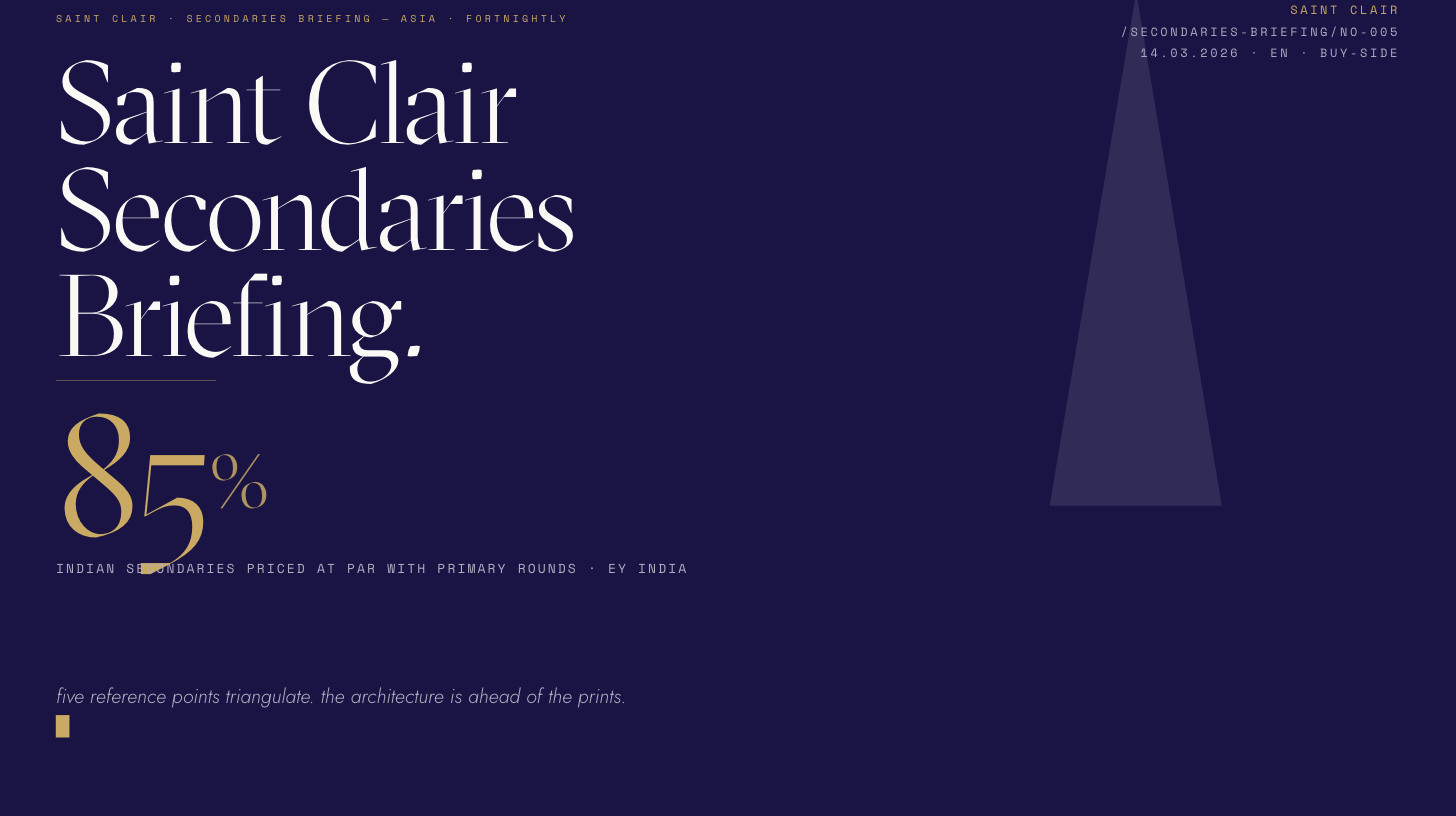
The methodological spread between providers (William Blair records 2025 at $220 billion, Ropes & Gray and Jefferies at $240 billion) is itself informative. Allocators benchmarking against any single provider’s number should expect a ±10% noise band. Edition 3 described the Asian discount band as a four-point frame; CW10 adds a fifth geography. EY India reports 85% of Indian secondary transactions priced at par with concurrent primary rounds, with discounts, where they occur, clustering near 20%. The dispersion across Asian sub-markets has widened.
Inside Korea, the regulatory architecture that Edition 4 described as an operationally closed domestic buyer ring is hardening into institutional form. The Business Development Company regime takes effect 17 March. KVCA chairman Kim Hakkyun used a 12–13 March press conference to propose a KRW 30 trillion KOSDAQ Activation Fund, drawing from the National Growth Fund with policy institutions and pension funds as anchors. 아시아경제’s 5 March analytical reading states what practitioners already suspect: first-cohort BDCs will operate as secondary funds by default. The 60% venture investment requirement combined with a 90-day listing requirement favours vehicles that acquire existing positions over vehicles that underwrite new primary rounds.
The Asian pricing edge remains hidden for a third consecutive edition. La Caisse has not disclosed its China sale clearance level. Morgan Stanley Asia has not disclosed terms on its pan-Asian continuation fund. Jefferies’ data point that five Chinese continuation vehicles closed in 2025, against one in 2024, is the first multi-transaction Chinese reference the market has produced; it means La Caisse, when it clears, will supply the second multi-transaction reference. The architecture is ready. The prints have not landed.
Ropes & Gray Q1 2026 Secondaries Update confirms $240 billion 2025 market; 2026 projected $250 billion
Global · Cross-sector · Ropes & Gray, March 2026
The Q1 2026 Secondaries Update from Ropes & Gray confirms the 2025 global secondary market at $240 billion in transaction volume, a 48% year-on-year increase and the first time the market has broken $200 billion. GP-led volume reached $115 billion (+53% year-on-year), accounting for 48% of total activity; continuation vehicles made up 89% of GP-led transactions. Available capital for secondaries stands at an estimated $477 billion. Jefferies projects $300 billion of annual transaction volume within 12–24 months. Campbell Lutyens forecasts $130–145 billion of new secondaries fundraising over the next year; Evercore calls $200 billion-plus. The Q1 Update is the consolidated full-year 2025 reference allocators have been waiting for; the inside-window publication makes it the anchor print for 2026 allocation conversations.
Jefferies and William Blair publish 2025 reviews; APAC still under 10% of global
Global / Pan-Asian · Cross-sector · Jefferies / William Blair, March 2026
Jefferies’ 2025 Global Secondary Market Review and William Blair’s 2026 Secondary Market Report carry the same headline but not the same data. Jefferies records $240 billion for 2025; William Blair records $220 billion. William Blair projects $250 billion for 2026 with an H1 2026 backlog above $100 billion. Both confirm APAC remains under 10% of global volume, 2–3% on William Blair’s accounting. Jefferies’ underlying detail: five Chinese continuation vehicles closed in 2025, against one in 2024; Jefferies advised on more than 25 APAC transactions totalling $10 billion in 2025. The methodological spread between providers, likely reflecting differing treatment of private credit secondaries and multi-asset vehicles, is the signal for allocators using composite benchmarks.
Jefferies · William Blair · Secondaries Investor summary
EY India: 85% of Indian secondary transactions priced at par with primary rounds
India · VC / PE · EY India, March 2026
EY India’s March note on Indian start-up secondary pricing finds 85% of disclosed Indian secondary transactions priced at par with concurrent primary rounds. Where discounts occur, they cluster in a narrow band averaging approximately 20% below NAV. The data point matters structurally. Indian pricing behaviour is distinct from the reported 40–50% Chinese band, from the Korean policy-anchored discount conventions, and from Campbell Lutyens’ 13.9% global LP-led average. The Asian pricing band Edition 3 described as four points is now five. India clusters near primary; Indian secondary liquidity therefore competes with primary capital willing to accept near-NAV entry, sitting apart from the deeper-discount Asian segments. The dispersion across Asia has widened.
KVCA proposes KRW 30 trillion KOSDAQ Activation Fund
Korea · VC · The Asia Business Daily / Seoul Economic Daily, 12–13 March 2026
KVCA chairman Kim Hakkyun used a 12–13 March press conference to propose a KRW 30 trillion KOSDAQ Activation Fund, structured as a parent fund drawing from the KRW 150 trillion National Growth Fund, with policy institutions and pension funds as anchors, operating horizon up to five years, designed to supply institutional liquidity to the KOSDAQ secondary market and rebalance its individual-investor weighting. The proposal is the first time a serving KVCA chairman has publicly called for a trillion-won KOSDAQ liquidity fund. It signals that Korean venture industry leadership has moved past diagnosis and toward a specific funding architecture for the exit problem downstream of the National Growth Fund. Buy-side allocators approaching 2026 Korean co-investment should read the proposal as an early statement of where Korean policy capital expects to channel in H2 2026 if the concept advances.
The Asia Business Daily · Seoul Economic Daily
Market Intelligence
Korea BDC regime takes effect 17 March. The revised Financial Investment Services and Capital Markets Act establishes Business Development Companies as a new legal vehicle. Fund minimums: KRW 30 billion raised, five-year non-redeemable term, 60% in high-potential venture companies, 10% in safe assets, KOSDAQ listing within 90 days of establishment. 아시아경제’s 5 March read is that the 60% venture requirement combined with the 90-day listing window favours BDCs acquiring existing positions over those underwriting primary rounds: first-cohort BDCs will in practice operate as secondary funds. The regime formalises a third route for Korean domestic secondary demand, alongside the financial-group VC ring (Edition 4) and the KVIC general-secondary sub-fund category. Kim & Chang · FSC · Asia Business Daily
Deloitte and KPMG APAC barometers converge on a post-2021 distribution turn. Exit value +24% year-on-year in 2025; net cash flows to investors turned positive for the first time since 2021; dry powder fell from a 2023 peak of $315 billion to approximately $240 billion at end-2025. Secondary exits accounted for 25% of deal count and 30% of value across APAC in H1 2025. The SEA 5+ year hold overhang continues to grow (+18% vs 2024). The secondary channel remains the operating release valve. Deloitte · KPMG
Korea 2026 venture fund target KRW 4.4 trillion; Mother Fund contribution doubles. Ministry of SMEs and Startups confirms the 2026 venture fund creation target at KRW 4.4 trillion, supported by KRW 2.1 trillion in Mother Fund (모태) contributions, approximately double the 2025 commitment. KVIC’s 2026 1차 정시 applications closed 26 February at KRW 2.144 trillion across 13 categories including segmented secondary brackets; GP selection scheduled for April. The doubling is the scale of domestic Korean co-investor underwriting for 2026. KoreaTechDesk
Japanese domestic secondary architecture matures. NGS Partners discloses that acquisitions from Japanese LPs and of Japan-focused fund positions now exceed 80% of predecessor-fund investment volume; domestic LP-side supply has overtaken cross-border inbound as the primary deal source. WTW Japan and Lincoln International (via Nikkei Financial) frame Japan’s CV growth as moving from single-manager exceptions toward a broader GP-led wave driven by 2015–2018 vintage ageing. No transaction-level Japanese GP-led CV print in CW10; the institutional infrastructure is being narrated in Japanese-language primary sources. NGS Partners · WTW Japan · Lincoln International
SCMP: Asian wealth-channel capital flows into global rather than regional secondaries. Asian investors accounted for more than half of subscriptions to a $1.2 billion secondary fund co-managed by Franklin Templeton and Lexington Partners. The buy-side thinning thesis from Edition 3 is partially funded by Asian capital that is not returning to Asian assets. SCMP
More than 10% of MSS-designated Korean unicorns cannot transact secondary shares. Zigbang, Ridi, Tridge, IGAWorks among them. IPO delays and persistent losses are eroding demand for late-stage Korean venture positions. The domestic buyer cohort is assembled; the asset population it faces concentrates write-down risk. Through H1, the question is whether discovered pricing emerges through selection pressure or through forced realisation. KoreaTechDesk
Regional Context
Two H1 prints still define the regional frame. La Caisse’s US$1.5 billion China PE secondary sale (stakes in HSG, formerly Sequoia Capital China; Warburg Pincus; Boyu) remains in active phase through CW10 without disclosed clearance. Morgan Stanley Asia’s pan-Asian continuation fund, announced inside CW08, remains without disclosed terms, anchor identity or size. The Asian LP-led pricing reference for H1 hinges on La Caisse; the pan-Asian platform CV benchmark hinges on Morgan Stanley Asia. Both continue to build while the consolidated global print (Ropes & Gray Q1) lands around them.
For European allocators: the 2025 global reference is now a firm $240 billion anchor; Asian transaction-level references remain inferred rather than observed; architectural readiness is documented through Korean regulatory activation and Japanese domestic market maturation; clearance-level visibility is the missing layer.
Signal
A three-edition pattern has emerged in the 2026 Asian secondary market. The architecture is ahead of the prints.
Consider the evidence Edition 5 assembles. Korea’s regulatory stack is now triple-layered: the financial-group VC secondary ring assembled through February (Edition 4), the BDC regime activating 17 March, and the KRW 30 trillion KOSDAQ Activation Fund proposed by KVCA’s chairman on 12–13 March. Japan’s domestic secondary architecture has reached pre-disclosure visibility in Japanese-language primary sources, with NGS Partners at 80% domestic supply and WTW Japan and Lincoln International narrating the GP-led wave before transaction-level disclosures land. India has entered the Asian pricing frame with disclosed near-par behaviour, widening the dispersion further. Chinese CV volume tripled in 2025.
And yet. No Asian LP-led clearance has printed inside CW10. Morgan Stanley Asia has not disclosed. La Caisse has not cleared. Korean domestic secondary pricing remains inferred from the standing cohort; a transacted benchmark has yet to land. Ropes & Gray’s Q1 Update gives allocators a global anchor; the Asian anchor stays absent.
The implications fall in three directions. First, allocators should now underwrite Asia on the assumption of a five-point pricing band: Campbell Lutyens’ 13.9% global average, the Freshfields/ADIA/CDH 36% Asian CV anchor, the reported 40–50% China band, the forthcoming Morgan Stanley Asia level, and EY India’s near-par behaviour. The band will hold its width through H1. Any single Asian price input remains a segment reference; the market reference is the band itself.
Second, the Korean policy stack (financial-group VCs, BDC first cohort, KVIC 1차 정시 general secondary and small-scale secondary brackets, the proposed KOSDAQ Activation Fund) is designed to absorb domestic Korean secondary supply at domestically discovered pricing. Foreign allocators approaching Korean processes in H1 should expect the domestic cohort to be the binding counterparty; price discovery sits elsewhere. Discovered pricing will emerge from the friction between this domestic architecture and the unicorn asset population flagged by KoreaTechDesk: selection pressure versus forced realisation.
Third, Japan is the market to watch for the next transaction-level Asian print. The Japanese-language documentation inside CW10 marks architectural readiness. When a 2015-vintage Japanese GP-led CV prints at disclosed terms, which the Lincoln International and NGS Partners framing suggests is a 2026 rather than a 2027 event, it will reset the Asian CV pricing conversation outside the China context that has defined it through H1.
The pattern holds: architecture first, prints later. The question through CW12 and CW14 is whether the first transaction-level Asian print of H1 closes the gap, or whether the architecture continues to outrun the clearance evidence for a fourth consecutive edition.
Saint Clair Secondaries Briefing — Asia. Fortnightly. Published by Saint Clair Pte. Ltd., Singapore.
The briefing is editorial intelligence. It is not investment advice.
© 2026 Saint Clair Pte. Ltd.
Disclaimer: This briefing is for informational purposes only and does not constitute investment advice. All decisions should be made based on independent research and consultation with qualified advisors.
About Saint Clair: Saint Clair designs and builds cross-border capital infrastructure between Europe and Asia — proposing access where access is scarce, and creating structure where structure is absent. Since 2016.