
Saint Clair Secondaries Briefing — Asia
Edition 11 · 13–26 May 2026
Saint Clair Capital · Ground Truth | May 2026
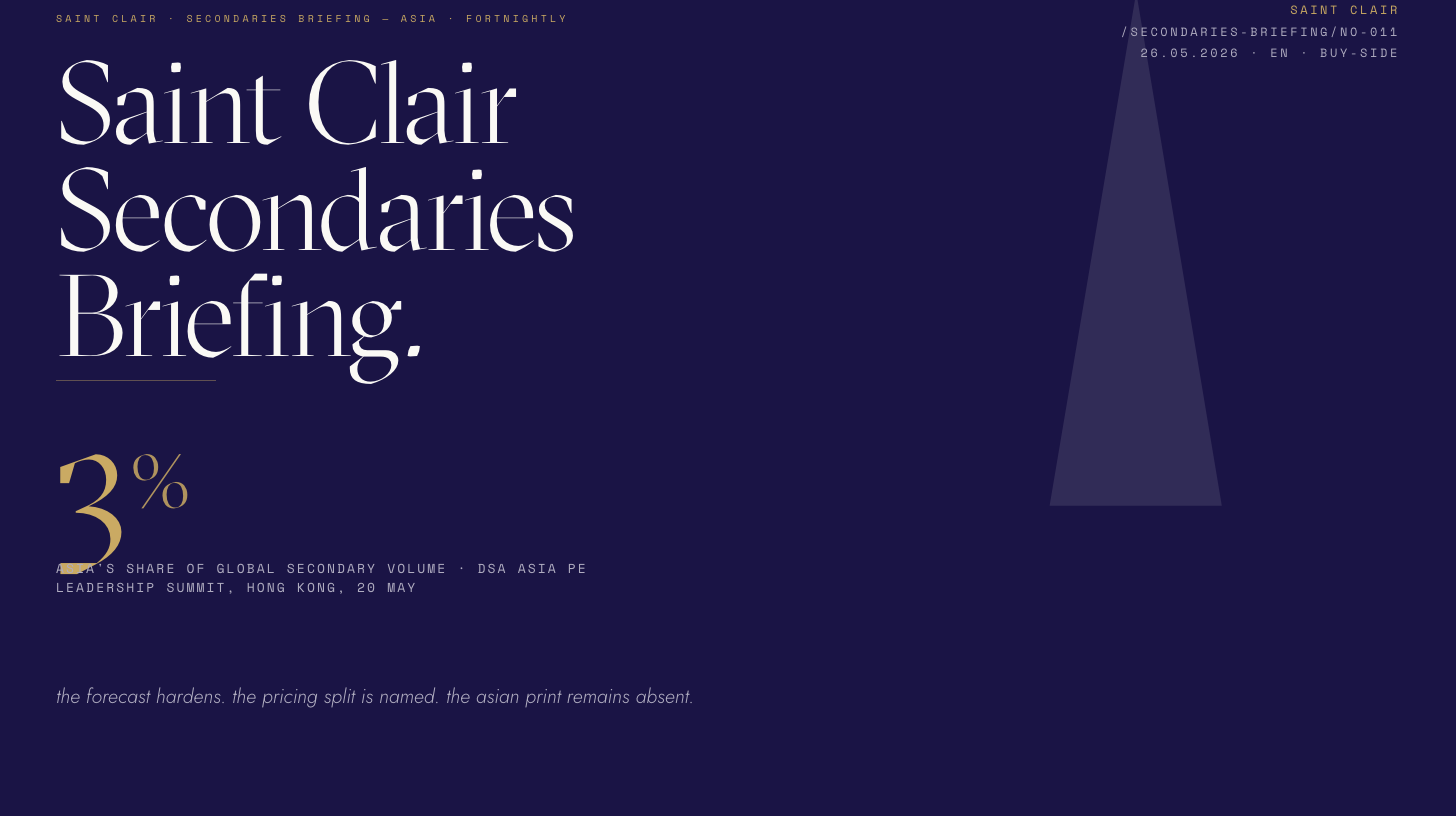
Asia’s secondary market spent the fortnight describing its own breakout. A Hong Kong summit put the region at 3 per cent of global volume. It named the second half of 2026 as the timing. It set out the pricing split the breakout will run on. Korea widened its bank-funding base. The only completed LP-led print of size was Canadian. The forecast sharpened. The Asian transaction did not arrive.
Hong Kong summit puts Asia at 3 per cent of global secondary volume
Pan-Asian · Both · DealStreetAsia, 20–21 May
At DealStreetAsia’s first Asia Private Equity Leadership Summit, a secondaries panel put the region at roughly 3 per cent of global LP-led and GP-led volume. That is far below its share of private equity assets. Partners Group, Coller Capital and Evercore expect Asian flow to grow through the second half of 2026. Funds of the 2017–20 vintage have reached five to eight years old, with weak distributions.
The summit named the pricing structure. Asia-focused LP-led portfolios trade at wider discounts than US or European equivalents: a smaller buyer base, less predictable venture and growth exits. GP-led deals on quality assets draw firm bids. The read is clean. The LP-led discount is the Asian entry point. The GP-led premium is not.
DealStreetAsia · DealStreetAsia
The drag is not geopolitics — it is AI
Pan-Asian · Both · DealStreetAsia, 22 May
Summit panellists reported no slowdown from the Middle East conflict. Evercore said no LP-led process had been paused. Partners Group described sellers “pushing up the sales by a quarter”. Coller Capital cited first-time sellers and large regional LPs returning after two years away.
The pressure on price came from elsewhere. Panellists described a “war on enterprise software”, with buyers marking down software and private-credit holdings on AI-disruption fear. Sellers now strip tech-heavy managers out of sale portfolios to protect headline pricing. OMO Capital flagged a growing “cliff” of 15-to-20-year-old funds feeding tail-end deals. Buyers should expect Asian books split in two: a clean book and a tech book.
Korea cuts the capital charge on bank money for its National Growth Fund
Korea · Both · Herald Business, 18 May
Korean financial authorities have cut the risk weight on commercial-bank investment in the National Growth Fund from 400 per cent to 100 per cent. That is a four-fold reduction in the capital a bank holds against the position. A 5 per cent subordinate-tranche loss buffer accompanies it. The relief is specific to the policy fund.
Korean banks have avoided private equity LP commitments for years. The Basel charge made them uneconomic. This opens the channel. Bankers quoted in the Korean press call it a “marketing point” for selected GPs. The IB desks warn it will split fundraising between shortlisted and rejected managers. The buyer base for Korean GP-led secondaries gets wider. But only for the policy-favoured.
Bain Capital closes its sixth Asia fund at US$10.5 billion
Pan-Asian · Both · Bain Capital, 17 May
Bain Capital closed Asia Fund VI at US$10.5 billion, against an original US$7 billion target. Of that, US$9.1 billion came from external investors and US$1.4 billion from the firm itself. The fund deploys across Japan, India, China, Australia and Korea.
The close is the third pan-Asia mega-fund in thirteen months, after KKR’s US$15 billion vehicle and EQT BPEA’s US$15.6 billion. Together they hold some US$41 billion of primary buyout dry powder. That capital builds the portfolio universe Asian secondary buyers will price against later. The buyer base for LP-led trades stays thin. The asset base beneath it does not.
MUFG and Goldman test risk transfer on loans to private funds
Japan / Pan-Asian · Buy-side · Caproasia, Bloomberg, 13–15 May
Within one week, two banks floated synthetic risk transfers tied to fund-finance exposure. MUFG sounded investors on roughly US$200 million of first-loss protection against US$2 billion of loans to listed private-credit funds. Goldman Sachs floated a transfer linked to a multi-billion-dollar portfolio of subscription-line loans, with first-loss sized near 10 per cent.
Neither trade moves a fund stake. Both free bank capital held against lending to private funds, including Asian-deploying ones. If investors absorb this risk at scale, banks keep room to extend new credit lines. That eases the financing constraint behind the thin buyer base. Risk transfer is becoming a liquidity tool that sits beside the secondary market, not inside it.
A C$4 billion LP-led print clears — in Canada, not Asia
North America · Buy-side · DealStreetAsia, 21 May
Canada Pension Plan Investment Board sold 33 private equity fund interests to Blackstone Strategic Partners and Ardian. The portfolio was built over two decades. Net proceeds came to about C$4 billion (US$2.9 billion). CPP’s head of secondaries called the fund “a systematic buyer and seller”. The underlying funds are not disclosed as Asia-weighted.
The transaction is not an Asian secondary. It earns a place here for the buyers. Blackstone Strategic Partners runs about US$100 billion. Ardian manages or advises some US$200 billion. These are the same desks Asian sellers will face. A print this size shows the capital and pricing discipline are ready. The fortnight’s lesson is that they were exercised on a Canadian seller, not an Asian one.
Market Intelligence
Korea names its National Growth Fund shortlist. KDB and Shinhan Asset Management confirmed a 22-firm shortlist across seven leagues on 15 May, roughly twice the 11 final slots. The structure runs an explicit GP-development ladder, rookie to large. Securities firms have entered as co-GPs. Final selection is due end-May. Etoday
Continuation-vehicle terms hold steady. Morgan Lewis’s 2026 study of 169 continuation vehicles found 97 per cent charge management fees of 1 per cent or less. Another 79 per cent use tiered carry. The firm expects continuation vehicles to deliver at least a fifth of private-market distributions this year. Morgan Lewis
Korean institutional buyers declare for secondaries. Kiwoom Asset Management said it will consider LP-led and GP-led secondaries across asset classes in 2026. GEPS, the government employees’ pension, will look at private equity, debt, real estate and infrastructure. Both join NPS, KIC and Korea Post on the Korean buy-side roster. Secondaries Investor
TR Capital exits Lenskart on lock-up expiry. TR Capital, a Hong Kong secondaries firm, fully exited Indian eyewear group Lenskart on 8 May. It sold through a ₹5,314 crore block trade, the day the post-IPO lock-up ended, at a 3 per cent discount to the prior close. BusinessToday
Signal
Edition 10 watched the architecture harden ahead of the print. Edition 11 watched the forecast harden too.
The summit did the market a service. It put a number on Asia at 3 per cent of global volume. It put a date on the breakout in the second half of 2026. And it set out the structure of the price: LP-led wide, GP-led firm, tech sold on its own. Korea widened the bank-funding channel beneath all of it. None of this is a transaction. The fortnight’s one completed LP-led print of scale belonged to a Canadian pension, bought by the two desks an Asian seller would also meet. We assess the gap between forecast and execution as the open question. The capital is identified. The pricing model is now public. What is missing is an Asian seller willing to test either against a real book. The first to do so will not lack for buyers or comparables. It will simply be late, and the comparables now set the terms.
Saint Clair Secondaries Briefing — Asia. Fortnightly. Published by Saint Clair Pte. Ltd., Singapore.
The briefing is editorial intelligence. It is not investment advice.
© 2026 Saint Clair Pte. Ltd.
Disclaimer: This briefing is for informational purposes only and does not constitute investment advice. All decisions should be made based on independent research and consultation with qualified advisors.
About Saint Clair: Saint Clair designs and builds cross-border capital infrastructure between Europe and Asia — proposing access where access is scarce, and creating structure where structure is absent. Since 2016.