
Saint Clair Secondaries Briefing — Asia
Edition 9 · 14–28 April 2026
Saint Clair Capital · Ground Truth | April 2026
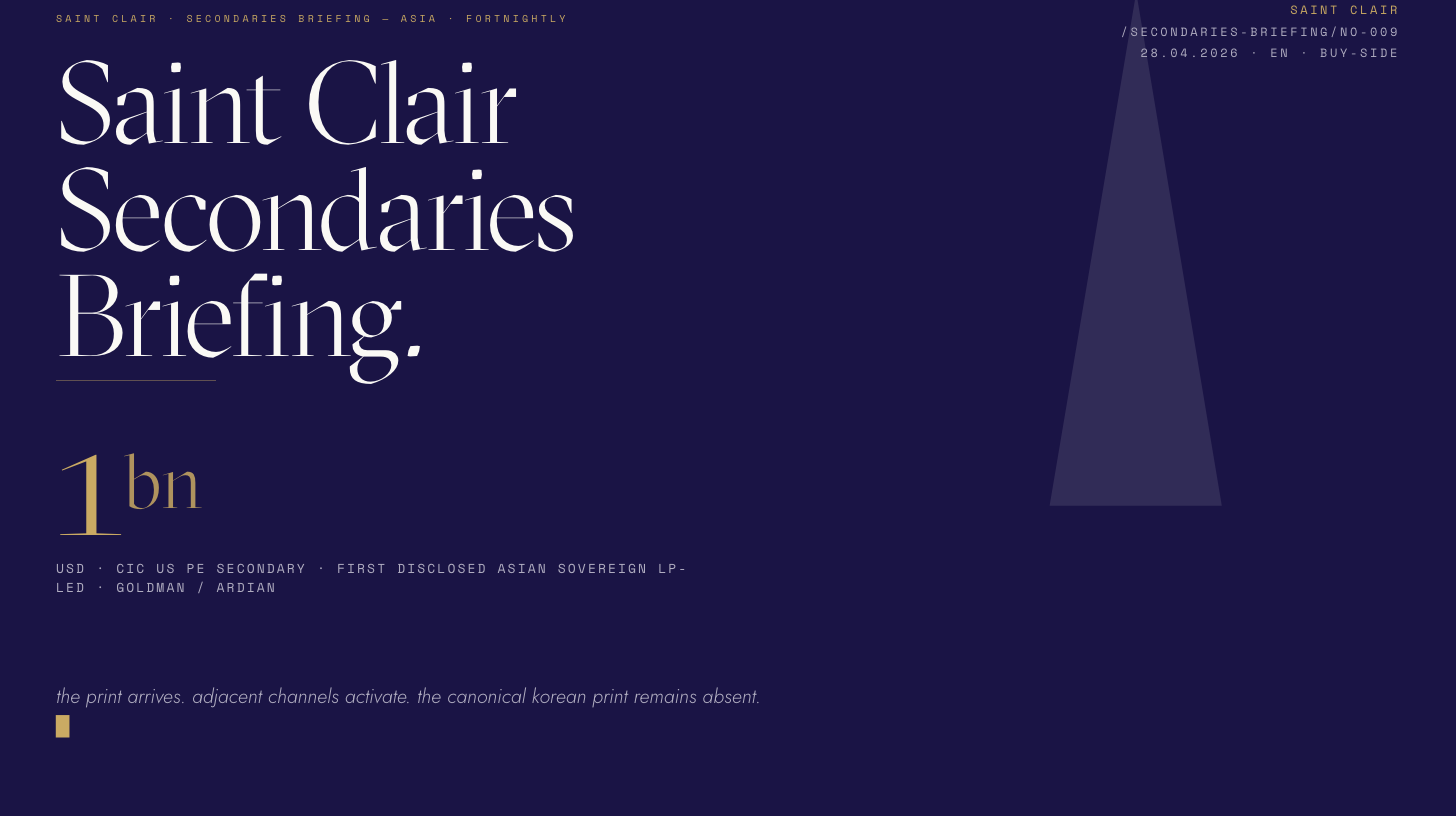
The fortnight produced disclosure of a shape Edition 8 did not anticipate. China Investment Corporation’s USD 1 billion US PE portfolio cleared to Goldman Sachs Asset Management and Ardian at disclosed pricing. Shinhan Asset Management launched Korea’s first Business Development Company with an explicit secondary allocation. EcoBit, an IMM-controlled platform, signed to acquire a Korean environmental asset from VL Investment in a Korean PE-to-PE secondary buyout. None of the three is a Korean domestic LP-led print. Each is a different liquidity path opening while the canonical Korean LP-led print remains absent.
CIC USD 1 Billion US PE Portfolio Cleared — First Disclosed Asian Sovereign-Seller LP-Led at Scale
Greater China · LP-led · Bloomberg, 14 April 2026
China Investment Corporation has sold a portfolio of approximately USD 1 billion in US private equity fund stakes to Goldman Sachs Asset Management and Ardian, with Evercore advising and the transaction closing in late 2025. Bloomberg disclosed the trade on 14 April. Underlying positions include vehicles managed by Blackstone, Carlyle and six other US managers. Pricing was disclosed in the same report: Goldman Sachs Asset Management acquired its share at a single-digit discount to NAV, Ardian at a double-digit discount.
The print matters on three counts. It is the first publicly disclosed Asian sovereign-seller LP-led secondary on a North American underlying at this scale. The pricing band, running from a single-digit to a double-digit discount depending on buyer, establishes a hard reference against which subsequent Asian sovereign paper will transact. The route, advised by Evercore and cleared through two global platform buyers, replicates the Nan Shan / Fubon / Ping An pattern, now extended from insurer sellers to a sovereign seller. CIC is Asia’s largest sovereign LP. A clearance reference is now in the public record.
EQT BPEA IX Final Close at USD 15.6 Billion — Largest Asia-Pacific PE Fund Raised
Pan-Asian · Buy-side · EQT Group, 20 April 2026
EQT closed BPEA Private Equity Fund IX at USD 15.6 billion in total commitments (USD 14.9 billion fee-generating), oversubscribed and now the largest Asia-Pacific dedicated PE fund raised to date. Pension funds and SWFs led contributions among more than 75 new investors; the fund is already 5–10% invested.
The close lands against a 2025 Asian primary fundraising figure at a 12-year low. The two-tier dynamic continues: global incumbents concentrate dry powder while mid-sized Asian GPs face LP pressure that will produce secondary supply. EQT’s enlarged Asia portfolio will generate continuation-vehicle and LP-led opportunities across vintages now in the ground. LP access constraints in BPEA IX itself will produce primary-rejection capital seeking secondary entry.
Partners Group Eighth and Ninth Secondaries Programmes Close — Asia-Pacific LPs Lead, Asia Allocation Lifted
Pan-Asian · Buy-side · Secondaries Investor, 17–20 April 2026
Partners Group closed its eighth flagship PE secondaries programme above USD 9 billion, with the largest individual commitments from Asia-Pacific investors and approximately one-third of new commitments from outside Europe. The programme is already 60% committed, with 5–20% allocated to Asian underlying. The ninth programme also closed above hard cap; the firm guides that its Asian allocation has been lifted relative to prior vintages, driven by continuation-vehicle deal flow from Japanese and Korean GPs and widening discount-to-NAV on Asia-exposed portfolios.
Two reads run in parallel. Asia-Pacific LPs are increasingly significant capital providers on global secondaries programmes, consistent with appetite at Korean and Japanese institutional level. On the deployment side the Asia weight remains a minority sleeve. The eighth programme deploys mostly outside Asia; the ninth lifts Asia weight without disclosing the magnitude.
Secondaries Investor — eighth programme · Secondaries Investor — ninth programme
Cerberus / SubCom USD 2.3 Billion Single-Asset CV — Digital Infrastructure Pricing Reference
US-Global · GP-led · Alternatives Watch, 20 April 2026
Cerberus Capital Management closed a USD 2.3 billion single-asset continuation vehicle for Subsea Communications, a US-headquartered subsea fibre-optic cable systems supplier. CVC Secondary Partners led; Evercore advised; Cerberus-managed funds (including from the Supply Chain strategy) co-invested and retain controlling ownership. The transaction is US-underlying; its relevance to Asia runs along two axes.
First, it sets a pricing reference for single-asset CVs in digital-infrastructure assets at USD 2 billion-plus scale in a subdued 2026 exit environment. Asian GPs preparing first continuation vehicles around data-centre, subsea-cable and tower portfolios now have a comparator. Second, CVC Secondary Partners’ willingness to anchor at this size confirms that capital concentration among global lead investors prices single-asset CVs across geographies, not only North America. The same dynamic prices Asian LP-led paper.
Shinhan AM Launches Korea’s First BDC — 60% Allocation to Innovation and Secondary Investment
Korea · LP-led · Seoul Shinmun, 22 April 2026
Shinhan Asset Management has launched Shinhan Innovative Enterprise Growth Investment Trust No. 1 (신한혁신기업성장투자신탁제1호), the first product of any kind under the Korean Business Development Company regime that came into force in March. The vehicle commits at least 60% of assets to a combined strategy of innovation-company investment and LP-stake secondary acquisition. Management sits with the Innovation Investment Finance division at Shinhan AM. Initial subscribers are institutional and professional investors, with progressive listing as retail tax treatment is finalised. Parallel coverage carried by Newspim, Herald Economy, FN News, Digital Daily, News1, Digital Times and Edaily.
The launch operationalises the framework Edition 8 noted as still without products. The first named BDC fund explicitly tags secondary acquisition as part of its primary mandate. That confirms the operating-model thesis that Korean BDCs in their initial phase function as listed secondary-fund vehicles, with the 60% allocation requirement and the structural fit between listed-vehicle liquidity and LP-stake acquisition driving the choice. Follow-on launches from KB Asset Management, Mirae Asset Management and Samsung Asset Management are expected within weeks rather than months.
EcoBit / IMM × VL Investment / K-Eco — Korean PE-to-PE Secondary Buyout, KRW ~140 Billion
Korea · PE · Bloter, 26 April 2026
EcoBit, the waste-management platform IMM acquired from TY Holdings/KKR in December 2024 for KRW 2.07 trillion, has signed a share-purchase agreement to acquire 100% of K-Eco from VL Investment for approximately KRW 140 billion. Bloter, citing IB sources, framed the transaction as “effectively a secondary deal between PEF managers.” K-Eco is a North Chungcheong landfill site near Eumseong, completed in the second half of 2024 and largely permitted but not yet in commercial operation. For VL Investment, an environmental and energy-focused Korean PEF, the sale provides partial liquidity ahead of fund-cycle pressure on its broader Korean portfolio. For IMM, it extends EcoBit’s incineration–landfill–recycling vertical.
Sponsor-to-sponsor secondary buyouts at the portfolio-company level sit beside the LP-led, GP-led and continuation-vehicle taxonomy as a distinct exit route, closer to M&A than to a fund-stake transfer. Korean GPs are increasingly using it where IPO and trade-sale routes remain narrow. Watch whether further Korean PEF-to-PEF asset transfers cluster as a 2026 exit pattern. If they do, the Korean liquidity stack will have expanded along a route that bypasses the secondary advisory channel altogether.
Temasek / Azalea Plans Evergreen PE Fund with Secondaries as Core Underlying
SEA · Buy-side · Reuters via Manila Times, 23 April 2026
Azalea Investment Management, the Seviora Holdings unit indirectly owned by Temasek, plans to launch an evergreen PE fund later in 2026, market conditions allowing. CEO and CIO Chue En Yaw told Reuters that secondaries are among the most suitable underlying strategies for the evergreen structure, citing their cash-generative profile, with co-investments as a complementary engine. The product is being developed in parallel with Singapore’s March 2025 long-term investment fund framework that may eventually allow retail access to certain private-market funds.
The signal sits alongside Korean buy-side appetite for credit secondaries and Korean BDC operationalisation as a regional expansion of secondaries demand on the buy-side. Azalea’s Altrium programme has prior Japanese and Korean LP participation, which makes the platform a credible distribution channel into Asia institutional pools now leaning toward secondary entry as a defensive route into private markets.
Korean LP Appetite for Credit Secondaries — Samsung AM Names the Strategy
Korea · Private credit · Secondaries Investor, 14–16 April 2026
Two Secondaries Investor pieces, on 14 and 16 April, describe Korean buy-side appetite from named-institution and thematic angles. Samsung Asset Management’s head and OCIO Cho Seong-Sup is quoted that credit secondaries and co-investments “can provide us with some downside protection against the macro flows rather than going with the flow as part of the herd.” Samsung AM holds KRW 350 trillion-plus at parent group level. Cho’s framing positions the segment as counter-cyclical entry through the secondary discount.
This is the first named Korean institutional-asset-manager declaration on credit secondaries. Korean institutional credit-secondary capacity has historically lagged the equity-secondary pool; a Samsung AM allocation establishes an addressable Korean buyer pool at a moment when credit-secondary pricing benchmarks are still forming.
Secondaries Investor — Samsung AM · Secondaries Investor — Korean LPs thematic
SMTB × Hunter Point Capital — Japanese Institutional Alternatives Capacity-Building
Japan · GP-stakes · Nikkei Asia, 25 April 2026
Sumitomo Mitsui Trust Bank has formed a capital tie-up with Hunter Point Capital, the GP-stakes investor that closed a USD 3.3 billion debut fund in 2024. Stake size and terms have not been disclosed. HPC has been building Tokyo coverage since appointing Peter Rosenbloom Head of APAC in January 2025. The tie-up channels Japanese institutional capital toward GP-economic interests in alternative managers.
Read alongside SMTB’s 2022 USD 1.5 billion Apollo–Athene partnership and the firm’s March 2026 Raymond James US tie-up, this is continued Japanese institutional alternatives capacity-building — partnership architecture upstream of any future transaction. Track whether the tie-up produces onshore Japanese capital deployable into Asian GP-stake or secondary strategies, and whether HPC’s Asia coverage, now anchored on a Japanese partner, shifts its sourcing toward Korean or Japanese GP-economic interests.
La Caisse USD 1.5 Billion China Sale — Underlying GPs Now Disclosed, Buyer Still Absent
Greater China · LP-led · Private Equity Insights, 23 April 2026
La Caisse, the renamed CDPQ, has formally put approximately USD 1.5 billion of China-focused PE fund stakes up for sale, with Greenhill mandated as adviser. Underlying positions are reported to include fund stakes in vehicles run by HSG (formerly Sequoia Capital China), Warburg Pincus and Boyu Capital. Buyer is not disclosed. The sale extends the Bloomberg signal first reported in February, now characterised as La Caisse’s first China-specific LP-led sale and consistent with its 2023 Shanghai-office closure.
The Edition 8 read on this trade was that sustained non-disclosure on a named, advised process is itself a market signal. That read holds. Underlying-GP names and adviser are now public; pricing and the buyer side remain undisclosed. Reported discount ranges on China-focused LP paper continue to run up to 30%. Until a buyer prints, the reserve-to-bid gap remains the most durable pricing information the Chinese-underlying secondary segment is currently producing.
Market Intelligence
KVIC Mother Fund 2026 First Regular Round — secondary tracks shortlisted, final selection imminent. Korea Venture Investment Corp has shortlisted nine GPs across two secondary tracks for second-stage oral presentation. Secondary Small allocates a KRW 20 billion KVIC anchor across six candidates with child funds of at least KRW 40 billion each. Secondary General allocates KRW 60 billion across three candidates with child funds of at least KRW 150 billion each. Aggregate KVIC anchor commitment to the secondary segment in this round is KRW 80 billion; aggregate child-fund formation target is at minimum KRW 190 billion. The 2026 First Regular Round runs at twice the 2025 scale. Final selection is scheduled within April. The round is vintage-determining: Korean policy capital is sizing the secondary segment as a stand-alone allocation line. Newstop
Korean VC top-twenty earnings double in 2025; KIP and Mirae Asset Venture lead. Korea Economic Daily data on 19 April put combined operating profit across the top twenty Korean VC firms at roughly USD 218 million for 2025, more than double the prior year. KIP and Mirae Asset Venture top the cohort; Atinum, Woori Venture Partners, SBVA, IMM Investment, KB Investment, Smilegate and DSC also placed. The recovery is markup-driven, sourced from KOSPI and KOSDAQ exits and portfolio-valuation reset. For secondary pricing this resets the reference points against which Korean VC paper will next clear. KED Global
NPS to ease single-fund rule for Korean VC managers. South Korea’s National Pension Service intends to relax its single-fund rule, which has restricted senior portfolio managers at NPS-backed Korean VC houses from running multiple funds concurrently. The change relaxes a structural constraint on senior bench deployment across successor and specialist vehicles, including continuation-vehicle stewardship. NPS is acting as an LP on its allocation policy. KED Global — NPS Watch
Korea brokerage-led KRW 2 trillion secondary fund — discussion continues. Korean brokerage firms and related institutions remain in discussion on a KRW 2 trillion (approximately USD 1.3 billion) secondary fund to absorb 2021 to 2022 vintage VC positions that cannot clear through IPO or M&A. Sponsors, anchor LPs and fund design are not yet disclosed. If launched at anything close to headline size, the vehicle would reset the scale of Korean domestic secondary buying capacity, where current vintages cluster at KRW 100 billion to KRW 400 billion per fund. KED Global
Golden Gate Ventures USD 150 million secondary tender on Fund II. Singapore-based Golden Gate Ventures is running a tender offer to raise approximately USD 150 million through a secondary sale of stakes in seven SE Asian portfolio companies held by its second fund. The structure is a GP-led tender on a SEA-focused VC portfolio. Buyer identity has not been publicly disclosed. The transaction extends the SEA VC continuation-vehicle and tender pattern visible earlier in 2026 around Navis Capital and broader regional GP-led activity. DealStreetAsia
Bain SEA PE 2025 deal value at USD 14.3 billion, exit activity constrained. Bain & Company’s Southeast Asia PE Pulse 2026 puts 2025 SEA PE deal value at approximately USD 14.3 billion across 84 transactions, down roughly 10% year-on-year. Exit activity remains constrained. The data confirms a sustained holding-period extension in SEA PE that has been driving GP-led CV adoption and LP-led portfolio sales as alternative liquidity routes. For pan-Asian LP-led portfolios marketed in 2026, the SEA primary compression alongside flat-to-rising Korean and Japanese activity narrows the relative-value case for SEA underlying versus North Asian. Crowdfund Insider
Signal
The fortnight printed three transactions and one fund launch that together describe a market reorganising itself around an absent benchmark.
The absent benchmark is the Korean domestic LP-led print. It has not arrived. Edition 7 anticipated it would matter out of proportion to its size. Edition 8 noted the voluntary channel was idle in the Korean domestic cohort. Edition 9 records that the cohort remains idle while the surrounding architecture continues to harden.
What did print is instructive. CIC cleared a USD 1 billion US-underlying portfolio at disclosed pricing through Goldman and Ardian. Shinhan AM launched the first Korean BDC with an explicit 60% allocation to innovation and LP-stake secondary acquisition. EcoBit signed to acquire K-Eco from VL Investment for KRW 140 billion in a sponsor-to-sponsor structure that bypasses the secondary advisory channel. Three transactions, three different liquidity routes. The Korean fund-stake LP-led print remains absent from the set.
The pattern reads as adjacent-channel substitution. Where the canonical structure does not move, capital and assets find adjacent paths. Korean institutions are pivoting toward credit-secondary buy-side roles. Korean GPs are exiting via PE-to-PE asset transfers. Korean retail-listed structures are absorbing LP stakes through the BDC route. Foreign sovereigns and insurers are clearing via global platform buyers on non-Korean underlying. Each route generates a partial pricing signal. None of them, in this fortnight, generated a Korean-domestic LP-led reference.
Two consequences follow. The first Korean LP-led print, when it arrives, will price into a structure that has substantially formed without it. Its reference points are now external: the CIC band, the Cerberus single-asset comparator, the Partners Group capital-formation evidence. The second consequence is more subtle. Each adjacent channel that activates reduces the pressure for the canonical print. Korean GPs that exit via sponsor-to-sponsor can defer LP-led process design. Korean LPs that buy credit secondaries can defer selling fund stakes to fund the allocation. The architecture that hardens around the absent print also raises the cost of disclosure, because the disclosure itself sets a benchmark that competitors will use against the seller in the next round.
The print has not arrived. The system is adjusting. A first domestic Korean LP-led print is still expected in 2026, but at this point the surrounding infrastructure may matter more than the moment itself.
Saint Clair Secondaries Briefing — Asia. Fortnightly. Published by Saint Clair Pte. Ltd., Singapore.
The briefing is editorial intelligence. It is not investment advice.
© 2026 Saint Clair Pte. Ltd.
Disclaimer: This briefing is for informational purposes only and does not constitute investment advice. All decisions should be made based on independent research and consultation with qualified advisors.
About Saint Clair: Saint Clair designs and builds cross-border capital infrastructure between Europe and Asia — proposing access where access is scarce, and creating structure where structure is absent. Since 2016.