
Saint Clair Secondaries Briefing — Asia
Edition 10 · 29 April – 12 May 2026
Saint Clair Capital · Ground Truth | May 2026
The architecture for Asian secondaries is hardening faster than the Korean voluntary print can arrive. Two more independent advisers were absorbed into global platforms. Sovereigns sat on both sides of the largest disclosed processes. Korean policy capital anchored a 7 per cent return floor on the secondary segment. Each new external reference raises the bar the eventual Korean print must clear.
Lazard buys Campbell Lutyens for USD 575 million
Pan-Asian · Adviser-side · Secondaries Investor, 30 April
Lazard signed a definitive agreement to acquire Campbell Lutyens for USD 575 million, with up to USD 660 million after earn-out. The combined unit will trade as Lazard CL under co-CEOs Holcombe Green and Gordon Bajnai. It will run about 280 advisory professionals against an estimated 2027 revenue run-rate near USD 500 million. Closing is targeted for the second half of 2026.
This is the second top-tier independent secondaries adviser absorbed into a larger platform in four months — EQT took Coller in January. Two of the three benches Asian sponsors have used for first LP-led and GP-led mandates now sit inside global institutions with cross-sell agendas. Korean and Japanese GPs preparing first continuation vehicles will negotiate against a thinner independent panel at the precise moment Asian flow is accelerating.
ADIA named preferred bidder on La Caisse’s USD 1.5 billion China sale
Greater China · LP-led · DealStreetAsia, 30 April
Abu Dhabi Investment Authority has emerged as preferred bidder on La Caisse’s USD 1.5 billion China-focused private equity secondary. The underlying positions sit in fund stakes managed by HSG (formerly Sequoia Capital China), Warburg Pincus and Boyu Capital. Greenhill is advising the seller. Pricing has not been disclosed, and ADIA is named preferred rather than final.
Both directions of 2026’s largest Asian-underlying processes have now closed through sovereign vehicles. ADIA bought from La Caisse. Goldman Sachs Asset Management and Ardian bought from CIC. Sovereign buyers hold longer than private secondaries funds and take more concentration. When the La Caisse price prints, it will sit alongside the CIC band as the second reference for Asian-underlying clearance.
KVIC finalises nine secondary GPs at a 7 per cent IRR threshold
Korea · Sell-side · Bloter, 29 April
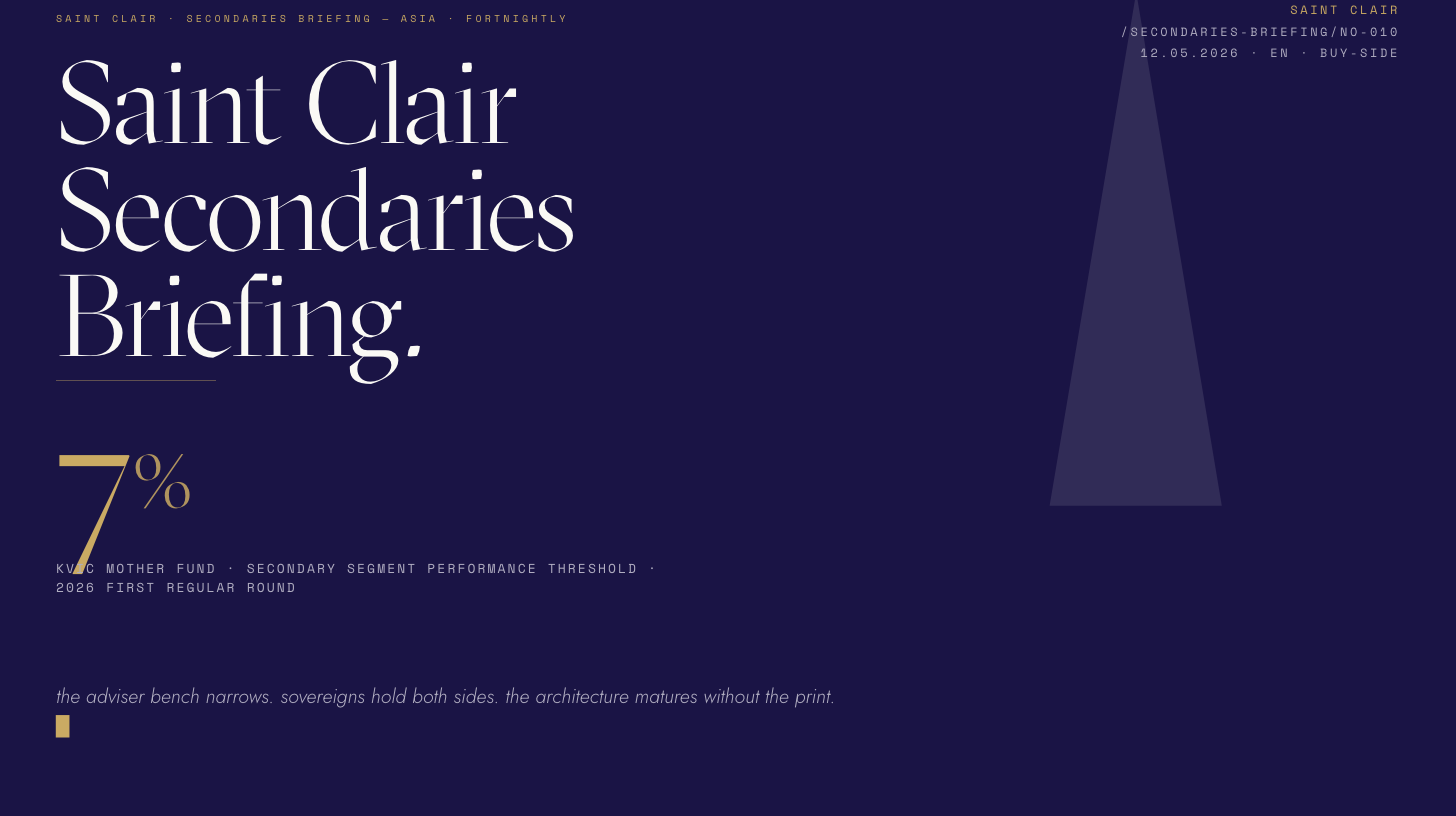
KVIC and the Ministry of SMEs and Startups confirmed nine secondary GPs in the 2026 First Regular Round of the Mother Fund on 29 April. Three sit in the general bucket; six in the small bucket. The performance-fee threshold is 7 per cent IRR — joint-highest in the programme. Aggregate child-fund capital in the secondary segment is KRW 140 billion, formed within three months of selection.
Korean policy capital is now treating the secondary segment as a standalone allocation line, priced for outperformance. The 7 per cent threshold becomes the benchmark Korean domestic secondary vintages will be measured against. Nine fresh mandates seed into the second half of 2026 alongside the broader KDB-anchored buy-side build. The infrastructure Edition 9 read as forming around an absent print is now forming faster than the print itself.
Japan blocks MBK’s Makino tender under FEFTA Article 27(5)
Korea-Japan · Cross-border · Seoul Economic Daily, 1 May
MBK Partners accepted on 1 May the Japanese government’s recommendation to halt its JPY 275 billion tender offer for Makino Milling Machine. The action is the first formal use of FEFTA Article 27(5) since the 2017 amendment. The transaction is primary, not secondary — its relevance to Asian secondaries runs further.
MBK is Korea’s largest buyout sponsor and a frequent prospective seller in any future Asian LP-led process. A constraint on Japanese deployment reshapes its disposal arithmetic. More broadly, sponsors evaluating Japanese carve-outs adjacent to FEFTA core-industry categories (machine tools, semiconductors, nuclear, weapons) must now price an economic-security premium that did not exist eight years ago. Korean PE outbound into Japan operates under live precedent.
64 per cent of APAC LPs plan to add secondaries exposure — up from 42 per cent
Pan-Asian · Buy-side · Coller Capital, May 2026
Coller Capital’s 2026 outlook reports 64 per cent of Asia-Pacific LPs intend to increase secondaries exposure over the next three years. The earlier reading was 42 per cent six months ago. India and Japan lead the country distribution; Korea reads structurally underweighted in the survey relative to its visible domestic build. Of APAC LPs surveyed, 67 per cent plan to expand alternatives allocations overall — the strongest regional reading in the survey.
The figures confirm a shift we have tracked through Partners Group’s ninth programme, Ardian’s ASF IX APAC anchor list and the Samsung Asset Management credit declaration. Asian LPs are no longer target deal-flow recipients. They are buyer-side participants. For Western sponsors marketing 2026 vintages, the read narrows: India and Japan country vehicles, or coherent Asia-focused regional theses.
JIC commits JPY 12 billion to Polaris — Japanese sovereign LP build continues
Japan · Buy-side · Alternatives Watch, 4 May
Japan Investment Corporation committed JPY 12 billion (USD 74 million) to a Polaris Capital Group buyout fund targeting JPY 100 billion enterprise-value transactions. JIC’s stated rationale is that few Japan-focused managers can execute at that scale today. The commitment is sized to address the capacity gap.
The transaction is a primary commitment, not a secondary. The implication sits one layer back. Sovereign Japanese capital is deepening the primary buyout asset base from which Japanese continuation vehicles and LP-led trades will scale through 2027 and 2028. JIC’s role here parallels KVIC’s. Read alongside SMTB × Hunter Point in Edition 9 and the Coller data above, Japanese institutional capacity is forming at multiple layers simultaneously, ahead of the secondary supply the 2018–2020 vintage cohort will deliver.
Market Intelligence
Korea’s National Growth Fund — 81 applications for 11 GP slots. KDB and Shinhan AM, on behalf of the FSC and the Ministry of Economy and Finance, received 81 PEF/VC applications by the 29 April deadline. Round-one allocation: KRW 1.385 trillion of commitment capital within a KRW 3.9 trillion indirect-investment tranche. Final selection: end-May. Bloter
Five-financial-group MOU at Tipsdown. KB, Shinhan, Hana, Woori and NH-Nonghyup signed a tripartite MOU with the Ministry of SMEs and Startups and the FSC on 30 April. The headline is a private venture mother fund building to KRW 800 billion by 2029. The secondary-relevant element is a KRW 100 billion LP Growth Fund anchored with KVIC. Newspim
Korean 종투사 secondary plan signalled at KRW 1–2 trillion. Korea’s seven Comprehensive Investment Banks supplied KRW 9.88 trillion of risk capital in Q1 2026, up 25.7 per cent on Q4 2025. Financial authorities are reviewing a KRW 1–2 trillion secondary scheme with operating terms targeted by June. A 모험자본 intermediation platform launches in July. Etoday
Continuation-vehicle fee terms converge. Management fee, carry and hurdle terms on continuation vehicles are narrowing into a tighter band as buyer competition intensifies. For Asian sponsors structuring first continuation vehicles, the window for outsize fee retention is closing. Secondaries Investor
Korean dual-listing rules postponed to June. The Korea Exchange has pushed its dual-listing screening guidelines from May to June. The delay extends IPO-route uncertainty for conglomerate-controlled portfolio companies into Q2 and reinforces adjacent-channel demand among funds approaching maturity. Seoul Economic Daily
Signal
Two consolidations on the adviser side. Two sovereigns on the principal side. One Korean stack hardening without the print it was built to receive. That is the shape of the fortnight.
Edition 9 read the surrounding architecture as forming around an absent print. Edition 10 reads it as setting the terms the print will face. The CIC band, the ADIA clearance once it confirms, the KVIC 7 per cent threshold, the Lazard CL and EQT × Coller cost structures — each is an external reference the eventual Korean voluntary print will price against, not benefit from. We assess the cost of the delay as compounding, not diminishing. The first Korean LP-led print will arrive into an architecture that has matured without it.
Saint Clair Secondaries Briefing — Asia. Fortnightly. Published by Saint Clair Pte. Ltd., Singapore.
The briefing is editorial intelligence. It is not investment advice.
© 2026 Saint Clair Pte. Ltd.
Disclaimer: This briefing is for informational purposes only and does not constitute investment advice. All decisions should be made based on independent research and consultation with qualified advisors.
About Saint Clair: Saint Clair designs and builds cross-border capital infrastructure between Europe and Asia — proposing access where access is scarce, and creating structure where structure is absent. Since 2016.