
Saint Clair Secondaries Briefing — Asia
Edition 8 · 14–25 April 2026
Saint Clair Capital · Ground Truth | April 2026
Two forms of disclosure define the window. Ping An’s ~USD 1 billion software LP-led sale enters buyer-syndicate formation on the platform route. BlackRock’s second Asia private credit fund records its first borrower default, forcing the first benchmark loss disclosure on Asian private credit paper. The Korean regulatory calendar advances, with the FSC’s “prohibition in principle” framework on dual listings set to take effect as early as July, while no Korean-domestic secondary transaction has yet printed. The apparatus keeps running ahead of the trade.
FSC “Prohibition in Principle” Framework on Dual Listings — July Implementation
Korea · Regulatory · Seoul Economic Daily / Korea Herald, 16 April 2026
FSC Chairman Lee Eog-weon announced on 16 April that Korea will establish a framework of “prohibition in principle with exceptions allowed” for parent-subsidiary dual listings. Three review criteria (operational independence, management independence, investor protection) must each be satisfied; failure on any one is a rejection. Parent-company shareholder approval will be required. The Korea Exchange aims to complete regulations in H1 2026 for implementation as early as July. The ruling party is progressing a parallel legislative track targeting June law reform.
The mechanism matters for the Korean secondary market for a narrow but important reason. A material share of Korean VC-backed companies reach IPO via KOSDAQ subsidiary listings from conglomerate parents, a route that has drawn rising investor-protection criticism. If that exit channel narrows, the portfolio companies it would have served remain private for longer. That lengthens hold periods at primary funds and raises the inventory of LP interests exposed to extended duration, the underlying demand curve for CV and LP-led liquidity routes.
Seoul Economic Daily · Korea Herald · KED Global
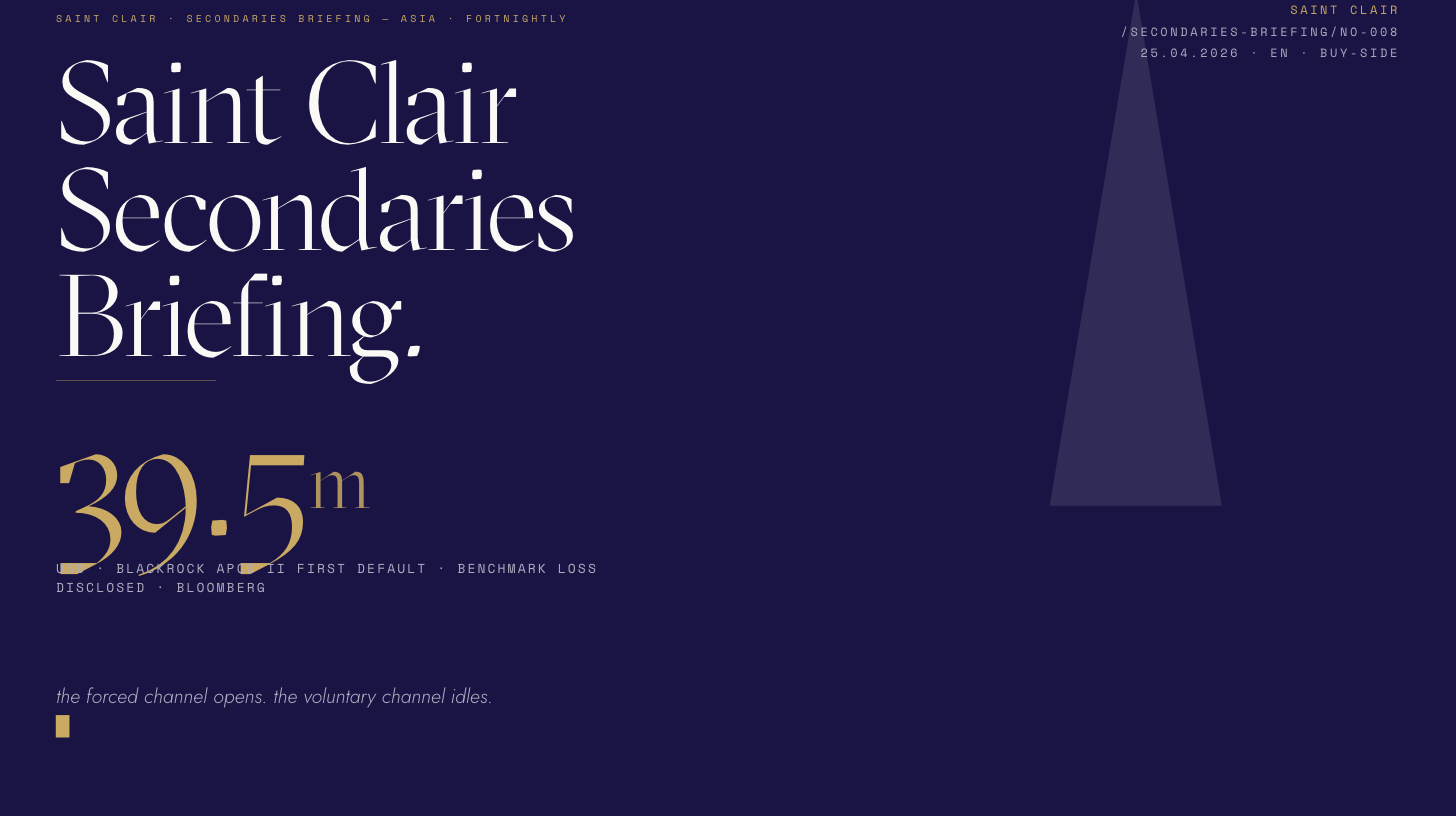
BlackRock APAC Private Credit Opportunities Fund II — First Default, USD 39.5m Metcold Exposure
Greater China · Private credit · Bloomberg, 14 April 2026
Bloomberg reported on 14 April that BlackRock’s second Asia private credit fund has recorded its first portfolio default. Metcold Holdings, a Shanghai-based cold-chain logistics provider, failed to repay USD 27.5 million of principal on 1 April. Unpaid interest runs approximately USD 12 million. The exposure is against an original USD 52.5 million facility originated in 2022, of which Metcold had repaid USD 25 million in 2024. The APCO II fund raised approximately USD 435 million at inception.
The USD 39.5 million default on a USD 435 million fund is benchmark-setting. Asian private credit has had, to date, no materially disclosed loss event from a major global platform. The 30 June NAV marks on APCO II will be the first time the Asian private credit market sees a global-platform fund move from marked-at-cost discipline to marked-against-default reality. Secondaries pricing on Asian private credit CVs in the pipeline will now price against this reference; the 2022–2024 unbroken-history benchmark no longer governs. BlackRock’s public positioning the same day was to frame private credit tumult as a market-share opportunity, signalling continued commitment to the Asia credit strategy despite the default; the messaging is directed at LPs who might rotate allocations away.
Ping An ~USD 1bn Software LP-Led — Buyer Syndicate Forming
Greater China · LP-led · Bloomberg / Secondaries Investor, 13–16 April 2026
Reporting through 13–16 April confirms Ping An Insurance has appointed Campbell Lutyens for a USD 1 billion sale of software-heavy private equity fund stakes. The process started in March and is now in buyer-syndicate formation phase. Underlying funds are Vista Equity Partners late-2010s vintages plus a North America-focused KKR software vehicle. All underlying is North American; the seller is Chinese.
The structural pattern, now visible across three 2025 insurer disposals (Nan Shan, Fubon) and one 2026 (Ping An), is that Asian insurer LP paper clears through global platform advisers with North American buyer syndicates when the underlying is North American. Nothing in Edition 8 data complicates that pattern. Pricing guidance from CW14 reporting remained mid-teens discount; no revision has surfaced through CW16. What does not clear this way is Chinese-underlying paper. La Caisse’s USD 1.5 billion China portfolio sale (HSG, Warburg Pincus, Boyu; Greenhill advising) is now seven consecutive editions unresolved since February disclosure. Two adjacent Asian-insurer-scale processes therefore produce different market information: platform-route trades (Ping An) disclose progression; non-platform or deep-discount trades (La Caisse) do not disclose.
Bloomberg · Secondaries Investor · Private Equity Wire
La Caisse USD 1.5bn China Sale — Six-Edition Non-Disclosure Becomes the Signal
Greater China · LP-led · La Caisse / Greenhill / Private Equity Insights
La Caisse’s sale of HSG, Warburg Pincus and Boyu positions, advised by Greenhill, has now passed six consecutive fortnightly briefings without clearance. The Edition 7 handoff flagged escalation of this item: either retire the reference or reframe it as an analytical observation about Chinese-underlying paper pricing. Edition 8 takes the second course.
Sustained non-disclosure at this duration, on a named, advised process, is itself the market signal. Published commentary now estimates reported discount ranges up to 30% on China-focused LP paper. If the process could clear at disclosable pricing, it would have. The reason it has not is that the depth of discount required to attract buy-side commitment is deep enough, or the buyer pool thin enough, that clearing terms remain unreconciled with the seller’s reserve. That reserve-to-bid gap is now the most durable pricing information in the Asian secondary market, measured not by closing print but by months of non-closure.
Private Equity Insights · Pensions & Investments
Market Intelligence
KVIC 2026 first regular round, final GP selection into late April. KVIC’s 2026 first regular round of Korea Fund of Funds (KRW 2.144 trillion, the largest single round in KVIC history) is in final GP selection phase. Announcements staged from the 23 January launch; final allocations are scheduled for completion during April. The round’s significance is vintage-determining, not transactional: the 2026 primary vintage KVIC seeds becomes the 2030–2032 secondary supply profile. Fund sizes and GP mix chosen now determine whether the Korean domestic secondary pool a decade from now is weighted toward fragmented mid-market or concentrated large-cap vehicles. The brokerage-led KRW 2 trillion secondary fund, which would need to deploy against 2026 vintages and earlier, is effectively being price-anchored by decisions KVIC takes this month. KVIC · KoreaTechDesk
Ares secondaries platform signalling Asia expansion post Antares CV close. Following the 1 April close of the USD 1.7 billion second Ares-Antares North American private credit CV, Ares is publicly positioning Asia as the adjacent deployment opportunity. Buyer-side capacity present; no transaction print. Ares Management
APAC GP CV adoption intent at 55% for next 24 months. Dechert and Dakota commentary through April confirms the APAC intent-shift: 55% of regional respondents plan to use GP-led secondaries within 24 months, up from 10% a year ago; 60% cite fundraising pressure. Intent, not transactions. Dechert
Greenhill forecasts 20% CV share of GP exits over several years. April 2026 restatement of the 2026 outlook; framing CV route as secular rather than cyclical. Secondaries Investor
Samsung Asset Management credit secondaries entry, still no transaction. CW14 signal remains in development through 19 April. First transaction disclosure would establish the first major Korean asset-management-company credit-secondary buyer. Secondaries Investor
BDC regime effective 17 March; no products launched through 19 April. Forty-two licensed managers. First KOSDAQ-listed BDC product remains in pipeline, expected Q2. The Edition 5 thesis (first-cohort BDCs will operate as secondary funds by default) remains untested. Seoul Economic Daily
Korean ruling party legislative track on dual listings, June target. Parallel to the FSC exchange-regulation track, a statutory amendment is progressing toward June enactment. Harder constraint than the exchange rule. Seoul Economic Daily
Regional Context
Japan. No Japanese-target GP-led CV print surfaced in the window. The 55% APAC CV intent figure is Pan-Asian; Japan sits inside that figure but produces no standalone print. NGS Partners and WTW Japan have not issued transactional commentary through CW16. The Japan gap remains structural. A targeted Japanese-language source addition (Nikkei Financial) is being advanced in the source pool.
India. Multiples India USD 430 million and ChrysCapital USD 700 million remain the 2026 reference CVs. No new India-target transaction in the window. Bain India commentary on primary deal flow continues at lower tempo.
Greater China. Two data points, Ping An progressing and La Caisse not clearing, define the window. The pricing dispersion between the two, both Chinese-sovereign-proximate sellers, is the clearest structural market information on China-exposed Asian secondary paper that Q2 has produced.
Signal
Edition 7 introduced “apparatus precedes print” to describe asymmetric disclosure in the Korean domestic secondary market. Edition 8 extends the construct by recognising a second channel through which information now moves.
The Korean domestic cohort produced no new transaction print in CW16. This is the second successive edition without one. The apparatus continues to harden: FSC dual-listing framework on 16 April, KVIC 2026 first-round GP selection completing this month, the ruling party’s June legislative track, BDC regime products still pending. All of this is regulatory sequencing on a published calendar.
Meanwhile, BlackRock’s APCO II default and Ping An’s mid-process buyer syndicate are disclosures of a different kind. Ping An discloses because a mandated sell-side adviser on an in-progress process produces rolling-basis market updates. BlackRock discloses because a default, once it crosses principal payment, becomes a fact that cannot be concealed at 30 June marks. Both flow through platform infrastructure that resists the seller’s or manager’s disclosure preference.
This is the forced channel. The market here moves under structural compulsion. The regulatory calendar is a forced channel. A default is a forced channel. A platform-advised process with syndicated buyer disclosure is a softer forced channel.
What is absent is unchanged: a voluntary Korean domestic disclosure. The KRW 2 trillion brokerage fund has not been ratified. Samsung AM’s credit secondary positioning has not transacted. No BDC product has launched. These remain on the voluntary channel, which in the Korean domestic cohort is presently idle.
The next Korean-domestic print was predicted in Edition 7 to matter out of proportion to its size. That prediction stands, but the probability shifts. The longer voluntary disclosure remains idle while the forced channel produces steady information, the more the pricing benchmark for Korean domestic secondaries is set by external data: the Ping An band, the APCO II default reference, the FSC calendar. Domestic transactions retreat from benchmark-setting. The first Korean print, when it arrives, will be priced against a benchmark it did not set.
Saint Clair Secondaries Briefing — Asia. Fortnightly. Published by Saint Clair Pte. Ltd., Singapore.
The briefing is editorial intelligence. It is not investment advice.
© 2026 Saint Clair Pte. Ltd.
Disclaimer: This briefing is for informational purposes only and does not constitute investment advice. All decisions should be made based on independent research and consultation with qualified advisors.
About Saint Clair: Saint Clair designs and builds cross-border capital infrastructure between Europe and Asia — proposing access where access is scarce, and creating structure where structure is absent. Since 2016.