
Saint Clair Secondaries Briefing — Asia
Edition 6 · 17–28 March 2026
Saint Clair Capital · Ground Truth | March 2026
Edition 5 described a Q1 consolidated reference (Ropes & Gray, Jefferies, William Blair, Deloitte, KPMG) converging on a 2025 market cleared at $240 billion, with APAC under 10%. Individual Asian pricing prints were not yet landing. Edition 6 opens on the first day of Korea’s BDC regime taking legal effect, closes on a CNBC reading that the 2025 Asia fundraising number is the lowest in over a decade, and carries a Bain APAC Report that for the first time since 2021 shows net cash flows to LPs turning positive. None of the major undisclosed Asian processes cleared inside the window. The architecture continued to publish. The prints continued to wait.
What did land is the second buyer universe. NPS’s dedicated continuation-fund and GP-stakes teams, Korea’s BDC regime, the Ministry of SMEs KRW 200 billion secondary funds, the brokerage-led KRW 2 trillion fund under consideration, La Caisse on the sell-side, the CIC $1 billion US PE closing: this is a buyer cohort Campbell Lutyens’ top-fifteen frame does not describe. They operate to policy mandates, sovereign rebalancing logic, or domestic clearance obligations. For Asian sell-side supply, the operational question at the end of March is no longer only which global platform to address; it is which of the two books a process is run to.
Korea’s BDC Regime Takes Effect 17 March
Korea · Regulatory · Seoul Economic Daily
Korea’s Business Development Company regime took legal effect on 17 March 2026, the opening day of this edition’s window. Comprehensive asset managers, 42 firms in total, received automatic operating licences. BDCs must allocate at least 60% of total assets to primary investment targets (unlisted venture firms, venture partnerships, KONEX and KOSDAQ-listed companies). The 90-day listing requirement that follows any new BDC launch favours vehicles acquiring existing positions over vehicles underwriting fresh primary rounds. Products are expected on KOSDAQ once exchange system upgrades complete in April or May. Edition 5 read first-cohort BDCs as secondary funds by default; the April–May launches will now test that reading against actual product disclosures.
Bain APAC 2026 Report — Exits +24%, Secondary Value +41%, Distributions Turn Positive
Pan-Asian · Market reference · Bain & Company, March 2026
Bain’s 2026 Asia-Pacific Private Equity Report published inside the window confirms the structural turn described in aggregate since CW06. Regional exit value rose 24% year-on-year in 2025; exit count rose 8%. Net cash flows to LPs turned positive for the first time since 2021. Secondary transaction value, GP-led and LP-led combined, rose 41% year-on-year. IPO and open-market exits rose 70%, reclaiming the top exit channel position. The Bain, Deloitte and KPMG tri-provider APAC reference set is now published for 2025; the three agree on direction. The Q1 2026 APAC baseline is established; 2026 Asian allocations will be calibrated against these three reports for the rest of the year.
Iran Deepens the APAC Fundraising Slump — $58 Billion Decade Low
Pan-Asian · Market sentiment · CNBC, 27 March 2026
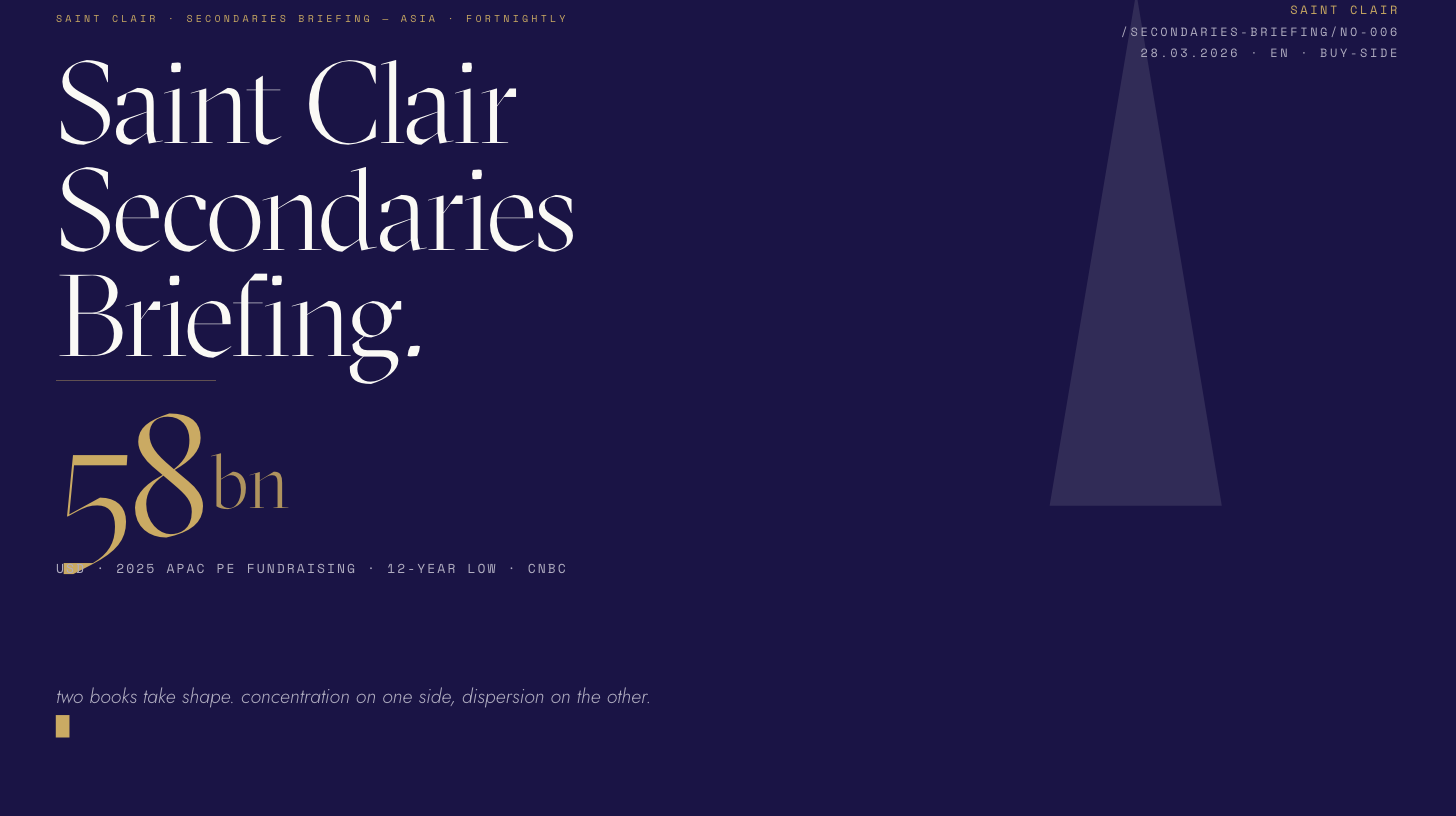
Twenty-seven March CNBC coverage reports APAC-focused PE fundraising at $58 billion across 2025, the lowest reading in more than a decade. Middle Eastern LPs, a material capital source for Asian platforms, have paused outbound commitments with the Iran conflict entering its fourth week. KPMG’s APAC PE head drew the parallel to the early-2025 tariff pause: “causing people to pause, slow down, and just wait.” Inside the 2025 $58 billion figure, EQT cleared $11.4 billion, Bain Capital $10.5 billion and Blackstone above $12 billion; KKR is targeting $15 billion across 2026. The fundraising drag is clear. The asymmetric secondary consequence is not: Middle Eastern LP pause reduces fresh primary commitments but may increase secondary supply from rebalancing portfolios.
La Caisse $1.5 Billion China Sale — Active Through March, No Clearance
Greater China · Deal · La Caisse / Greenhill / Private Equity Insights
La Caisse’s $1.5 billion China-focused PE secondary (positions in HSG, formerly Sequoia China, Warburg Pincus and Boyu, with Greenhill advising) remained in active process across the entire CW12 window with no clearance level disclosed. The sale has now been pending disclosure across four consecutive editions. The reported Chinese quality-asset secondary band (30% to 50% to NAV) stands as the expectation the eventual print will either anchor or break. La Caisse’s 9.3% 2025 return and C$517 billion net assets frame this as portfolio rebalancing, implying a seller defending pricing against the outer edge of the band. A Goldman Sachs / Ardian closing on CIC’s $1 billion US PE secondary, reported in April but cleared late 2025, Goldman at single-digit discount, Ardian at double-digit, provides a useful adjacent Asian SWF data point: Asian sovereigns as sellers can clear at discounts consistent with global LP-led averages on the right portfolio.
Private Equity Insights · Bloomberg on CIC
Market Intelligence
KVCA proposes KOSDAQ Activation Fund anchored by the National Growth Fund. KVCA Chairman Kim Hakkyun’s 12 March press conference proposed a KOSDAQ Activation Fund anchored by the KRW 150 trillion National Growth Fund, with secondary fund activation and special technology listings named as 2026 goals. The move integrates the secondary-funds question into the Growth Fund mandate negotiation. The negotiation cycle runs through Q2 2026 across KVCA, the Financial Services Commission and the Ministry of Strategy and Finance. Asia Business Daily
Government secondary fund expansion: KRW 200 bn established, KRW 2 tn under consideration. The Ministry of SMEs and Startups has established KRW 200 billion in secondary funds with mandatory acquisition of at least 10% of LP stakes. Separately, Korean brokerage firms (KB, Mirae Asset, Korea Investment, NH) are considering a KRW 2 trillion (approximately $1.3 billion) secondary fund to address the VC exit bottleneck from the 2020–2021 vintage boom. The combination pairs policy-anchor with industry-anchor capital — a domestic buyer cohort distinct in structure, mandate and time horizon from the global platforms. KED Global
NPS continuation-fund and GP-stakes teams operating through the window. Korea’s $793 billion National Pension Service maintained dedicated continuation-fund and GP-stakes teams through CW12. The 2026–2030 strategic plan targets a 55% equity ratio by 2030 with a 65% risk-asset ceiling. No NPS public bid commentary has yet been issued. The first NPS-originated continuation-fund or GP-stake transaction remains the most consequential pending Korean institutional print: a sovereign LP with dedicated infrastructure is a different buyer archetype from the subsidised KVIC cohort or the brokerage-led one, and the third element of a three-tier Korean domestic buyer layer. Private Equity International
Korean unicorn pricing reset: over 10% cannot transact at meaningful levels. More than 10% of unicorns formally designated by the Ministry of SMEs and Startups cannot currently conduct meaningful secondary share transactions. KoreaTechDesk’s March reading reframes the 2026 Korean venture question away from funding volume and toward exit clarity. The Korean disclosure convention means individual names are not published; the >10% share is the structural data point allocators must work with. KoreaTechDesk
KVIC Fund of Funds lifespan extension past 2035. KVIC’s Fund of Funds will extend in ten-year increments beyond 2035, with the extension process beginning H2 2026. Mandatory investment fulfilment for venture investment companies lengthens from 3 to 5 years; the mandatory divestment rule for conglomerate-acquired start-ups is abolished. Together these shift the mathematical framework underlying Korean venture vintage-maturity assumptions: 2019–2021 vintage exit-timing models must be recalibrated against the extended fulfilment window. The secondary-pricing effect is non-linear — extension reduces forced-exit pressure on some cohorts while concentrating it on those whose carry structures do not benefit. KoreaTechDesk
Japan GP-led inflection: Morrison Foerster note carried forward. Morrison Foerster’s January note on Japanese GP-led activity remained the structural anchor cited through CW12 industry commentary. 2019–2021 vintage funds are approaching end-of-life; continuation vehicles are increasingly considered where IPO or trade-sale exits remain constrained. NGS Partners’ >80% domestic-supply disclosure (Edition 5) corroborates the structural shift. No transaction-level Japanese GP-led CV print has yet landed in 2026; the anticipated Q2–Q3 Japanese reference remains the gap in the five-point Asian pricing band. Morrison Foerster · NGS Partners archival
Asia LP-led at $5 bn in 2025: 4% of $125 bn global total. HSF Kramer’s Asia private capital data series records Asian LP-led secondaries at approximately $5 billion in 2025, roughly 4% of the $125 billion global LP-led total. Asia’s share of global PE AUM is substantially higher than 4%; the gap between the AUM share and the transactions share is what the 2026 buyer-cohort architecture is being constructed to address. Herbert Smith Freehills Kramer
EY India: January –37% month-on-month; pricing still clusters near primary. EY India’s March 2026 IVCA report records January 2026 PE/VC investment value down 37% versus December 2025. Full-year 2025 reached $60.7 billion across 1,475 deals (+8% YoY), with record fundraising of $23.2 billion. Indian continuation funds are gaining traction. The 85%-at-par finding carried forward from CW10 confirms Indian secondary behaviour as distinct from Chinese or Korean conventions; in the five-point Asian band, India sits at the near-primary end. EY India
Signal
Edition 1 proposed buyer-base rotation. Edition 2 produced the first numbers: fifteen firms, 71% of 2025 volume, EQT absorbing Coller. Edition 3 triangulated pricing to three points, then four. Edition 4 added the Korean financial-group cohort as the undisclosed fifth. Edition 5 confirmed the Q1 consolidated reference and named the gap: the architecture is ahead of the prints.
Edition 6 takes the argument to its operational consequence. Through the first day of Korea’s BDC regime on 17 March to the CNBC fundraising reading on 27 March, the window produced two simultaneous facts. The global platform buyers remain concentrated: EQT, Blackstone, KKR, Ares, Pantheon, Hamilton Lane, Lexington, HarbourVest and a thin tier around them. And a second buyer universe is proliferating: NPS with a dedicated continuation-fund and GP-stakes team, KVIC with subsidised Korean secondary mandates, the Ministry of SMEs with KRW 200 billion established, Korean brokerages considering KRW 2 trillion, La Caisse and CIC as sovereign sellers, the forty-two licensed Korean BDCs about to launch. These are two buyer books. They operate to different mandates, different time horizons, different pricing conventions. They will clear different processes.
The implication for the sell-side is direct. A Korean GP running a continuation vehicle has a different process if it is addressed to the global platforms versus the domestic Korean cohort of KVIC-subsidised buyers, brokerage-led funds and the BDC channel. A Chinese GP running an LP-led tender has a different clearance if La Caisse-type sovereign sellers are the reference than if Campbell Lutyens’ global average is. A Japanese GP with a 2021-vintage fund has different continuation economics if NGS Partners and Japanese domestic capital are the buyer versus Morgan Stanley Asia-class platforms.
This is what the three months since 1 January have produced, read together. Concentration on one side. Dispersion on the other. Two books. The 2026 question for participants is which book a process is designed for; the existence of the two books is settled.
The prints will start to land in Q2. La Caisse will clear. Morgan Stanley Asia will disclose. The first NPS-originated secondary transaction will arrive. The first Korean BDC product will list. The dispersion pattern they trace will be the two books printing simultaneously at their respective clearance levels, and that dispersion will be the operating environment for Asian secondary allocation for the rest of the year.
Saint Clair Secondaries Briefing — Asia. Fortnightly. Published by Saint Clair Pte. Ltd., Singapore.
The briefing is editorial intelligence. It is not investment advice.
© 2026 Saint Clair Pte. Ltd.
Disclaimer: This briefing is for informational purposes only and does not constitute investment advice. All decisions should be made based on independent research and consultation with qualified advisors.
About Saint Clair: Saint Clair designs and builds cross-border capital infrastructure between Europe and Asia — proposing access where access is scarce, and creating structure where structure is absent. Since 2016.