
Saint Clair Secondaries Briefing — Asia
Edition 7 · 31 March – 11 April 2026
Saint Clair Capital · Ground Truth | April 2026
Ping An’s ~USD 1 billion software LP-led sale breaks a four-edition absence of transaction-level prints from the Asian secondary source pool. At the same time, the Korean domestic cohort continues to build secondary infrastructure (NPS rule relaxation, a KRW 2 trillion brokerage consortium, BNK’s KOSDAQ fund, Samsung Asset Management’s credit secondaries intent) without putting a single transaction on tape. The disclosure asymmetry is now the story.
Ping An ~USD 1bn Software LP-Led Sale
Greater China · LP-led · Secondaries Investor / Private Equity Wire
Campbell Lutyens is advising Ping An Insurance on a portfolio of software-heavy private equity fund interests of approximately USD 1 billion. Underlying positions include Vista Equity and KKR software-focused funds. Pricing guidance is reported in the mid-teens discount range. The sale process was under preparation through the CW14 window; initial reporting broke on 13 April across Bloomberg, Secondaries Investor and Private Equity Wire.
The Ping An trade matters on three counts. It is the first large-ticket, transaction-level Asian-seller print to surface across the source pool since Edition 3. It confirms the global platform route (Campbell Lutyens advising, North American buyers in the syndicate) works for Asian insurance-company LP paper at scale. And it re-opens the insurer-disposal sequence that ran through Nan Shan Life and Fubon Life in 2025. The pricing sits within the 2025 precedent band; the Ping An structure operates inside an established pricing construct. The market position it tests is buyer appetite for China-underlying paper where the underlying funds themselves are North American software.
Bloomberg · Secondaries Investor · Private Equity Wire
NPS Relaxes Single-Fund Concentration Rule; KRW 400 bn VC Allocation
Korea · LP · KED Global, 3 April 2026
The National Pension Service confirmed on 3 April a KRW 400 billion commitment to domestic venture capital and, structurally the more interesting half, relaxation of its single-fund concentration rule. The cap limited NPS exposure to any individual vehicle and was the reason Korean GPs historically targeted multiple KRW 150–300 billion fund sizes rather than single large vehicles. Relaxation raises the ceiling on deployable NPS capital per fund. Korean GPs can now fundraise toward larger single vehicles. Within 24–36 months, the secondary consequence begins to appear: the stock of NPS-backed LP interests in larger Korean funds increases, and the secondary supply profile of Korean domestic funds shifts from fragmented to concentrated. Primary-fund news with medium-term secondary implications; track NPS allocation releases over the next two reporting quarters.
KED Global — NPS Watch · Seoul Economic Daily
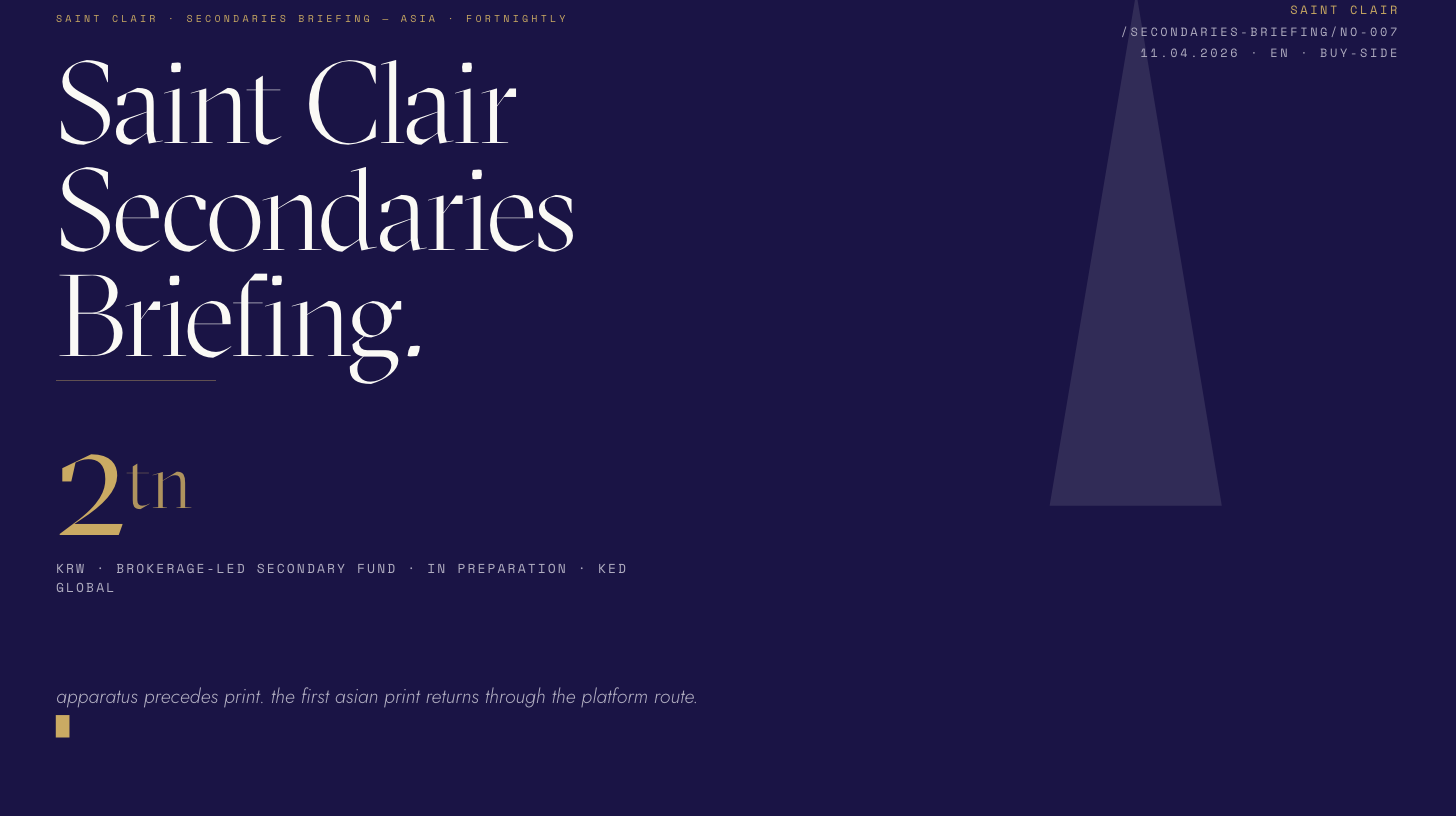
KRW 2 tn Korean Brokerage-Led Secondary Fund in Preparation
Korea · Fund formation · KED Global, 7 April 2026
A consortium of Korean brokerages is preparing a secondary fund of approximately KRW 2 trillion (~USD 1.3 billion). KED Global reported the structure on 7 April; final composition remains to be confirmed. If it closes at announced size, it will be the largest pool of domestic Korean secondary capacity formed to date. The interesting feature is the anchor: brokerages, not insurers or pension funds. Korean brokerages have historically been distribution channels and secondary-market intermediaries; primary LP commitments at this scale would shift them toward a direct participant role. Whether brokerage LPs commit to secondary funds at the KRW 200 billion+ individual check size is a test of their balance sheet appetite for illiquid private capital. No transaction prints; the activity is capacity formation.
Temasek Tri-Partite Restructure Effective 1 April
Singapore · Sovereign platform · Temasek Holdings
Temasek Holdings separated into three wholly-owned entities on 1 April: Temasek Global Investments, Temasek Singapore, and Temasek Partnership Solutions. Partnership Solutions now houses the fund investments and partnerships activity: the perimeter inside which Azalea Investment Management (LP interest securitisation, Astrea bond programme) and Aranda Investments (SGD 10 billion private credit) sit. Operationally, the restructure clarifies internal governance for secondary participation: Partnership Solutions is the entity that will evaluate LP-led opportunities, GP-led continuation vehicles and platform stakes. Azalea’s securitisation pipeline (six Astrea transactions to date) now has a clearer reporting line and a cleaner mandate boundary against the Global Investments direct-PE book. No immediate transaction consequence; the structural effect is institutional, and Temasek’s secondary-adjacent activity becomes easier to place and easier to read.
Ares / Antares USD 1.7bn Private Credit CV
Global · Private credit CV · Cleary Gottlieb / Antares, 1 April 2026
Ares Management and Antares Capital closed a USD 1.7 billion private credit continuation vehicle on 1 April. Cleary Gottlieb advised. It is the second Ares-Antares CV together. The print is US-underlying; it is filed here because it confirms large-ticket buy-side support for private credit CVs remains intact through 2026. That matters for the Asian private credit CV pipeline still in preparation: BlackRock Asia, Partners Group, and KKR Asia Credit are all referenced across AVCJ and Secondaries Investor as CV candidates. The North American comparator sets the pricing expectation; Asian credit CVs will price at discounts to that comparator, with the discount shaped by currency, jurisdiction and default experience.
Market Intelligence
L Squared Fund V USD 2 bn close + BTX Precision single-asset CV (HarbourVest-led), 2 April. HarbourVest continues to feature in the single-asset buyer cohort. L Squared
Blackstone opportunistic credit final close USD 10 bn, 7 April. Credit capital overhang widens; relevant as a pricing floor for Asian private credit secondaries when those finally print. Blackstone
Samsung Asset Management signals credit secondaries and co-investment entry, 14 April. First Korean insurance-adjacent asset manager positioning on the buy-side of credit secondaries. Secondaries Investor
BlackRock Asia private credit records first China borrower default, 14 April. Pricing pressure on APAC credit secondaries to watch over Editions 8–10. Bloomberg
BNK Venture Investment launches KOSDAQ-focused fund, 1 April. Primary-vintage capacity on the KOSDAQ exit channel; reduces, at the margin, pressure on continuation-vehicle routes for KOSDAQ-eligible companies. Seoul Economic Daily
FSC convenes AI-based credit rating task force, 9 April. Long-dated NAV-marking implication for Korean GP books. Ajou Economy
FSC Two-tier KOSDAQ plan debate continues. Liquidity fragmentation versus exit predictability; no regulatory amendment yet. Korea Times
Regional Context
Japan. No large-ticket GP-led CV print surfaced in the window. The pipeline tracked by AVCJ remains in preparation phase. NGS Partners and WTW Japan both ran April commentary on GP operating constraints and CV readiness; nothing transacted. The Japan/Korea disclosure pattern continues to diverge: Japan produces commentary without prints, Korea produces apparatus without prints, and only the global platform route (Ping An, Nan Shan, Fubon) is producing prints.
India. Multiples India USD 430 million CV and ChrysCapital USD 700 million NSE CV remain the two 2026 reference transactions. No new India-target CV print in the window. Praxis Global Alliance commentary on India PE exit pressure in April was structural rather than transactional.
Greater China. Ping An is the only China-seller data point of consequence in the window. La Caisse’s ~USD 1.5 billion China portfolio sale remains undisclosed for the fifth consecutive edition.
Signal
Edition 6 separated the secondaries market into two books: a global platform book where capital concentrates, and an emerging sovereign / policy book where capacity disperses. CW14 extends that observation rather than displacing it. The two books are now visible through a new lens: asymmetric disclosure.
Book One, the global platform route, produced the first large-ticket Asian-seller print in four editions. Ping An is running ~USD 1 billion of software LP interests via Campbell Lutyens. The buyer side is the familiar North American platform cohort. Pricing guidance is mid-teens discount, which sits inside the 2025 Nan Shan / Fubon band. The route works.
Book Two, the Korean domestic cohort, produced no prints. It produced four items of apparatus: NPS relaxed its single-fund concentration rule, a KRW 2 trillion brokerage consortium secondary fund was disclosed in preparation, BNK launched a KOSDAQ venture fund, and Samsung Asset Management signalled a credit secondaries and co-investment entry. Each is capacity formation. None is a transaction.
The asymmetry is the observation. One book discloses prints. The other book discloses apparatus. The sequence is inverted from the usual pattern where transaction volume drives infrastructure development. In Korea the infrastructure is being built first.
This matters for three reasons. First, pricing benchmarks for the Korean cohort cannot be established from Korean trades because Korean trades are not being disclosed. The benchmarks in use are imported: from global platform prints like Ping An, and from 2025 Asian insurer precedents. Second, the KRW 2 trillion brokerage fund, if it closes, will need to deploy into Korean secondaries at prices established by other means. The pricing negotiation between that fund and the first Korean GPs it transacts with will set domestic benchmarks that were absent before. Third, the capacity of the Korean Book 2 apparatus to transact is now the rate-limiting variable. The infrastructure is near-operational. The question is which first trade gets printed through it.
The next Korean-domestic secondary print will matter out of proportion to its size. It will set the benchmark the infrastructure was built to enable.
Saint Clair Secondaries Briefing — Asia. Fortnightly. Published by Saint Clair Pte. Ltd., Singapore.
The briefing is editorial intelligence. It is not investment advice.
© 2026 Saint Clair Pte. Ltd.
Disclaimer: This briefing is for informational purposes only and does not constitute investment advice. All decisions should be made based on independent research and consultation with qualified advisors.
About Saint Clair: Saint Clair designs and builds cross-border capital infrastructure between Europe and Asia — proposing access where access is scarce, and creating structure where structure is absent. Since 2016.