
Saint Clair Secondaries Briefing — Asia
Edition 2 · 20–31 January 2026
Saint Clair Capital · Ground Truth | January 2026
The fortnight produced two events of structural weight and one dataset that will frame the rest of the year. EQT agreed to acquire Coller Capital on 22 January for USD 3.2 billion, with the combined platform holding approximately USD 50 billion of secondaries AUM and an explicit mandate to scale in Asia. Campbell Lutyens’ 2025 Flash Report, released five days later, recorded full-year secondary market volume at USD 225 billion — the first crossing of the USD 200 billion threshold — with LP-led pricing at a 13.9% average discount. Against that backdrop, Freshfields publicly confirmed ADIA’s role in the CDH multi-asset continuation vehicle, and reported discount-to-NAV terms at the anchor portion that sit materially below the global average.
EQT Combines with Coller Capital — The Asian Mandate Is Explicit
Global · Deal / Consolidation · 22 January 2026
EQT will acquire Coller Capital for USD 3.2 billion in newly issued shares, plus up to USD 500 million contingent, in a transaction expected to close in Q3 2026. The combined entity will operate as Coller EQT with approximately USD 50 billion of secondaries AUM at close. The adviser and structuring activity that the Edition 1 Signal flagged in early January has now resolved into the largest M&A transaction in secondaries history.
The Asian component of the announcement is explicit. EQT named Asia in its press release, citing the region as “fast-growing and structurally underpenetrated.” The intent is to scale through the combined entity rather than build from Coller’s modest Asian footprint or EQT’s non-secondary regional platform. Coller EQT will bid in Asia; the relevant question for Asian LPs and GPs is which mandate it prioritises within its first twelve months post-close. The candidate pipeline is narrow: Japanese GP-led processes on 2020–2021 vintages, Korean LP-stake rotations from maturing mother fund vintages, and sponsor-level continuation vehicles emerging from Greater China at the discounts Campbell Lutyens has now quantified.
The structural read is that global platforms have effectively closed the option to build a pan-Asian secondaries franchise from scratch. A regional specialist now either partners into a platform of this scale or concedes the larger LP-led flow.
EQT announcement · Bloomberg · Asian Private Banker
Campbell Lutyens 2025 Flash Report — USD 225bn and a Widening Discount Band
Global · Pricing Signal / Market Data · 27 January 2026
Campbell Lutyens’ 2025 Secondaries Market Flash Report records full-year 2025 volume at USD 225 billion, a 45% year-on-year increase. LP-led volume reached USD 121 billion, up 54%. The headline LP-led discount widened modestly to 13.9% from 13.3%, attributed to a broader mix of fund quality trading rather than deterioration in underlying pricing. GP-led activity increasingly concentrated in multi-asset continuation vehicles, which now account for 44% of the GP-led market. Credit-focused continuation vehicles grew 66% to USD 12 billion; infrastructure secondaries reached approximately USD 11 billion. The top fifteen buyers executed 71% of total volume.
The disciplined comparable matters. Jefferies’ separate January print at USD 240 billion reflects a wider inclusion methodology. For fortnight-on-fortnight reading, Campbell Lutyens is the more useful series.
Three implications for Asian buy-side strategy. First, the buyer base is concentrating: the top-fifteen share continues to climb, supporting the dispersion-will-widen thesis developed in Edition 1. Second, the GP-led share that matters for Asian allocators is the multi-asset continuation vehicle, which is the instrument ADIA and Freshfields have just validated via CDH. Third, credit continuation vehicles now represent a third fundable template, distinct from traditional LP-led and single-asset GP-led structures, and the one where Asian managers are furthest from having their own precedent.
Campbell Lutyens · Secondaries Investor · DealStreetAsia
Freshfields Confirms ADIA / CDH Continuation Vehicle — 36% Discount at Anchor
China · Deal · 23 January 2026
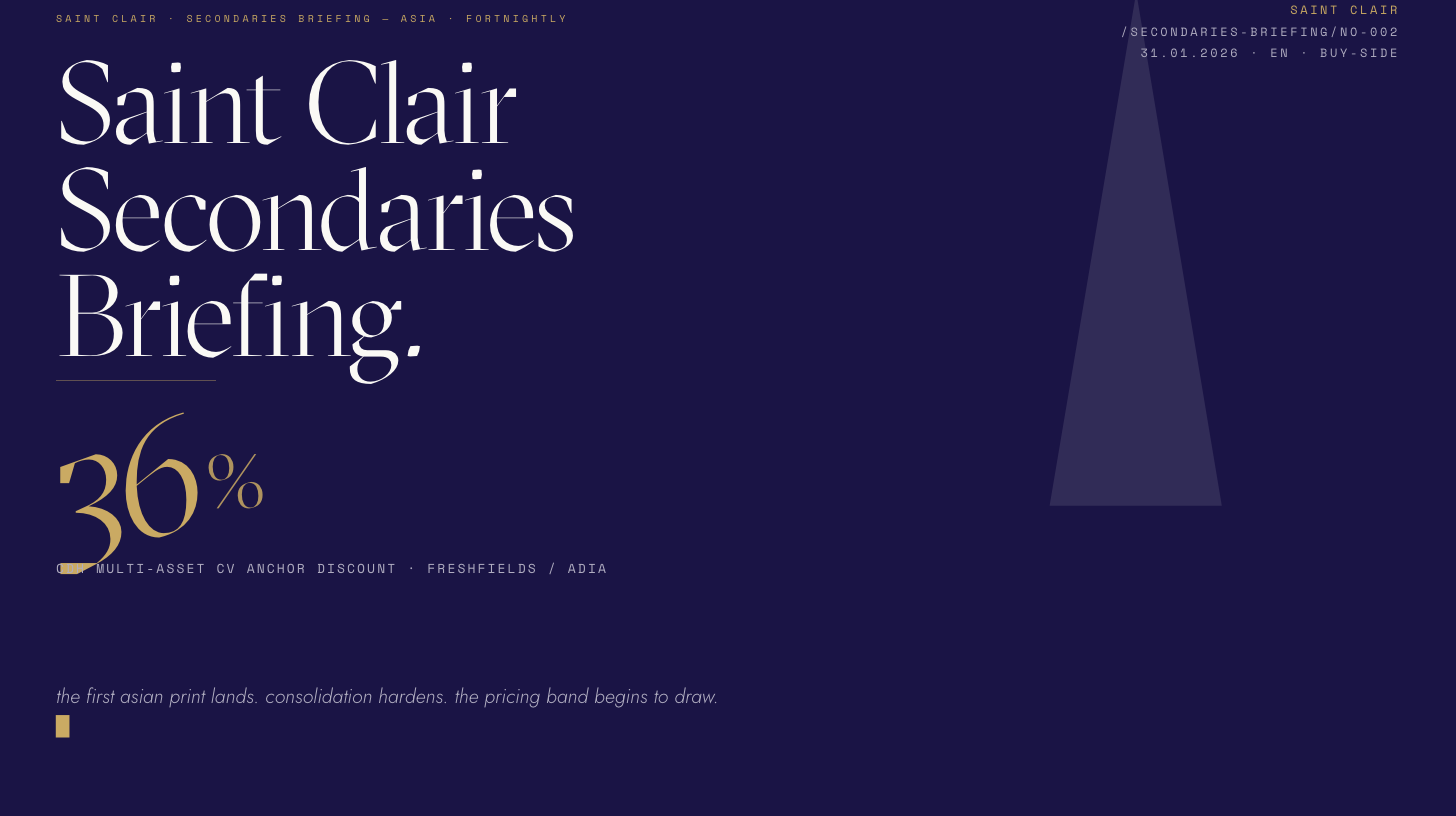
Freshfields publicly confirmed on 23 January its role advising ADIA on the multi-asset continuation vehicle for CDH Investments Fund V — the lead story of Edition 1, now closed. The update supplies two numbers that were not available a fortnight ago. The raised commitment is approximately USD 500 million against the USD 770 million NAV anchor portfolio, implying a discount-to-NAV of roughly 36% at the anchor portion. The asset mix is formally disclosed as Grand Pharmaceutical (HK-listed), Sirtex Medical (Australia), Belle International, Ednovation, ATA Online and LEH.
The 36% figure sits approximately 22 percentage points below the Campbell Lutyens 13.9% global LP-led average reported four days later. At a single asset this is not yet a market pattern. If it persists across two or three further disclosed Asian continuation vehicles in H1, it becomes the operating definition of the Asia discount band for the year — and the number against which sovereign LPs and family offices will test incoming Asian CV propositions.
BlackRock APCO Fund II — Extension and Secondary in One Structure
Pan-Asian · Deal / LP-GP Dynamics · 20 January 2026
BlackRock received consent from investors in its Asia Pacific Private Credit Opportunities Fund II on 20 January to extend the investment period by one year. Up to USD 135 million of new investments may be deployed during the extended window. The structure includes a distinct secondary element: Ares Management and Pantheon Ventures entered the fund by acquiring stakes from Bermuda-based insurer Arch Capital. The fund closed at USD 435 million against an original USD 1 billion target, with the initial investment period having expired in October 2025.
The transaction is a hybrid extension-plus-secondary. The extension provides the GP with additional deployment runway; the secondary provides partial LP liquidity while bringing in two specialist private credit investors as replacements. It is the first material Asian private credit secondary of 2026, and it does so through a template that sits outside the canonical LP-led and GP-led categories. Expect it to recur. The structure gives under-invested managers a way to reset the clock without a conventional restructuring, and gives insurers and other secondary-selling LPs a clean exit that does not require a GP-led process at full scale.
Market Intelligence
Crescent / Pantheon close USD 3.2 billion private credit continuation vehicle. The largest private credit CV on record — Crescent Credit Solutions VII CV — closed on 20 January with Pantheon as lead and Allianz Global Investors as co-lead. Participants include Hamilton Lane, Dawson Partners, Ares Credit Secondaries and Antares Capital. The transaction sets a fundable template for credit CVs at scale. Asian credit managers with 2016–2018 vintage funds approaching maturity have an eighteen-month window to attempt a regional version before the template matures and the pricing hardens. Crescent Capital · Secondaries Investor
Ropes & Gray Q4 2025 continuation vehicle review reports “meaningful uptick” in Asia deal volume. European deal volume grew faster than US volume in Q4; Asia growth, while smaller in absolute terms, grew faster than either. LPs are showing increasing sophistication on roll-versus-sell decisions, and continuation vehicles have expanded into credit, infrastructure and venture beyond traditional buy-out PE. The qualitative signal complements the Campbell Lutyens quantitative print. Ropes & Gray
NPS institutionalises secondaries allocation. The National Pension Service fund management committee met on 26 January and approved revisions to the 2026 target portfolio. Domestic equity rises to 14.9%; overseas equity trims to 37.2%; alternatives hold at approximately 16.8% with private credit, secondary deals and direct lending named as the growth areas within alternatives. Against CW02’s committee formation for continuation funds and GP stakes, the signal is that secondaries now sit as a standing allocation. The 26 January committee revision treats them as long-cycle exposure. Korea Herald
KDB National Growth Fund parent-fund RFP closes 5 February. The RFP for four parent-fund managers under the KRW 7.45 trillion programme (launched 15 January) closes within days of the window’s end. Eligible applicants require Capital Markets Act licence and KRW 1 trillion minimum AUM as of end-2025. The secondary / continuation strategy carve-out within parent-fund allocations is retained. Selection is scheduled for March. KoreaTechDesk
Japanese GP-led preparatory signal intact. No single disclosed Japanese continuation vehicle closed in the CW04 window. Morrison Foerster’s January outlook continues to anchor expectations for a Q2–Q3 Japanese uptick, and Ropes & Gray Q4 data corroborates that the Asian “meaningful uptick” is disproportionately weighted to Japan where 2020–2021 vintages cluster. Read alongside EQT’s explicit Asian mandate, the most plausible H2 storyline is a disclosed Japanese CV with a major international anchor — the structural analogue of the ADIA / CDH framework. Morrison Foerster
Regional Context — GIC Project Royal Eagle Framing
GIC’s “Project Royal Eagle” (the LP-led portfolio sale enlarged from USD 1 billion to approximately USD 3 billion) anchors pricing interpretation of the Campbell Lutyens 2025 data for sovereign LP participation. Core NAV of approximately USD 2.8 billion against original commitments of USD 5.5 billion implies a sale against an aged portfolio, with Apollo VIII, Bain Capital XI and Blackstone VI among the stakes. Final bids closed in October 2025; closing extends into early 2026. Not a CW04 event; included here for interpretive context. If Royal Eagle clears at or near the Campbell Lutyens 13.9% LP-led average, the Asian sovereign is not the forcing function on pricing this year. If materially wider, it is.
Secondaries Investor · DealStreetAsia
Signal
The Edition 1 thesis was that the Asian buyer base is rotating in composition while overall headcount holds. CW04 supplies the first hard numbers to test it.
The rotation evidence is now concrete. EQT’s acquisition of Coller Capital replaces a specialist with a platform. Ares, Pantheon and Hamilton Lane have each appeared as co-leads or participants in major GP-led and credit CVs within this fortnight. Campbell Lutyens reports that the top fifteen buyers executed 71% of 2025 volume. The buyer universe is concentrating and consolidating.
The expansion evidence is thinner. Korean government vehicles are being enlarged — KVIC’s secondary carve-out quadrupled to KRW 200 billion, NPS has formalised secondaries allocation, KDB’s RFP sustains the parent-fund lattice. These are subsidised buyers operating to mandated clearance obligations. Their bidding is confined to domestic Korean processes; they widen the buyer base in that context only.
The pricing consequence is visible in the 22 percentage point gap between the Freshfields / CDH 36% anchor discount and the Campbell Lutyens 13.9% global LP-led average. A single asset does not make a band. Two more disclosed Asian continuation vehicles at or near that level, across H1, and it will.
For buy-side allocators the operational implication is that the January reference data now exists. Campbell Lutyens supplies the global average; Freshfields / CDH supplies the Asian anchor comparable; Ropes & Gray supplies the directional confirmation. Incoming Asian CV propositions should be marked against this triangulation. Propositions without discounts in the 20–35% band against comparable underlying portfolios will need to justify the compression on quality grounds. Those substantially wider than 35% should be interrogated on structuring and asset-mix grounds.
For sell-side LPs and GPs, the Korean policy infrastructure now makes it feasible to clear smaller and mid-sized positions against subsidised buyers with programmatic demand. The BDC framework, the KVIC carve-out, and the NPS allocation are functionally a set of domestic liquidity corridors. International bid-side pricing remains the reference for larger processes; the Korean infrastructure reduces the need to accept it on transactions that fall below international scale. Japanese GPs with 2020–2021 vintage concentrations should treat the EQT announcement as an invitation rather than a threat: there are now more large anchors than sophisticated sellers in the region.
The year’s pricing band is being set this quarter, by a small number of large transactions. The thinner the buyer base, the more the terms go to whichever buyer does show up.
Saint Clair Secondaries Briefing — Asia. Fortnightly. Published by Saint Clair Pte. Ltd., Singapore.
The briefing is editorial intelligence. It is not investment advice.
© 2026 Saint Clair Pte. Ltd.
Disclaimer: This briefing is for informational purposes only and does not constitute investment advice. All decisions should be made based on independent research and consultation with qualified advisors.
About Saint Clair: Saint Clair designs and builds cross-border capital infrastructure between Europe and Asia — proposing access where access is scarce, and creating structure where structure is absent. Since 2016.