
Saint Clair Secondaries Briefing — Asia
Edition 3 · 3–14 February 2026
Saint Clair Capital · Ground Truth | February 2026
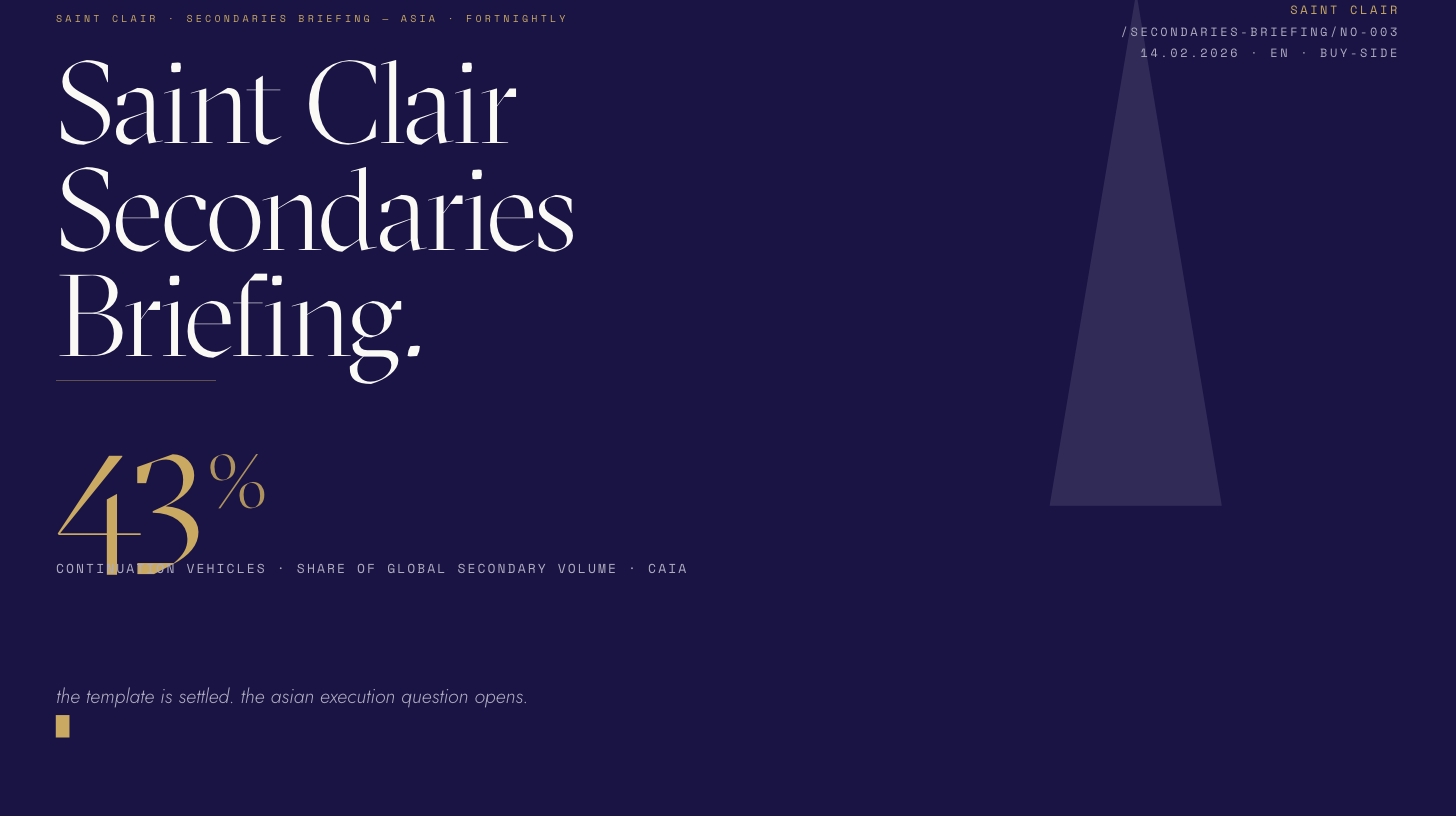
Edition 2 proposed that the Asian buyer base is rotating in composition while overall headcount holds. CW06 supplies the second set of numbers against which that thesis can be tested. CAIA’s 11 February analysis records continuation vehicles at 43% of total global secondary volume in 2025 — the structural confirmation that the instrument validated by ADIA / CDH in CW04 is now the dominant template. La Caisse moves its USD 1.5–2 billion China portfolio to active sale. Korea’s policy architecture proceeds on schedule: KDB’s parent-fund RFP closes on 5 February inside the window, and the Mother Fund’s 2026 secondary segmentation is disclosed four days before the formal application window opens.
Continuation Vehicles at 43% — the Dominant Template Confirmed
Global · Cross-sector · CAIA, 11 February 2026
GP-led transaction volume reached USD 115 billion in 2025. Continuation vehicles represented 89% of that figure and approximately 43% of total global secondary market volume. CAIA attributes the shift to structural rather than cyclical factors: DPI for 2018–2021 vintages runs approximately 0.2x below budget; distributions as a percentage of NAV have trailed historical norms by roughly 15% since 2022; nearly three-quarters of the largest global PE firms have now executed at least one continuation transaction. Read alongside the Campbell Lutyens 13.9% LP-led discount average published in CW04, the CV is now the dominant template by both volume share and pricing reference. For buy-side allocators evaluating Asian propositions, this matters in a specific sense: the template problem is solved. The Asian question is execution environment — Japanese fund structuring, Korean regulatory specifics, Greater China geopolitical discount persistence — not template legitimacy.
La Caisse Activates USD 1.5–2bn China Portfolio Sale — Testing the Asian Discount Band
Greater China · PE · Private Equity Wire / Reuters, early February 2026
La Caisse (formerly CDPQ) moved its China-focused portfolio sale to active phase in early February after several months of quiet soundings. The portfolio encompasses stakes in HSG (formerly Sequoia Capital China), Warburg Pincus and Boyu Capital. Quality China-focused PE assets continue to trade at reported 40–50% below NAV — approximately 22 percentage points wider than the Campbell Lutyens 13.9% global LP-led average and roughly 14 percentage points wider than the Freshfields / ADIA / CDH anchor disclosure of 36% reported in CW04. A sovereign-scale portfolio sale of this size, clearing at or near the reported China band, would establish the outer edge of the operating Asian discount range. A print materially inside the band would compress it. Either outcome resolves a substantial part of the 2026 pricing question for Asian secondary buyers.
Bain APAC Report 2026 — Regional Secondaries at 41% YoY
Pan-Asian · PE · Bain & Company, February 2026
Bain’s 2026 Asia-Pacific Private Equity Report records 2025 secondary transaction value, GP- and LP-led combined, up 41% year-on-year. GP-led continuation vehicles grew 62% year-on-year and 37% on a compound annual basis since 2022. Regional exit value rose 24%; exit count rose 8%; IPOs reclaimed the top exit channel as Hong Kong and regional markets reopened. Large exits above USD 1 billion increased roughly fourfold, reaching their highest level since 2021. The report quantifies what Ropes & Gray flagged qualitatively in CW04 as a “meaningful uptick” in Asian CV activity, and it provides a cleaner regional series for comparison with the Campbell Lutyens global print. The directional read is straightforward. Asia’s secondary volume growth is faster than global; its secondary volume share is still materially below its PE AUM share.
Korea’s Mother Fund Introduces Three-Stage Exit Segmentation
Korea · VC · Numbers / KVIC, 11 February 2026
Numbers (넘버스) reported on 11 February that the 2026 Mother Fund secondary allocation segments secondary investments into three stages — early, mid- and late-stage exit transactions — and consolidates all secondary categories into the first regular business cycle. Four days later, KVIC’s formal 1차 정기 round opens with a KRW 2.144 trillion allocation across 13 categories: “general secondary” at KRW 60 billion government anchor (targeting KRW 200 billion total fund size) plus a newly created “small-scale secondary” category at KRW 20 billion anchor. The architecture is the most structurally differentiated Korean policy capital design for secondaries yet produced. Two signals for international buyers. The first is segmentation: the three-stage framework separates underwriting requirements in a way that domestic and international buyers can now match against distinct transaction categories. The second is the small-scale tranche: a policy acknowledgement that a fragmented layer of micro-transactions exists outside the institutional channel, and that the market has not yet produced a specialist GP cohort to serve it.
Numbers · Korea Policy Briefing
Market Intelligence
Korean financial-group VCs converge on KRW 100bn secondary fund formation. Bloter reported that all major financial-group-affiliated Korean VCs except Hana Ventures now operate or are forming secondary funds at the KRW 100 billion scale. KB Investment closed its first large-scale secondary fund at KRW 107.5 billion; Shinhan Venture Investment — the longest-standing specialist — closed its fifth secondary fund at KRW 100 billion; Woori Venture Partners secured Industrial Bank secondary allocation GP status. The cohort now operates as a quasi-domestic LP universe anchored by Mother Fund participation. For international buy-side, this is the concrete evidence of the buyer-base rotation thesis at fund-formation level. Bloter
KDB National Growth Fund parent-fund RFP closes 5 February. The RFP for four parent-fund managers under the KRW 7.45 trillion programme closed inside the window. Eligible applicants required Capital Markets Act licence and KRW 1 trillion minimum AUM as of end-2025. Applicant identities were not disclosed. Selection scheduled for March. The secondary / continuation carve-out within parent-fund allocations is retained and carries directly forward from CW04. KoreaTechDesk
KPMG APAC PE Barometer confirms regional secondary adoption. KPMG records secondary exits at 25% of APAC deals and 30% of exit value in H1 2025. Japan, South Korea, India and Australia lead adoption; 60% of APAC respondents cite GP-led secondaries and continuation vehicles as a strategy to navigate fundraising headwinds. Continuation funds gained particular traction in Australia, India and Southeast Asia. KPMG
India PE/VC exits USD 32.9bn — second-highest on record. EY India records 257 exit transactions generating USD 32.9 billion in 2025. Strategic exits rebounded 211% year-on-year to USD 16 billion. Block deals emerge as a distinct off-market channel. GP-led secondaries and continuation funds gain traction for mid-market assets. India’s exit diversity contrasts with Korea’s channel constraint — fewer forced sellers, tighter discounts, a more competitive but more reliable secondary opportunity. EY India
SEA exit volume +18% but deal value −43%. EY’s 2025 Year in Review for Southeast Asia records 33 exit deals generating USD 4.4 billion, an 18% increase in volume. Total PE deal value declined 43% with deal count down only 12%; fundraising recovered 97% to USD 4.6 billion across 10 closes. The data is consistent: capital availability is not the SEA problem; deployment and realisation pathways are. EY Singapore
Regional Context — China and India as Pricing Bookends
India and China mark the two poles of the Asian secondary pricing spectrum. India’s exit infrastructure functions — USD 32.9 billion in realised 2025 proceeds across multiple working channels, block deals emerging as a distinct exit route, GP-led secondaries gaining adoption for mid-market assets. Secondary transactions in India occur by choice rather than by necessity; discounts are tighter, deal quality is higher, competition is sharper. China sits at the opposite pole. Exit channels remain broadly shut, geopolitical risk discounts are embedded, and institutional sellers transact under sovereign-level exposure pressure with pricing as consequence. The reported 40–50% discount band on quality China assets is the structural price of passing sovereign-level exposure in a jurisdiction where exit optionality is compressed. La Caisse’s USD 1.5–2 billion portfolio activation tests whether sovereign LPs can clear against that band at scale. Korea’s position between these poles — partial exit infrastructure, moderate reported discount bands, a domestically engineered buyer side — becomes more legible once the outer edges are anchored.
Signal
Edition 2 said the buyer base is rotating in composition while headcount holds. CW06 confirms the rotation at fund-formation level.
The rotation is now visible. KB Investment, Shinhan, Woori — the major Korean financial-group VCs are forming KRW 100 billion secondary vehicles in a coordinated cohort. Globally, CAIA records continuation vehicles at 43% of secondary volume. The buyer universe is consolidating.
The expansion is thin. KVIC’s KRW 200 billion general secondary category is a subsidised destination for positions; independent bidding capacity has not been added. The small-scale category at KRW 20 billion acknowledges a fragmented market segment without resolving it.
The pricing data is starting to triangulate. Campbell Lutyens supplies the 13.9% global LP-led average. Freshfields / ADIA / CDH supplies the 36% Asian anchor in CW04. Reported quality China assets sit at 40–50%. Three data points do not yet make a band. Two or three further disclosed prints in H1 — a closed La Caisse clearing level, a second Asian CV, one Japanese continuation vehicle with a disclosed anchor — will. The band will not be narrow. The early evidence says 25 to 45 percentage points of dispersion will separate the global LP-led average from the Asian CV anchor within a quarter.
For buy-side allocators the operational implication has sharpened. Campbell Lutyens supplies the floor. Freshfields / CDH supplies the Asian anchor reference. La Caisse supplies the Greater China outer edge. Incoming Asian CV propositions should be marked against the widening triangulation. A CV priced inside 20% requires justification on underlying portfolio quality grounds; one priced outside 40% requires interrogation on structuring and asset-mix grounds.
For sell-side participants, the Korean cohort in particular, the infrastructure continues to build on schedule. Financial-group secondary vehicles give small and mid-sized positions a domestic clearing pathway they did not have two years ago. International pricing discipline remains the reference for larger processes. The pathway reduces the need to accept it on small transactions that do not warrant a global process.
The year’s operating band is narrowing on the numbers. The buyer base is narrowing on the funds. Both facts favour the few buyers that have scale, reach and discount tolerance across all three Asian sub-markets. That is the buyer set being assembled this quarter.
Saint Clair Secondaries Briefing — Asia. Fortnightly. Published by Saint Clair Pte. Ltd., Singapore.
The briefing is editorial intelligence. It is not investment advice.
© 2026 Saint Clair Pte. Ltd.
Disclaimer: This briefing is for informational purposes only and does not constitute investment advice. All decisions should be made based on independent research and consultation with qualified advisors.
About Saint Clair: Saint Clair designs and builds cross-border capital infrastructure between Europe and Asia — proposing access where access is scarce, and creating structure where structure is absent. Since 2016.