
The Address Without a Name
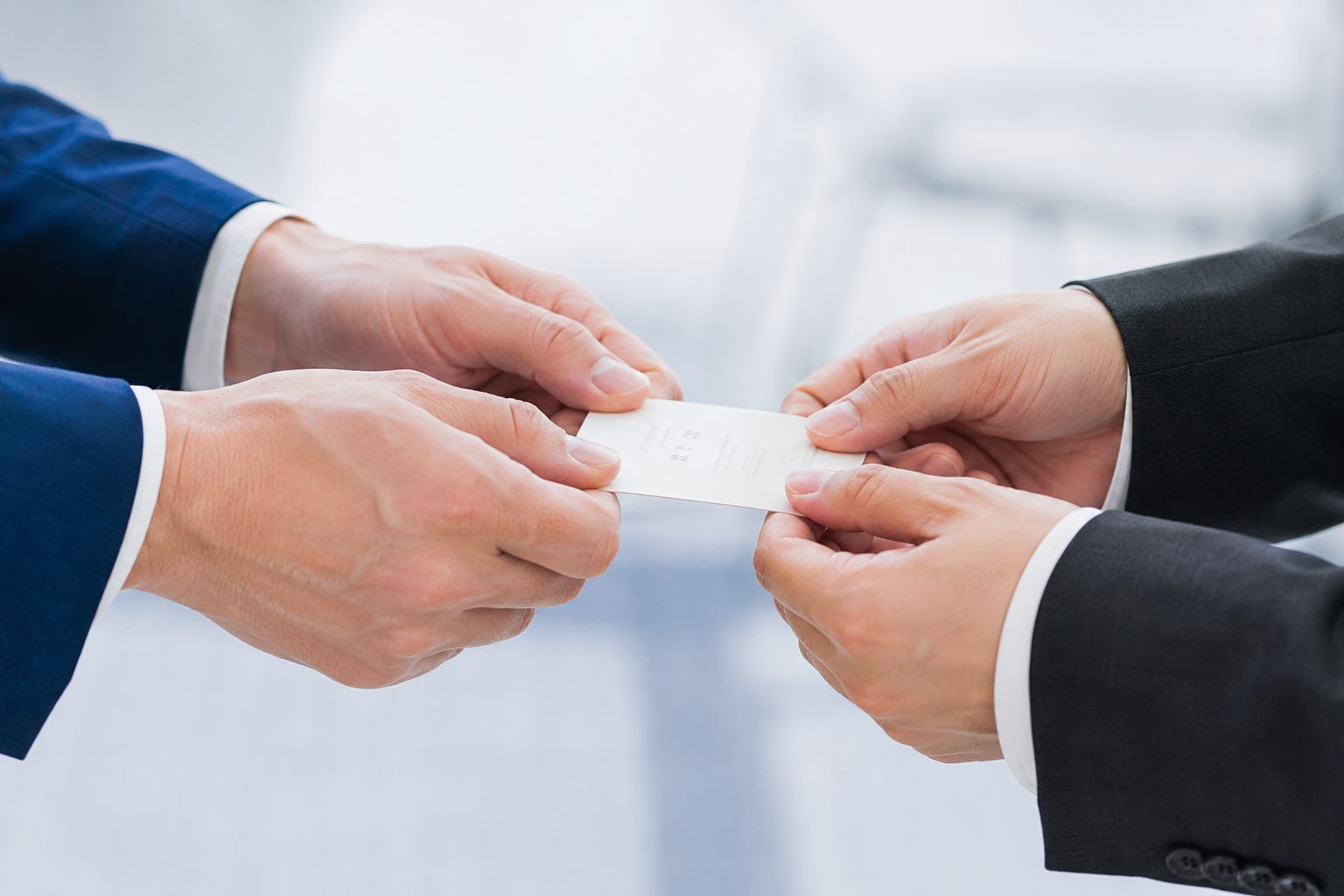
On business cards across Korea, from large companies and government offices alike, the email is often a personal one, and the handle in front of the @ is often not a name at all. To a foreign eye it can look careless. The reasons are more ordinary than that, and the standard it misses is almost trivially simple: your own name.
Saint Clair · Market Intelligence | August 2026
A living ritual
In Europe the paper card has all but disappeared. A LinkedIn connection or a WhatsApp number does the work now, and even that comes only once a conversation has earned it. In Korea the exchange is still a piece of formal etiquette: offered with both hands, received with both, read once on the spot. The card stands closer to a formal document, and it sets a first impression. So the few characters it carries should be deliberate. What do they tell the other person, and how do you wish to be seen?
Since 2016 Saint Clair has gathered thousands of cards across the Europe–Korea corridor. One pattern recurs. Even at companies whose names everyone knows, the address is frequently a personal one, a Gmail or a Naver rather than the company domain. It appears across ages and industries, well beyond startups and young founders. It reaches into government as well: Korea Pro, an English-language news and analysis service on South Korea, reported in 2024 that officials’ cards commonly show a personal Gmail, and that where they do not, staff often write one on by hand, a practice widespread enough to raise security concerns. And the handle in front of the @ is often not the person’s name.
Why the personal address
The reasons are usually plain, and they come down to convenience. Naver is the portal and mail service most Koreans live inside, tied to the phone and to the rhythm of the day, while official and corporate systems are cumbersome. That friction is exactly what Korea Pro described in government offices, where staff default to accounts that simply work. A personal address carries one further, practical advantage: it survives a change of employer, and Korean careers move often. A company address expires the day its holder leaves. Seen this way, the personal address is habit and infrastructure, and to read it as a lapse of seriousness is to misread the person.
And often, no name at all
The company domain is one thing; the handle is another, and what sits in its place is seldom a name. In its slot you find a self-chosen Daniel or Jenny that appears on no passport or badge; a number, most often a birth year or a birthday, or 1004, which in Korean reads as 천사, “angel”. Then come taste and self: a persona, as in coolguy or alwayssmile; a passion, as in coffeelover, tennismania, or Nadal, after the tennis star; Konglish, as in best-ing (”doing one’s best”); a bare phrase such as thiscountry; a Korean word typed with the keyboard still in English, which surfaces like a difficult password; even a personal mobile number. Chosen by a hand that does not work in English, some read oddly, and a few carry a meaning their owner never intended.
To a foreign counterpart this is especially strange. The expectation is that Koreans rarely show emotion or taste in the first place; yet on the card, the professional document itself, the personal spills out all at once. It reads as too personal, and not quite serious. That reaction deserves to be named plainly rather than explained away.
Perhaps the deeper reason is that Koreans seldom use one another’s names at all. At work people address one another by title rather than by name; a manager is “bujang-nim”, rarely “Jiwon”. Leading with one’s own name is, in that light, an unfamiliar move. The international standard runs the other way, and it is almost embarrassingly simple: you use the name you actually go by. Measured against something that plain, a handle with no name in it stands out on its own. (The examples here are illustrative, not drawn from any real card.)
No one was taught otherwise
Underneath sits a gap no one addresses. In Korea, nobody is taught to hold a professional identity, an email or a handle, to an international standard. Part of it is that English is still not quite second nature: on the 2025 EF English Proficiency Index, Korea ranks 48th, inside the “moderate” band. An unfamiliar language is easy to treat as ornament, and ornament is where the simple standard slips. The instant a Konglish string, a password-like handle, or an English name used nowhere in real life goes onto a card, form and substance part company.
What is at stake, then, is the international standard, which rewards a match between form and substance. The pull to look modern or Western is easy to read into the practice, yet the standard asks for something plainer. A single address moves the needle: Livermore, Scafe and Asher (2016) found that an email built from a real name on an institutional domain read as the most credible, while nicknames and generic accounts pulled credibility sharply down.
Reading what is in front of you
Capital Diplomacy begins by reading the other side on their own terms rather than through an imported idea of what “professional” should look like. For the person receiving the card, that means the discipline to resist marking the holder down, in seriousness or in seniority, for the want of a company domain; to doubt someone’s standing over a personal Gmail is to misread a practice that is ordinary here. A hobby in the handle is, if anything, a low-cost opening: a word about it costs nothing and is usually welcome.
For the person handing the card over, the task runs the other way. Credibility across a border holds when the identity on the card and the identity actually lived coincide, and using one’s own name covers most of that distance. The reading, in the end, runs both ways: one side reads a person in those few characters, the other sets a true one down there. Trust across a border is built where those two kinds of precision meet.
Sources:
Korea Pro (2024), “Korean government’s widespread use of personal emails poses security risks” — personal Gmail on official business cards; cumbersome official software; exposure to phishing. https://koreapro.org/2024/03/korean-governments-widespread-use-of-personal-emails-poses-security-risks/
EF English Proficiency Index 2025 — South Korea 48th, score 522, “moderate” band. https://www.ef.com/wwen/epi/regions/asia/south-korea/
Livermore, Scafe & Asher (2016), “The Impact of E-mail Address on Credibility,” Journal of Academic Administration in Higher Education — a real name on an institutional domain reads as most credible; nicknames and generic accounts reduce it. https://files.eric.ed.gov/fulltext/EJ1139123.pdf
Naver — South Korea’s dominant web portal and email service.
Saint Clair field observation across the Europe–Korea corridor (thousands of business cards), 2016–2026.
Editorial note: The central observation (personal email and non-name handles on Korean cards) is Saint Clair’s own field pattern, independently echoed by Korea Pro’s account of government cards; no academic study addresses it directly. Address-by-title and the “1004” wordplay are widely known features of Korean life; figures and cases are attributed to their sources, and the handle examples are illustrative, not taken from any real card.
Disclaimer: This article is for informational purposes only and does not constitute investment advice. All decisions should be made based on independent research and consultation with qualified advisors.
About Saint Clair: Saint Clair is a cross-border investment firm between Europe and Asia: an institutional investor that also builds the infrastructure through which capital crosses borders. Since 2016.
Learn more: saintclair.sg | Contact: contact@saintclair.sg