
Saint Clair Capital · Ground Truth | November 2026
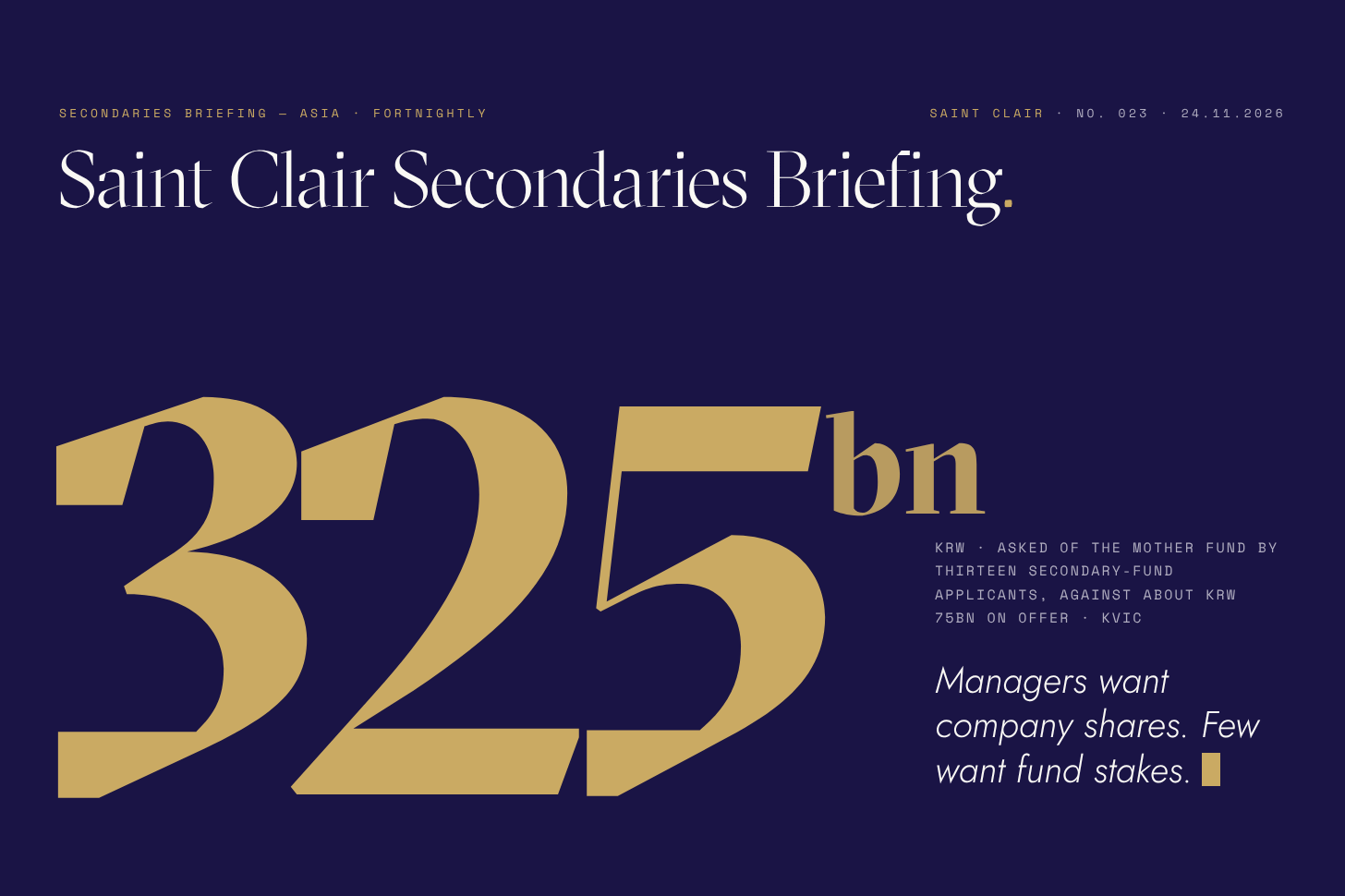
Korean managers want four times the policy money on offer to buy maturing venture holdings, and they want company shares rather than fund stakes. Thirteen applicants asked the mother fund for KRW 325 billion against about KRW 75 billion. About ten chose to buy company shares, TopDaily reports. The 2027 budgets give secondary funds small lines. New listings again traded below their offer prices, and a first fund began to look for a buyer for its last holding.
Thirteen managers ask for four times the mother fund’s secondary budget
Korea · VC · KVIC, 16 November; Yonhap Infomax, 19 November
Korea Venture Investment Corporation (KVIC) posted the applicants for its venture secondary round on 16 November. Thirteen proposed funds applied. The applicants ask the mother fund for KRW 325 billion. The round offers about KRW 75 billion to three managers. The thirteen funds plan KRW 666.5 billion of commitments in total. Three of the seven joint applications pair a venture firm with a securities or capital company.
Demand from managers is more than four times the policy money. Ten of the thirteen applicants will receive nothing from this round. KVIC will name the three managers this quarter. The type of fund that KVIC chooses will show which sellers the round serves.
Few applicants want to buy stakes in other venture funds
Korea · VC · TopDaily, 17 November
The round accepts three types of fund. Type 1 buys existing company shares or unsecured convertible and warrant bonds. A type 2 fund buys investors’ stakes in venture funds at least three years old or 45% invested. Control buyouts make up type 3. TopDaily reports that about ten of the thirteen applicants chose type 1. Type 2 drew few applicants. KVIC will pick three managers of any type, at KRW 25 billion each.
TopDaily gives two reasons. A buyer of a fund stake must value every company in the fund. The sale also needs the consent of the fund’s manager and its other investors. An investor who wants to sell a fund stake therefore finds few domestic buyers.
The 2027 budgets give secondary funds small lines
Korea · VC · TopDaily, 11 November; Asia Economy, 12 November
The Ministry of SMEs and Startups (MSS) has budgeted KRW 1.3 trillion for mother-fund commitments in 2027. TopDaily reports, from the National Assembly Budget Office’s analysis, that secondary funds get KRW 10 billion of that sum. The Ministry of Climate, Energy and Environment adds a KRW 25 billion secondary fund to its own account, Asia Economy reports. The climate ministry confirmed the secondary line but not its size.
By our arithmetic on TopDaily’s figures, secondary funds get 0.8% of the MSS account. The National Assembly has not yet passed the budget. Last year the Assembly cut KRW 280 billion from the ministry’s request. The 2027 plan still pays mainly for new investment. Secondary funds receive a small share.
A venture manager asks the President for a large state secondary fund
Korea · VC · Yonhap Infomax and Asia Economy, 13 November
President Lee Jae-myung chaired a capital-market meeting at the Korea Exchange on 13 November. A Korea Institute of Finance fellow proposed easing the limit on policy money that buys existing shares. Park Ki-ho, chief executive of LB Investment, asked the government to back a large secondary fund. The Deputy Prime Minister said the government is reviewing the matter. No measure was announced.
LB Investment’s request is far larger than the 2027 budget lines in the previous story. A state-backed fund would change the size of the domestic buyer base. The government gave no date for its review.
New Korean listings trade below their offer prices again
Korea · VC · Edaily, 11 November; The Stock, 23 November
Barofarm, a pharmacy-ordering platform, listed on KOSDAQ on 11 November. Barofarm closed its first day 28.17% below the offer price, on a day when the KOSDAQ index rose more than 5%. On 23 November KMF, a food-ingredient maker, withdrew its KOSDAQ listing after book-building. Most institutional orders came in below its price range. The Stock reports that all nine companies listed in November trade below their offer prices.
Edition 22 showed that listings take almost no existing shares from investors. Buyers now also refuse new shares at the asking price. A venture fund that planned a 2026 listing exit must extend, sell privately or write down the holding.
A first fund looks for a buyer for its last holding
Korea · VC · Dealsite, 11 November
BNH Investment is looking for a buyer for the Genbody shares in its first blind fund, Dealsite reports. Genbody is the fund’s last asset. The fund invested KRW 2 billion in Genbody in 2016. Genbody’s KOSDAQ listing failed in July 2025. The fund has already extended its term more than once. A BNH official linked the search to the fund’s maturity.
Dealsite reports no price, buyer or discount. The case shows the common shape of a fund at term: one unlisted holding and no listing planned. Most applicants in the KVIC round plan to buy holdings of this kind. A holding like Genbody is more likely to sell as company shares than as part of a fund stake.
Market Intelligence
Correction: TPG’s case against Kakao is an ICC arbitration. Edition 22 said that TPG filed at the Hong Kong International Arbitration Centre on 30 October. Kakao’s disclosure of 23 November shows an ICC case seated in Hong Kong, filed on 29 October. TPG values its claim at KRW 1.5 trillion or more. Kakao denies the claims. DART · Numbers
A new Asian secondaries buyer launches. DealStreetAsia reported on 16 November that Sung Ko and Chris Shen have launched Noveon Capital. Both are former Carlyle and Warburg Pincus dealmakers. The firm targets GP-led and LP-led secondaries in China, North Asia and Southeast Asia. Fund size and investors were not disclosed. Secondaries Investor · DealStreetAsia
A broken listing covenant reaches the appeal court. The Seoul High Court heard Smilegate RPG’s appeal on 20 November. A 2017 convertible bond of KRW 20 billion obliged the company to pursue a listing. In April the first-instance court awarded the bondholder’s full claim of KRW 100 billion. Bloter · The Fact
Asia’s lead buyers for continuation funds are still few. ION Analytics reported on 4 November that advisers name eight groups able to lead a US$200 million Asian deal. The advisers say the list has changed little in five years. One adviser links Korean deals to buyers with senior Korean staff. ION Analytics
Signal
Edition 22 expected the investors who refuse to extend to be the first sellers. This fortnight showed who the domestic buyers are. Few of the buyers want a fund stake.
Managers prefer company shares for plain reasons. A company share needs one valuation. A fund stake needs many valuations and the consent of the manager and the other investors. We assess that maturing Korean venture funds will reach buyers through their holdings, sold one company at a time. A dissenting investor will rarely find a buyer for its own stake. The investor’s exit then depends on the manager’s sales. The type of the three managers that KVIC names this quarter is the next measure. A type 2 winner would give fund stakes a domestic buyer.
Tesseractic, which Saint Clair operates, publishes the Saint Clair Net Supply Index. The index stands at 111.4 (June 2026 = 100). Commitments to Korean venture funds past or within two years of their original term exceed commitments to secondary funds by KRW 21.4 trillion.
Prepared by Saint Clair Market Intelligence
Saint Clair Secondaries Briefing — Asia. Fortnightly. Published by Saint Clair Pte. Ltd., Singapore.
Disclaimer: This briefing is for informational purposes only and does not constitute investment advice. All decisions should be made based on independent research and consultation with qualified advisers.
About Saint Clair: Saint Clair is a cross-border investment firm: an institutional investor that also builds the infrastructure through which capital crosses borders. Since 2016.
© 2026 Saint Clair Pte. Ltd.